CopilotKit OpenDots: Open-Source AI Coworker Template Alternative to OpenAI Dots
CopilotKit has released OpenDots, an MIT-licensed open-source AI coworker template for OpenAI Dots featuring AG-UI protocol, isolated sandboxes, and Slack/Teams
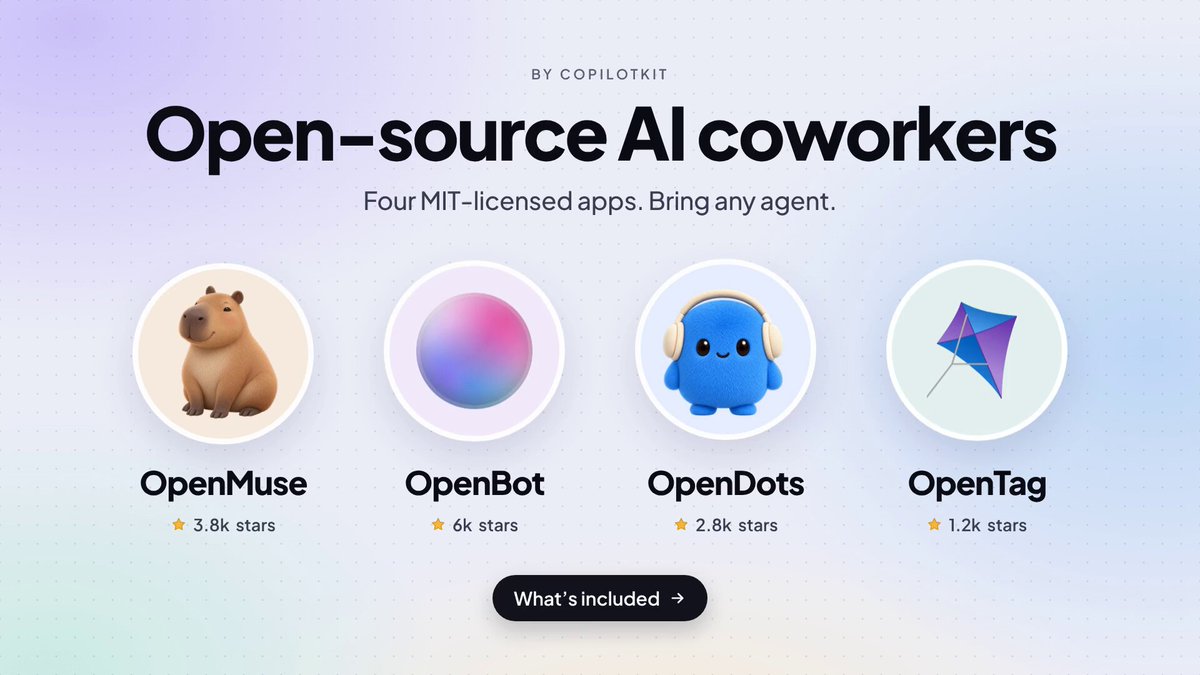
In October 2026, CopilotKit founder Atai Barkai announced the official release of OpenDots, an open-source, self-hostable AI coworker template designed as an alternative to OpenAI's recently introduced 'Dots' at DevDay. Alongside OpenDots, CopilotKit open-sourced three additional coworker templates modeling prominent enterprise interactions—OpenMuse, OpenBot, and OpenTag—all distributed under the permissive MIT license.
Image source: @ataiiam / CopilotKit
OpenAI's Dots introduced the concept of always-on coworkers provisioned with dedicated cloud computers that continue executing workflows in the background after a user closes the chat interface, delivering completed deliverables on demand. However, Dots remains closed-source, tightly coupled to OpenAI's proprietary model catalog, and restricted by specific subscription tiers and regional availability. CopilotKit's OpenDots provides developers with a modular, self-hostable alternative that integrates with any OpenAI-compatible inference endpoint and arbitrary agent runtime via open protocols.
Dismantling Closed Ecosystems: Core Architecture of OpenDots
Unlike conventional single-turn chat wrappers, OpenDots is architected around persistent workplace collaboration where autonomous agents operate within structured team workspaces.
- Spaces and Editable Pages: Work within OpenDots is organized into Spaces containing Pages. Instead of ephemeral chat transcripts, intermediate research and finished deliverables land on persistent Markdown-style Pages that human teammates can review, verify, and continuously edit.
- Scoped Roles and Permissions: Operators define granular identities, system prompts, and allowed tools for each Dot. For instance, a dedicated researcher Dot can scour the web and internal documentation, while a writer Dot synthesizes the extracted findings into structured briefs.
- Isolated Computer Sandboxes: Leveraging container supervisor technology derived from OpenBot, each Dot can run within an isolated execution sandbox equipped with a dedicated headless browser profile, terminal shell, and sandboxed filesystem.
- Multichannel Interoperability: In addition to standard responsive web and mobile interfaces, OpenDots supports voice interactions and integrates directly into primary enterprise collaboration hubs, including Slack and Microsoft Teams.
CopilotKit's 3-Tier Agentic UX Architecture: UX Layer, AG-UI, and Intelligence
Atai Barkai emphasized that prominent agentic products—such as OpenAI Dots, Meta Muse, Grok Bot, and ClaudeTag—are fundamentally UX variations built on shared underlying runtime primitives. CopilotKit structures its framework into three decoupled architectural tiers to accelerate agentic UX iteration:
- CopilotKit UX Layer: Provides production-ready building blocks for chat interfaces, dynamic generative UI components, and human-in-the-loop approval gates.
- AG-UI Open Protocol: A standardized open communication protocol designed specifically for agent-user interactions. AG-UI manages bidirectional streaming, real-time tool calling, shared application state, and asynchronous handoffs between frontends and backend agents.
- CopilotKit Intelligence Layer: Handles conversation thread lifecycle management, short- and long-term agent memory persistence, and multi-channel routing.
Because the communication layer is decoupled through AG-UI, engineering teams can pair any underlying orchestration framework—such as LangGraph or Mastra—with customized frontend experiences without re-engineering state synchronization from scratch.
Four MIT-Licensed Templates and Self-Hosting Considerations
To address diverse operational requirements, CopilotKit structured its open-source release across four distinct agent templates:
- OpenDots: The primary OpenAI Dots alternative, combining project Spaces, editable Pages, and multi-agent computer-use orchestration.
- OpenMuse: Modeled after Meta Muse as a personal agent environment capable of driving terminal commands, browsing sessions, and local filesystem workflows for multi-step reasoning.
- OpenBot: Inspired by Grok Bot, functioning as the containerized supervisor layer that isolates computer use into secure sandboxes.
- OpenTag: A Slack and Microsoft Teams knowledge-work and on-call triage bot built on LangGraph and the Channels SDK, featuring approval gates for external actions.
While every repository is released under the MIT license without commercial restrictions, engineering teams should note that all four templates are currently in an early alpha stage.
Self-hosting OpenDots requires provisioning Docker container environments, configuring API keys for preferred LLM backends, and tuning environment variables. When connecting agents to production communication channels like Slack or Microsoft Teams, developers must enforce strict network and container sandboxing policies to prevent unauthorized shell or browser commands within internal corporate infrastructure.
Sources
- CopilotKit Blog: Introducing OpenDots: the Open-Source Alternative to OpenAI Dots
- CopilotKit OpenDots Product Overview: OpenDots: Always-on AI coworkers
- Atai Barkai on X (@ataiiam): Release Announcement Thread for OpenDots and Templates
- GitHub Repository: CopilotKit/openmuse
- GitHub Repository: CopilotKit/opentag