OpenAI Navier–Stokes Proof: Discrepancies in Paper and Lean Verification
A research paper reveals discrepancies in input derivatives and bounds between OpenAI's Navier–Stokes text and its Lean formal proof, highlighting statement dri
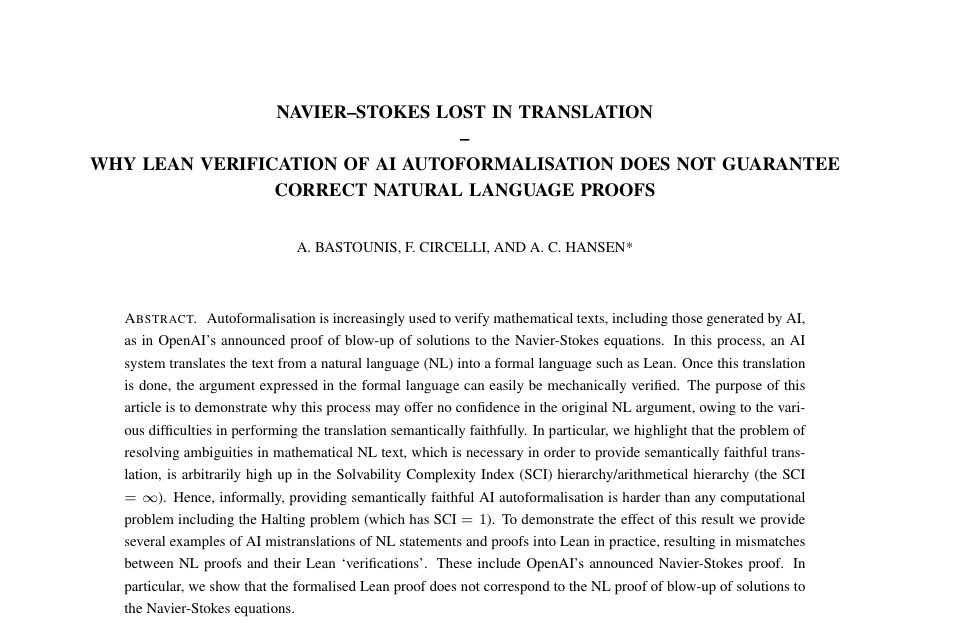
On October 8, 2026, an academic analysis (arXiv:2610.08144) revealed critical mismatches between the natural language claims and the Lean interactive theorem prover verification code in OpenAI's proposed solution to the Navier–Stokes equations.
Image source: X @ValerioCapraro / arXiv:2610.08144
The findings spotlight a fundamental semantic alignment challenge in AI-assisted mathematics: when AI translates informal mathematical reasoning into machine-checkable formal specifications, it can alter assumptions, weaken claims, or formally prove an entirely different theorem than originally asserted.
Two Core Discrepancies Between Natural Language Text and Lean Code
According to the analysis paper, at least two structural discrepancies were identified between the natural language manuscript and the machine-verified Lean codebase submitted for OpenAI's Navier–Stokes work:
- Input Derivative Requirements: While the natural language paper asserts that 4 additional input derivatives are sufficient for the argument, the actual Lean formal verification code requires 5 derivatives. In mathematical terms, this proves a strictly weaker result under more restrictive premises than claimed in the prose.
- Divergent Pressure-Flux Estimates: The derivation of the pressure-flux estimate in the Lean code relies on distinct bounds and an entirely different argumentative pathway compared to the natural language exposition.
Consequently, even though the Lean proof assistant successfully validated the formal code without syntax or logical errors, the verified statement does not align with the original theorem stated in the natural language paper.
Machine Verification and the Risk of 'Hallucinated Theorems'
This case underscores an inherent blind spot in relying strictly on formal interactive theorem provers like Lean during AI-driven mathematical discovery.
Lean verifies only the internal logical validity of the formal statements provided to it; it cannot judge whether those formal specifications accurately reflect the human researcher's intended semantic claims. When an AI models the translation from natural language prose into formal code, subtle modifications to premises or bounds can lead the proof assistant to certify a logically sound proof of an unintended, hallucinated theorem.
Academic Assessment and Next Steps
The mathematical community has not yet reached a final consensus on whether these identified discrepancies completely invalidate the overall Navier–Stokes proof architecture.
For now, the focus of mathematical and computer science researchers remains centered on establishing rigorous, independent alignment verification frameworks to ensure that AI-generated prose and machine-checked formal code faithfully represent identical mathematical claims.