Building an AI Second Brain with Obsidian and Claude Code: The LLM Wiki Blueprint
A complete guide to the 8M-view second-brain pattern based on Andrej Karpathy's LLM Wiki concept, featuring 18 agent skills, 72 slash commands, 6 subagents, and
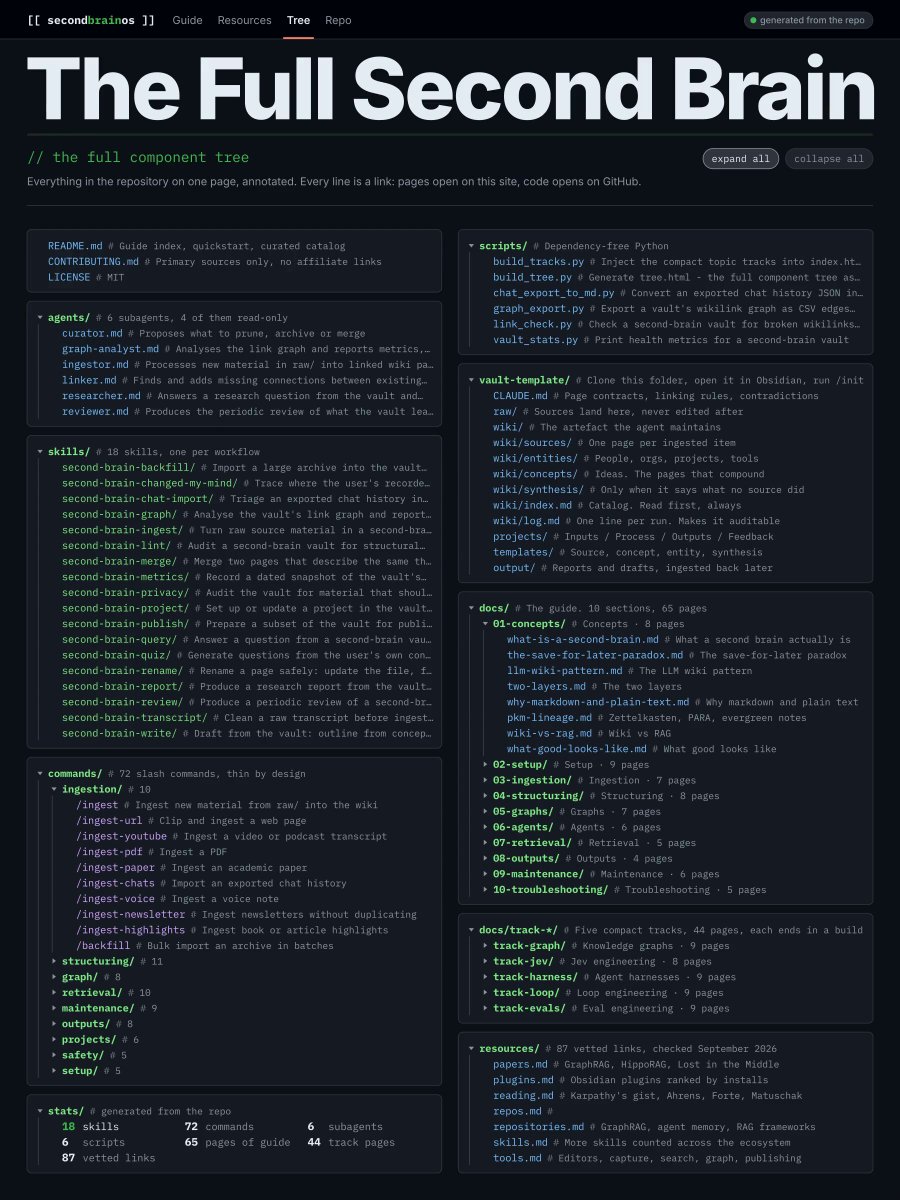
Following the viral success of a second-brain article exploring Andrej Karpathy's 'LLM Wiki' concept—which surpassed 8 million views—the author behind it has assembled the entire production setup into a unified, open-source reference package under the MIT license, as highlighted by tech curator Annatar.md (@AnnatarXBT). Designed for developers and researchers seeking an auditable, high-performance personal knowledge system, this release pairs an Obsidian vault with Claude Code agent automation, providing a complete blueprint from core theory to executable code.
Image source: Annatar.md (@AnnatarXBT) on X
The release contains a comprehensive 10-section, 65-page conceptual and troubleshooting guide alongside 5 deep-dive tracks spanning 44 pages, including 15 build guides with runnable code. Rather than treating an AI assistant as an unstructured chat interface, this architecture treats the knowledge base as a compiled, structured software artifact where automated agents continuously ingest, link, and audit notes while maintaining strict data boundaries.
Three-Layer Vault Architecture and the Immutability Contract
The most persistent failure mode in AI-augmented knowledge management is information corruption, where hallucinated inferences or inaccurate agent summaries overwrite authentic source materials. To eliminate this risk, the architecture enforces a strict three-tier hierarchy governed by a root CLAUDE.md specification.
raw/(Immutable Source Ingestion): Incoming primary materials—including PDFs, YouTube transcripts, voice recordings, and external web clippings—are deposited here. Once written, files in this directory are never edited or modified by any agent, preserving an authentic and untampered source of truth.wiki/(Agent-Maintained Knowledge Layer): Synthesized knowledge documents, structured summaries, topic overviews, and cross-referenced wiki pages live in this directory. Agents continuously organize, link, and maintain these markdown files according to strict schema guidelines.log.md(Single-Line Auditable Run Log): Every agent execution records exactly one entry per run in this root ledger. This guarantees a complete audit trail showing which subagent ran, what sources were processed, and which wiki pages were created or modified.
The starter vault's CLAUDE.md file defines explicit page contracts, naming conventions, and backlinking rules, ensuring that every automated pass preserves formatting standards and referential integrity across the entire graph.
The .claude/ Machine: 18 Skills, 72 Slash Commands, and 6 Subagents
Automation logic is decoupled from ad-hoc prompting and packaged directly into the vault's .claude/ harness, providing a standardized toolchain for local execution.
- 18 Specialized Agent Skills: Modular skills dedicated to individual workflow tasks, such as deep document analysis, cross-reference discovery, and graph traversal.
- 72 Slash Commands: Terse CLI commands designed for rapid terminal execution, including
/ingest-pdffor document parsing,/ingest-youtubefor video transcription processing,/ingest-voicefor voice memo intake, and/backfillfor repairing missing indices across the vault. - 6 Domain-Specific Subagents: Work is distributed among specialized roles:
curator,linker,researcher,reviewer,ingestor, andgraph-analyst.
Crucially, this system enforces role-based privilege isolation. Out of the 6 subagents, 4 operate in a strictly read-only mode. This permission boundary guarantees that analytical passes or background evaluations can never inadvertently rewrite or corrupt existing vault contents behind your back.
Zero-Dependency Python Utilities and 87 Vetted Resources
To avoid brittle package environments and setup friction, all core maintenance tasks are handled by standalone, plain Python scripts that rely exclusively on the standard library without external dependencies.
- Graph Export: Extracts bidirectional links and page metadata into standard graph formats for external analysis and visualization.
- Link Checker: Audits the entire markdown corpus to identify broken wikilinks, unreferenced targets, and isolated orphan notes.
- Vault Stats: Computes quantitative metrics on vault health, including word counts, growth velocity, and tag distributions.
- Chat Converter: Formats raw conversational exports from ChatGPT or Claude into structured, linkable markdown notes.
- Site Builder: Compiles the internal markdown wiki into a static web browsing interface.
In addition to the utility scripts, the package curates 87 vetted resources, including 28 developer tools, 26 recommended Obsidian plugins, 15 open-source repositories, 12 agent skills, and key research papers, saving builders dozens of hours of exploratory trial and error.
Five Deep-Dive Engineering Tracks and Production Caveats
While newcomers can start directly with the 65-page foundational guide, experienced builders can immediately dive into 5 modular technical tracks:
- Knowledge Graphs: Advanced patterns for semantic ontologies, property graphs, and multidimensional relationship mapping.
- Jev Engineering: Deploying lightweight decision models for ultra-fast, cost-effective document classification and routing.
- Agent Harnesses: Structuring execution environments, sandbox boundaries, and context injection protocols for local agents.
- Loop Engineering: Implementing autonomous, self-correcting feedback loops that iteratively refine document density and clarity.
- Eval Engineering: Quantitative benchmarking suites designed to measure link density, factual recall, and schema compliance across the vault.
When implementing this architecture, practitioners must adhere to two operational constraints. First, the immutability of the raw/ directory must be strictly maintained, and read-only subagent permissions should never be broadened, as data integrity depends entirely on these structural barriers. Second, the automated slash commands and subagents require a runtime capable of local filesystem operations, such as Claude Code. By packaging what enterprise consultants typically bill four figures to construct into an open MIT repository, this release provides a transparent, production-ready foundation for personal knowledge engineering.