NVIDIA Nemotron 3.5 Bolt E4B: October 23 Model Card and Unsloth's Edge Deployment Guide
NVIDIA's official October 23 release and text-in/text-out endpoint specifications, alongside Unsloth's separate October 24 guidance on 6GB devices and GGUF.
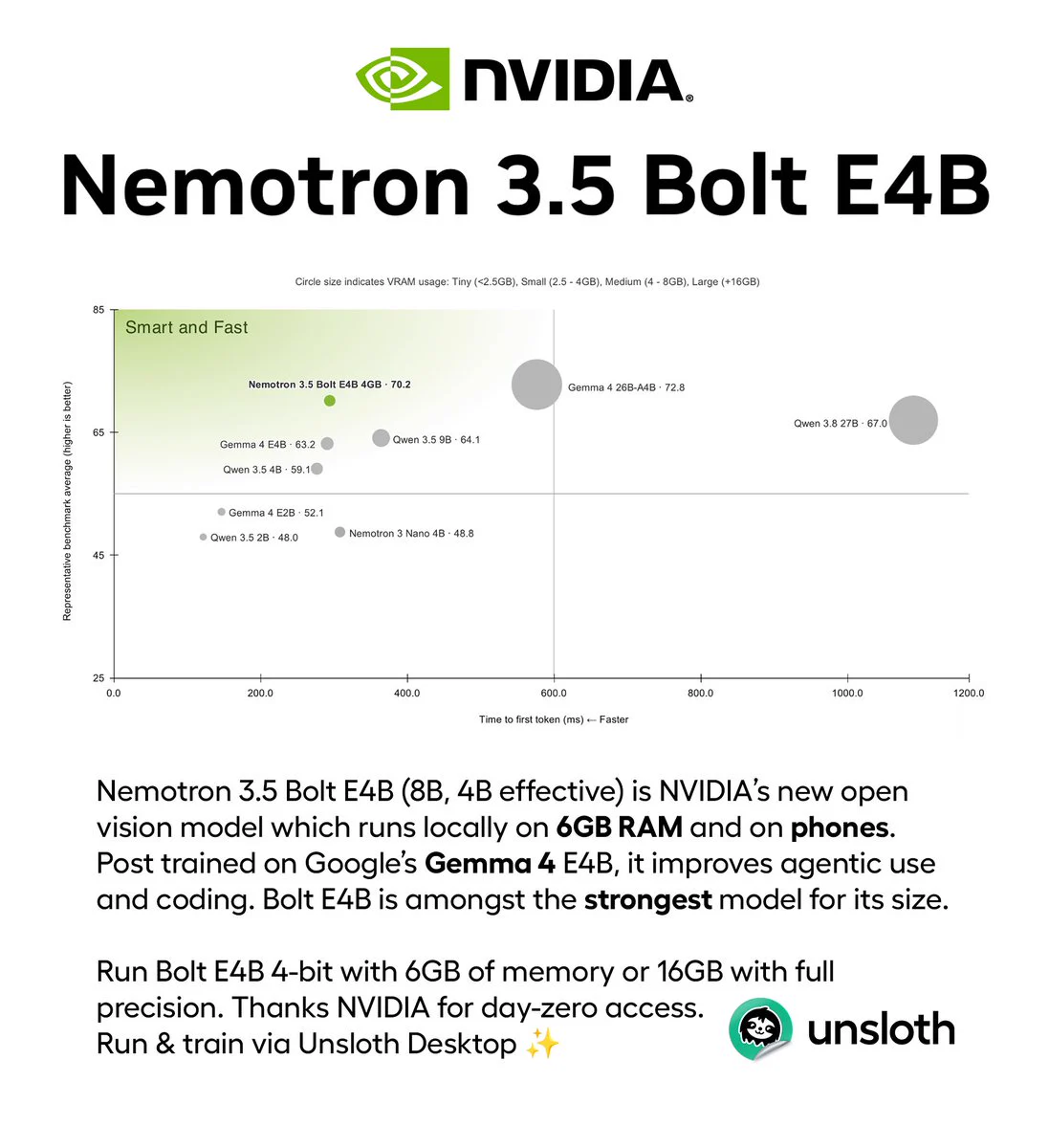
NVIDIA has introduced Nemotron 3.5 Bolt E4B. Its official NVIDIA model card records a October 23, 2026 release through NVIDIA Build and Hugging Face. On October 24, Unsloth AI separately announced resources for local edge deployment and GGUF use. Those dates refer to two different announcements.
Image source: @UnslothAI
What NVIDIA's Model Card Actually Specifies
The NVIDIA card describes Nemotron-3.5-Bolt-E4B-BF16, a general-purpose reasoning and conversational language model further post-trained from Gemma-4-E4B-it. Its listed model size is 8 billion total parameters, with 4 billion effective parameters. These specifications refer to the particular model identified in the card.
The same card lists Input Type(s): Text and Output Type(s): Text for the NVIDIA-hosted endpoint, together with a maximum context length of up to 64K tokens. These entries are not evidence that this BF16 service endpoint accepts image inputs. Any vision-related claim needs to specify which deployment and runtime it describes.
Unsloth's 6GB Local Model and GGUF Resources
In its October 24 X announcement, Unsloth AI says Bolt E4B can run locally with 6GB RAM, including edge devices such as phones. The same announcement describes training on Gemma 4 and mentions vision support. Here, vision support is explicitly attributed to Unsloth's statement, rather than presented as a supported input type for NVIDIA's text-only BF16 endpoint.
Unsloth provides a GGUF distribution on Hugging Face and a model usage guide. Its 6GB statement belongs to the quantized, local-deployment context. It should not be read as a RAM requirement for NVIDIA's BF16 service configuration.
Practical Implications for Local Deployment
Before selecting a download, developers should check whether the target is the BF16 model or a GGUF quantized build, and verify which input types and memory requirements their actual inference runtime supports. Both sources concern the same family of models, but they describe different deployment contexts.
The NVIDIA model card establishes the official release date, model lineage, parameter count, and text endpoint formats. The Unsloth announcement supplies the partner's local memory and vision claims. Keeping that attribution visible gives readers a more useful basis for choosing a compatible local deployment.