Nanobrowser: Open-Source Chrome Extension for Multi-Agent Web Automation
An open-source Chrome extension for multi-agent web automation using your own LLM API keys or local Ollama models, providing a local alternative to costly subsc
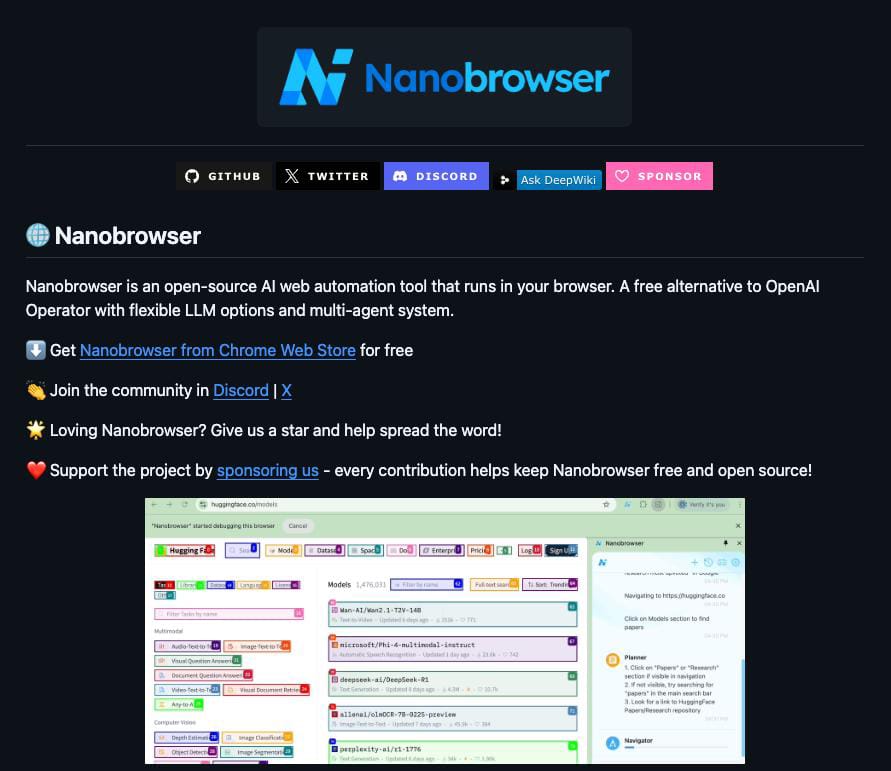
Nanobrowser, an open-source AI-powered web automation tool built as a Google Chrome extension, provides a local, subscription-free alternative to hosted browser automation platforms such as OpenAI Operator. Running directly inside the browser, it allows developers and power users to execute multi-agent web workflows using their own commercial LLM API keys or locally hosted Ollama instances.
Image source: @RoundtableSpace / Nanobrowser
Multi-Agent Architecture: Planner and Navigator Separation
Nanobrowser uses a dedicated two-agent architecture designed to handle complex web workflows reliably:
- Planner Agent: Analyzes high-level natural language instructions, breaks them down into sequential execution steps, and dynamically self-corrects its strategy whenever encountering unexpected obstacles or navigation failures.
- Navigator Agent: Receives dynamic instructions from the Planner to interact directly with the DOM—clicking buttons, filling forms, and traversing web page elements.
By decoupling strategic planning from tactical interaction, the extension minimizes hallucination loops and context saturation during extended browsing sessions.
Local Execution, Privacy First, and Flexible Model Choice
Unlike centralized cloud-based web agents, Nanobrowser executes all automation logic directly within the user's active Chrome environment:
- Local Credential Storage: Authentication states, browser sessions, and API keys remain strictly within the local browser runtime, never transmitting sensitive credentials to external cloud services.
- BYOK and Local Ollama Integration: Users can plug in standard LLM provider API keys to pay only for exact token usage, or route tasks to a locally running Ollama instance for zero-marginal-cost execution.
- Subscription-Free Economics: It eliminates mandatory monthly subscriptions (such as OpenAI Operator's $200/month tier), providing complete architectural and financial control to the user.
Practical Considerations and Limitations
When evaluating Nanobrowser for automated web tasks, several operational trade-offs should be kept in mind:
- Token Consumption & Compute Requirements: While there are no recurring software subscription fees, multi-turn reasoning across deep DOM trees can accumulate API token costs, while local Ollama models require adequate local compute and VRAM.
- Dynamic DOM and Compatibility Edge Cases: Complex single-page applications, dynamic shadow DOM layouts, and anti-bot verification mechanisms can introduce interaction latency or navigation mismatches.
Sources
- GitHub Repository: nanobrowser/nanobrowser
- Nanobrowser Documentation: Nanobrowser Documentation
- RoundtableSpace Announcement: Nanobrowser Release Post on X