AI Is Not a Conscious Being But a 'Modern Seer': The 2026 AI Ontology Framework
A paper published in AI and Ethics argues that viewing AI as either a mere calculator or a conscious entity is a category error, proposing instead the 'Modern S
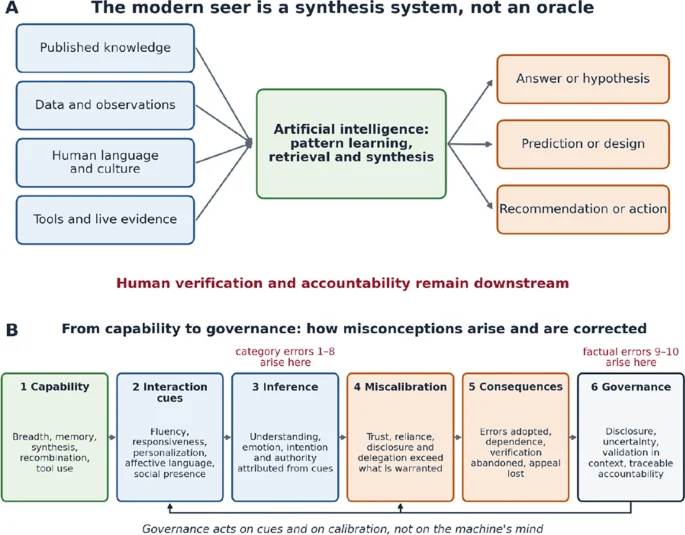
A paper recently published in the academic journal AI and Ethics has drawn significant attention for proposing a fresh philosophical and institutional framework to define the true nature of artificial intelligence. The research team points out that contemporary public discourse surrounding foundation models and generative AI remains starkly polarized between dismissing them as 'mere statistical machinery' and inflating them into 'conscious, sentient entities.' According to the study, both characterizations commit fundamental category errors by relying solely on observable performance and superficial social appearances.
Image source: https://link.springer.com/article/10.1007/s43681-026-01527-z
As an alternative, the authors advocate conceptualizing AI as a 'Modern Seer'—an intricate system that compresses, retrieves, and recombines recorded human knowledge at scales no individual can attain. Throughout history, societies consulted seers and learned elders not because they possessed supernatural omniscience, but because they connected present uncertainties with accumulated collective experience. Similarly, modern AI performs a distinct sociological and cognitive function by synthesizing novel insights and solutions without possessing any subjective inner consciousness.
Synthesis Without Consciousness and the Mechanism of 'Authority Illusions'
At the heart of the Modern Seer framework is a strict dissociation: synthetic systems can generate genuine novelty and high-level synthesis without experiencing subjective feelings, intentions, or moral agency. Large models process vast training corpuses to link disparate patterns that elude human observation. However, because these transformations unfold through multi-layered mathematical operations too complex to trace in traditional causal terms, the internal pathway remains obscure to the observer.
This very opacity fosters a profound 'authority illusion' among users and researchers alike. When an AI communicates fluently and projects empathetic conversational cues, deep-seated human inclinations trigger an instinctive inference that a thinking mind resides within. The research team analyzes these interaction cues as the root source of widespread conceptual confusion, stressing that future governance and trust calibration must anchor on demonstrated capabilities and operational contexts rather than speculative claims about machine minds.
Ten Misconceptions and Real-World Regulatory Alignment
The paper systematically categorizes ten recurring misconceptions surrounding AI. Eight of these are identified as category errors regarding the machine's true nature, while the remaining two are factual errors concerning active research integrity and regulatory permission. Common assumptions—such as believing AI possesses omniscience, that fluent conversation equates to consciousness, or that a tool must understand the world like a human to be useful—all fall squarely into category errors.
These philosophical insights directly align with practical policy measures already deployed by major institutional regulators. Bodies such as the United States Food and Drug Administration (FDA), the European Medicines Agency (EMA), and the International Committee of Medical Journal Editors (ICMJE) have moved beyond debating machine consciousness. Instead, they implement robust context-of-use frameworks that evaluate risk, credibility, and transparency for specific applications like drug development and scientific publishing.
Locus of Responsibility and Institutional Governance
The practical takeaway of the Modern Seer framework is profound. Acknowledging that AI lacks subjective experience or moral agency does not render the technology inherently safe. Systems devoid of sentience can still amplify errors, entrench societal biases, concentrate power, and execute consequential actions with real-world impact.
In critical domains like pharmaceutical development, clinical trials, and academic publishing, accountability remains an exclusively human and institutional obligation. The authors contend that an irreducible 'responsibility gap' does not exist; rather, consulting parties and governing institutions must own the decisions derived from AI consultation. Ultimately, effective AI governance is not about policing the phantom mind of a machine, but about rigorously calibrating human verification practices and institutional accountability.
Sources
- Springer Link (AI and Ethics): The artificial intelligence as a modern seer: an ontological and governance framework