Stanford and Luma AI Release 'pi-H3' and ComfyUI Nodes for 2-Step MiniMax H3 Acceleration
Stanford and Luma AI researchers have released pi-H3 adapters and ComfyUI nodes that distill the MiniMax H3 video generation model down to 2–4 steps and bypass
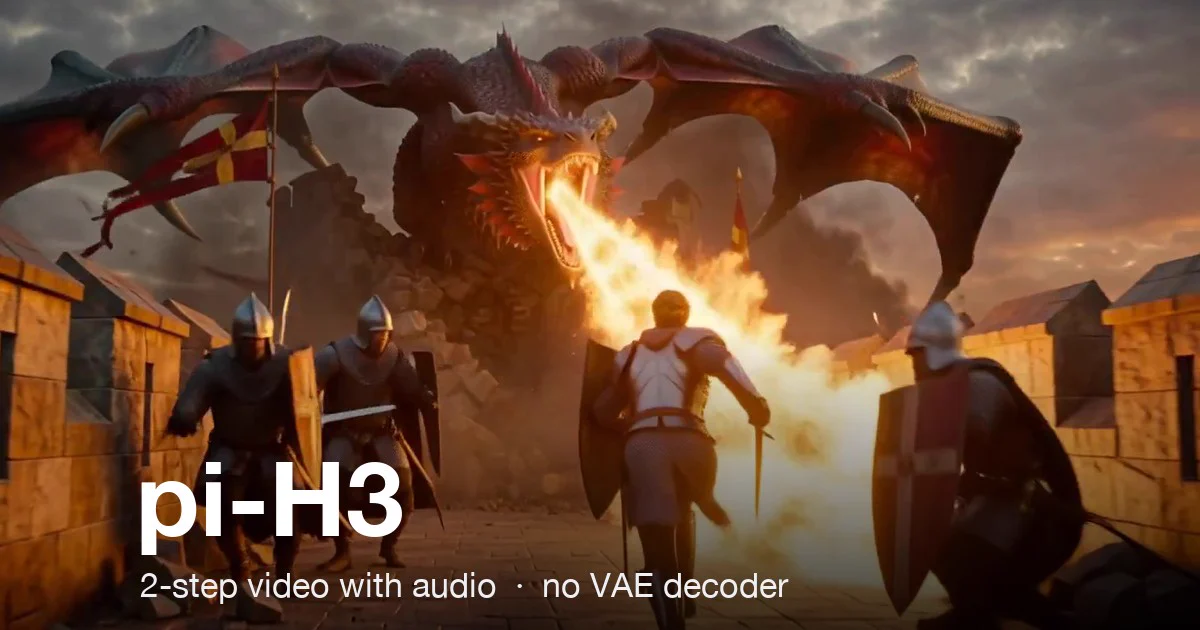
On November 21, 2026, researchers from Stanford University and Luma AI officially released pi-H3, a set of distillation adapters and open-source ComfyUI integration tools designed to run the high-performance MiniMax H3 video generation model in just 2 to 4 steps. Distillation is a machine learning technique where a smaller, faster model is trained to replicate the capabilities of a massive foundational model. This release paves the way for near real-time high-resolution video generation on local consumer and workstation hardware, drawing intense interest from researchers and creators alike.
Image source: https://comfyui-wiki.com/en/news/2026-11-21-pi-h3
The newly introduced project focuses on rapidly outputting high-definition video complete with synchronized stereo audio from text prompts. According to benchmark figures provided by the authors running on a single NVIDIA B200 hardware setup, generating a 5-second video at 1344×768 resolution with stereo audio takes a mere 3.81 seconds when configured for the 2-step (pi-H3 2-step) setup. This represents a dramatic acceleration compared to traditional generative models that require dozens or hundreds of inference steps and considerable processing time.
How pi-H3 Works: Two Distinct Adapter Families
The pi-H3 package ships with two primary adapter families, giving creators the flexibility to choose the pipeline that best suits their local hardware environment:
- Plain 2/4-Step Adapters: These versions pass through the standard
MiniMax H3VAE (Variational Autoencoder, a neural network that compresses complex high-dimensional video data into a latent space and reconstructs it) architecture to perform final decoding. - DWD (Direct Pixel Decoding) Adapters: These variants predict pixels directly in the final denoising step (the iterative process where random noise is cleaned up to form a sharp image or video), bypassing the VAE decoder entirely. They are provided in INT8 ConvRot (8-bit quantized convolutional rotation weights) formats tailored for ComfyUI.
The authors noted that for the DWD version, they replaced the heavier convolutional neural network refiner from version 1.0 with a lighter transformer architecture utilizing windowed attention. According to the research team, this modification yields smoother fine-detail motion and significantly enhanced 2-step coherence.
ComfyUI Integration and Practical Workflow Guide
By utilizing the ComfyUI-piFlow extension, users can seamlessly integrate pi-H3 into their local workflows without cumbersome manual code configuration.
- Installation Requirements: Install
ComfyUI-piFlowvia ComfyUI Manager or clone the repository directly into thecustom_nodesdirectory. The setup requires ComfyUI version 0.45.0 or newer, and any conflicting third-party pi-H3 or pi-Flow extensions must be uninstalled beforehand. - File Placement: Load either
pi-H3-DWD.jsonorpi-H3.jsonfrom the repository's workflows folder. Placepi_h3_2step_dwd_adapter_int8_convrot.safetensors(or the 4-step equivalent) into themodels/loras/folder, and pair it withminimax_h3_fl2va_pruned_int8_convrot.safetensorssourced fromComfy-Org/MiniMax-H3.
However, practical testing reports from community evaluators indicate that for the DWD variant, skipping the VAE decoder saved less than a second of render time on a 5-second 768p clip when paired with the INT8 Sol VAE. Consequently, prominent community tester Kijai and others suggest that the plain 2-step adapter remains more stable and reliable for general-purpose use. The audio VAE operates as usual, while the video VAE is restricted to keyframe regions.
Verified Conditions and Remaining Limitations
While pi-H3 offers a compelling pathway to extract high-quality video rapidly on local workstations, users must keep several technical caveats in mind.
First, the architecture exclusively supports the FL2VA trunk: text conditioning, first frame, last frame, or both. Because there is no Ref2VA adapter included, reference-image conditioning is currently unsupported. Furthermore, because the DWD variant trains blocks 46 through 49 directly through its pixel head, stacking other conventional H3 LoRAs (Low-Rank Adaptation, a lightweight fine-tuning method) that lack this training can trigger layer conflicts and unpredictable output.
The official project page, Hugging Face repositories, and documentation provide immediate access to the weights, adapter files, and ComfyUI workflow guides, with an online Hugging Face Space available for testing without local installation.
Sources
- ComfyUI Wiki: pi-H3 Release News
- pi-H3 Project Page: Hansheng Chen Blog
- GitHub Repository: ComfyUI-piFlow Docs
- Hugging Face Weights: Lakonik/pi-H3