Testing MiniMax H3 Long-Video Quality: Measured Notes at 36s and 60s
FoldingEnd A.I. ran a ComfyUI MiniMax H3 long-video workflow to test whether it holds up past the 25–30 second quality-drop zone. Two runs at 1344x768 and 8 ste
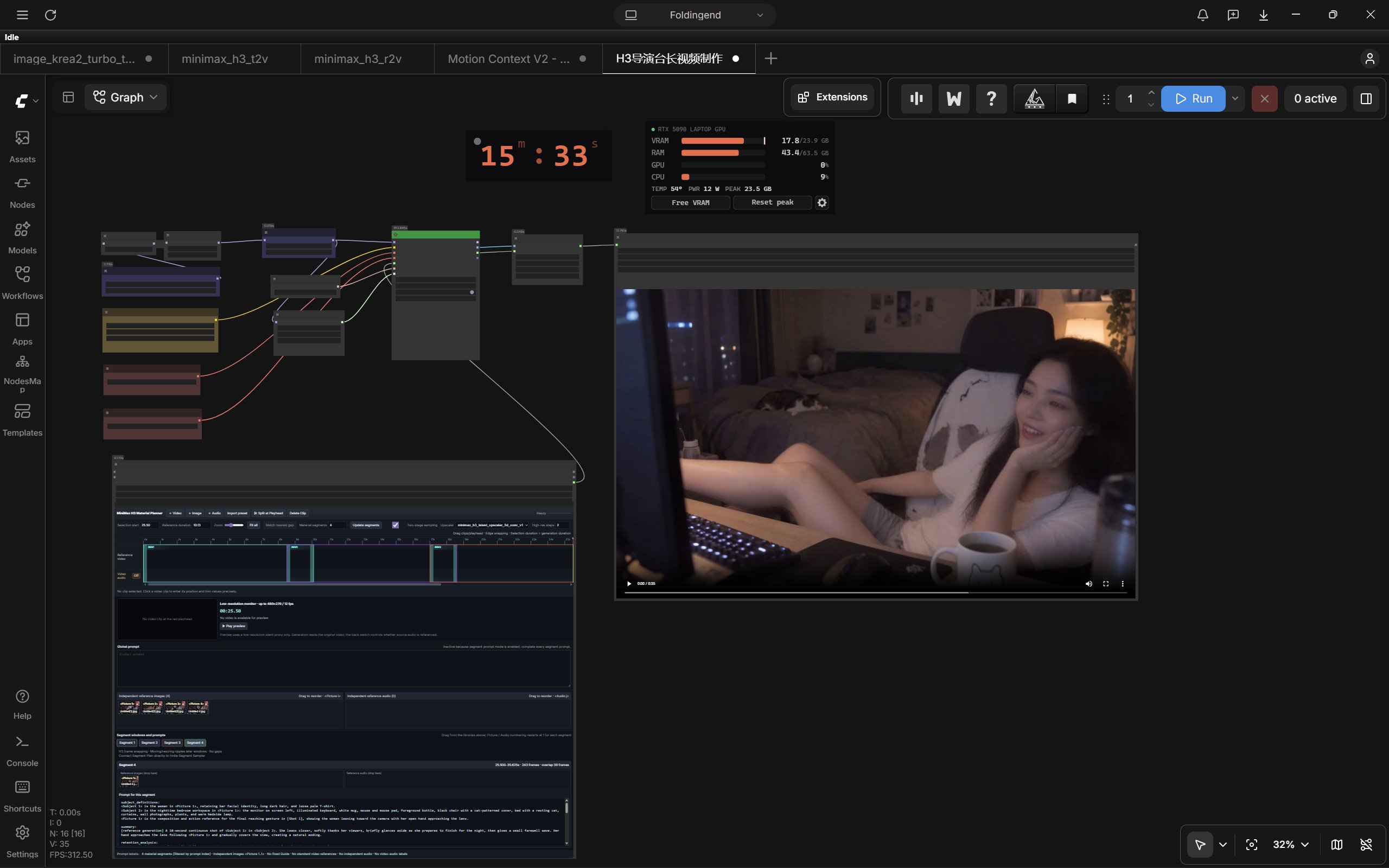
Original author FoldingEnd A.I. (@EndFolding79421) published a hands-on test on X, timestamped October 12, 2026 KST in the acquired evidence (October 11 in UTC terms), running a ComfyUI MiniMax H3 long-video workflow found on YouTube. The goal was explicit: get past the dreaded 25–30 second mark where H3 usually starts losing quality, and keep consistency all the way to the end.
Image source: FoldingEnd A.I. (@EndFolding79421) X post attached videos and PC spec images
The test consists of two clips. Both were rendered at 1344x768 with 8 steps, and the author states PC specs and render times are shown in the attached images. The first is the YouTuber's original example at 36 seconds; the second is the author's own simple close-up of a woman talking to the camera, extended to a full 60 seconds to push the limit.
Test setup: 36-second example and 60-second push
The workflow source is this YouTube video. The acquired thread evidence contains no node structure or parameter details, and the author defers technique questions to the video, saying the YouTuber "explains it better." Read this piece as a measured record of the workflow's long-form claim, not as a how-to.
- Test 1 — YouTuber's example, 36s: the provided example rendered as-is.
- Test 2 — own close-up, 60s: a simple camera-facing close-up pushed to 60 seconds.
- Shared conditions: 1344x768, 8 steps. PC specs and timing live in the attached images, per the author.
One replier asked whether this workflow continues from the previous segment's latent or restarts from the last frame, noting that the ooizj Long Video node carries video/audio latents forward with a 22-frame overlap. The author did not answer directly and pointed back to the YouTube video. Anyone reproducing this should watch the source video first, not just the thread.
Confirmed limits: mixed dual audio and the quality debate
The author openly admits one problem: in the 60-second close-up, the dual-audio voices got mixed up, described only as "something I can work on." No fix is given in the thread.
The second open question is visual quality. A replier posting in Chinese (爱玩ai的猫, @y7469591) observed progressive quality degradation through the second video. The acquired thread evidence shows no rebuttal from the author, while the author replied "agreed" to another replier (Kaer Freki) who called the result "not yet perfect, but a great step in that direction." The long-form consistency claim is best treated as still under verification.
The practical takeaway is threefold. First, the 36-second run is a reproducible starting point at the example level. Second, pushing to 60 seconds surfaces two bottlenecks at once: audio and visual quality. Third, the workflow itself lives in the linked YouTube video, so check the original explanation end to end before copying the setup.
Original source
- FoldingEnd A.I. (@EndFolding79421), original post (timestamped 2026-10-12 KST in acquired evidence): X post
- Workflow source video: YouTube — workflow explainer