Microsoft Open-Sources 'mxc' Code Sandbox for Windows with Unsloth Integration
Microsoft open-sources mxc for sandboxed code execution on Windows, while Unsloth introduces native OS-level integration with sub-100ms overhead.
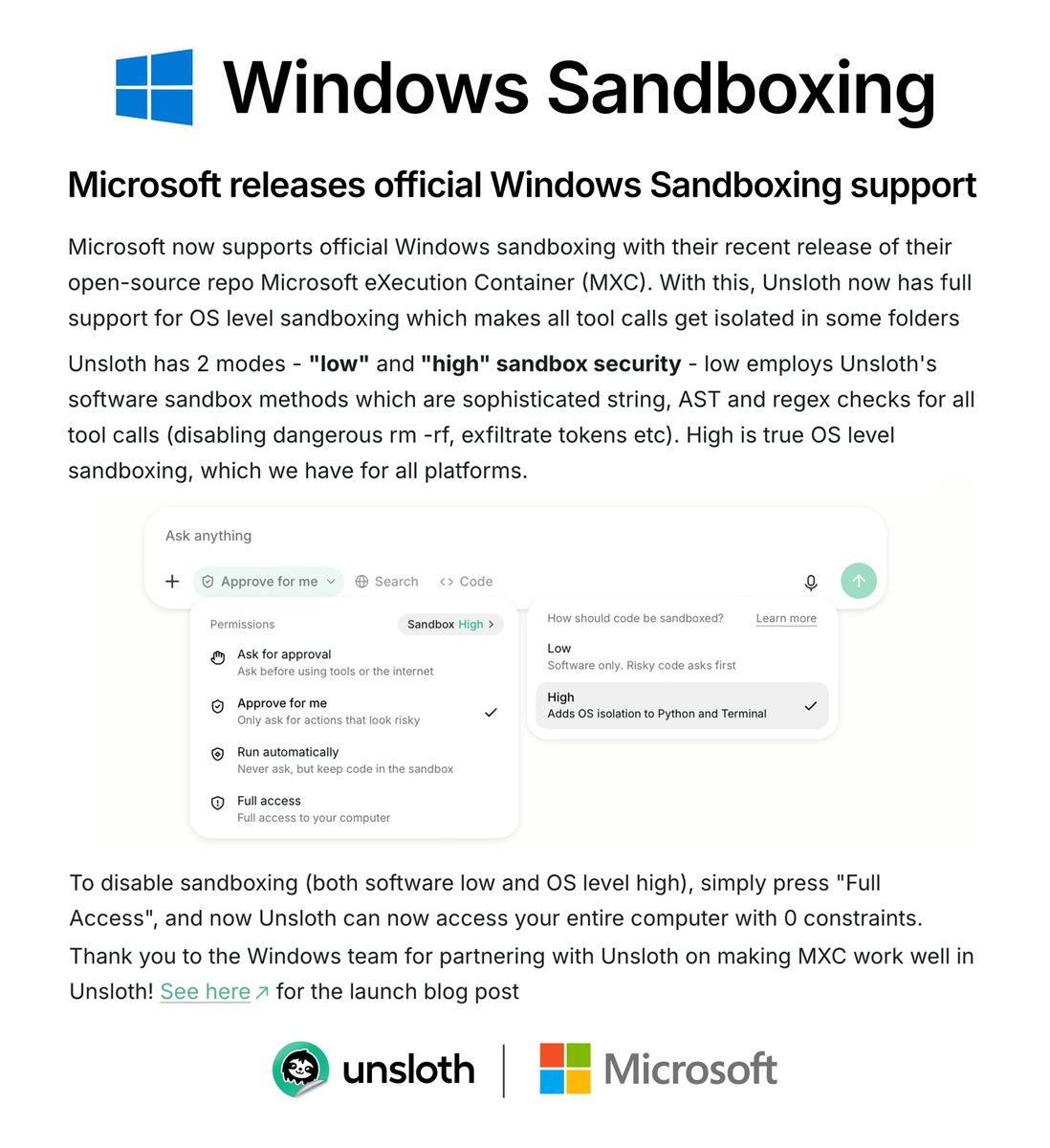
On October 9, 2026, Microsoft officially released 'mxc', an open-source repository designed for isolated, sandboxed code execution on Windows. Concurrently, the Unsloth AI team announced that, through direct collaboration with the Windows engineering team, native OS-level sandboxing powered by mxc has been added to the Unsloth framework.
Image source: Unsloth AI (@UnslothAI) / X
This release focuses on delivering robust isolation for local AI agent workflows and code execution pipelines while keeping execution latency overhead under 100 ms.
Windows Native OS-Level Isolation via 'mxc' and Unsloth Collaboration
Executing arbitrary model-generated code locally or handling multi-step AI agent tool calls requires strict isolation to safeguard host environments. Traditional approaches relying on virtual machines (VMs) or heavy container layers often introduce noticeable startup and runtime overhead.
Microsoft's open-source 'mxc' repository provides a native sandbox engine that operates directly at the Windows operating system level.
- Direct OS-Level Integration: Leverages native Windows isolation primitives without introducing heavy external runtime dependencies.
- Unsloth Framework Integration: Developed in partnership with the Windows engineering team, allowing developers to invoke sandboxed execution paths directly within Unsloth.
Sub-100ms Overhead and Practical Impact on Local AI Agents
The mxc OS-level sandboxing implementation in Unsloth introduces less than 100 ms (<100 ms) of overhead per execution cycle.
- Practical Agent Tool Calling: In agentic loops where models iteratively write, test, and evaluate code, keeping sandbox overhead below 100 ms makes it viable to isolate every tool call without disrupting real-time responsiveness.
- Streamlined Local Developer Workflows: Developers can safely test and run model outputs directly on Windows without configuring dedicated container runtimes.
Because this integration relies on Windows-native mxc isolation mechanics, it carries platform-specific Windows dependencies distinct from Linux or macOS environments. Workflows operating under ultra-low latency constraints should account for this minimal timing factor during high-frequency execution loops.
Official Documentation and Repository Distribution
The Unsloth team provides full documentation and implementation guidelines to evaluate this Windows sandboxing integration immediately.
- Unsloth Guide: Sandboxing in Unsloth
- Unsloth GitHub Repository
- Unsloth AI Official Announcement on X