mcp-for-blender Crosses 30K GitHub Stars and Ships Refactor Claiming 40% Less Token Usage
Open-source 3D automation tool mcp-for-blender's maintainer says it has passed 30,000 GitHub stars and 4.5 million downloads, announcing a refactor claimed to c
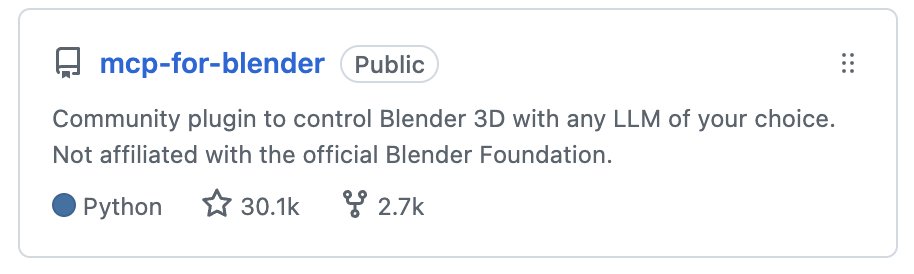
The open-source project mcp-for-blender (formerly blender-mcp), which connects Blender 3D software to LLMs via Model Context Protocol, was said by maintainer Siddharth Ahuja (@sidahuj) in an X post dated 2026-10-06 to have passed 30,000 GitHub stars and 4.5 million downloads. In the same post, he announced a refactor claimed to reduce LLM token consumption by 40% with faster speed at the same quality of results. A star count of 30,052 and an MIT license match the repository record observed at search time.
Image source: @sidahuj (X / Siddharth Ahuja)
mcp-for-blender connects a local Blender environment to AI clients such as Claude through a socket-based server. According to the repository description, users can create, modify, and delete objects, control materials and colors, inspect scenes, and run arbitrary Python code in Blender from natural-language instructions.
Refactor Claiming 40% Less Token Usage and Faster Speed
The headline technical claim in the announcement is a refactor with 40% less token usage at the same output quality, plus faster speed. No measurement conditions or benchmark procedure appear in the supplied evidence, so these figures must be read as the maintainer's claim.
- Token Optimization: The maintainer states 40% less token usage for the same quality of results. Input/output split and test setup are not disclosed.
- Speed: The maintainer states faster speed. Specific causes such as lighter socket payloads are not confirmed in the evidence.
- Two-Way Communication: The repository describes two-way communication connecting Claude AI to Blender through a socket-based server.
3D Asset Generation Pipeline: Hyper3D, Hunyuan, Tripo, and Asset Libraries
The maintainer says the update adds integrations to make it easier to create 3D scenes and assets for game development, architecture, robotics environments, scientific visualisation, and filmmaking.
- Generative 3D Foundation Models: In a reply, the maintainer names integrations with Hyper3D, Hunyuan, and Tripo plus a different harness. Details such as text/image-to-single-object behavior are not confirmed in the evidence and are not asserted here.
- Asset Library Integrations: In the same reply, the maintainer names Poly Haven and Poly Pizza. The repository lists an "Asset & model generation | Poly Haven" capability, but license scope and asset types are not fully confirmed in the evidence and are not asserted here.
- Scene Inspection and Code Execution: The repository lists scene inspection for the current Blender scene and running arbitrary Python code in Blender.
Package Rename, Backward Compatibility, and Production Considerations
For teams evaluating mcp-for-blender for in-house pipelines, several setup and architectural distinctions should be noted:
- PyPI Package Renaming: The official package name has transitioned from
blender-mcptomcp-for-blender. Existing setups keep working with no config change required, anduvx blender-mcpstill runs the server. New installs should referencemcp-for-blender. - System Requirements: Python 3.10 or higher is required, with a uv-based install flow documented. Specific config filenames and stdio/socket bridge distinctions are not fully confirmed in the evidence and are not asserted here.
- Independent Community Harness: mcp-for-blender is an independent, MIT-licensed third-party integration, not made by Blender. It is distinct from the official Blender project (
projects.blender.org/lab/blender_mcp, licensed GPL-3.0-or-later), which describes itself as deliberately small and minimal. Ahuja's project differentiates itself through a different harness and integrations with Hyper3D, Hunyuan, Tripo, Poly Haven, and Poly Pizza. - Iterative Work Caution: LLM-generated Python may fail on complex geometry work; this is stated only as a general caution. The evidence does not support attributing a specific recommended workflow or verdicts on single-prompt whole-scene generation.
mcp-for-blender aims to turn repetitive Blender work into natural-language operations connected with external generative models.
Sources
- GitHub Repository: ahujasid/mcp-for-blender
- Siddharth Ahuja Official Announcement on X (@sidahuj): mcp-for-blender 30k stars & refactor announcement
- Official Website: mcp-for-blender.com
- PyPI Package: pypi.org/project/mcp-for-blender