Kling 4.0 vs Seedance 2.5 API Pricing and Control: Video Generation Cost Analysis
A detailed comparison of per-second pricing, reference image limits, and resolution options for Kling 4.0 and Seedance 2.5 on the Revana unified API platform.
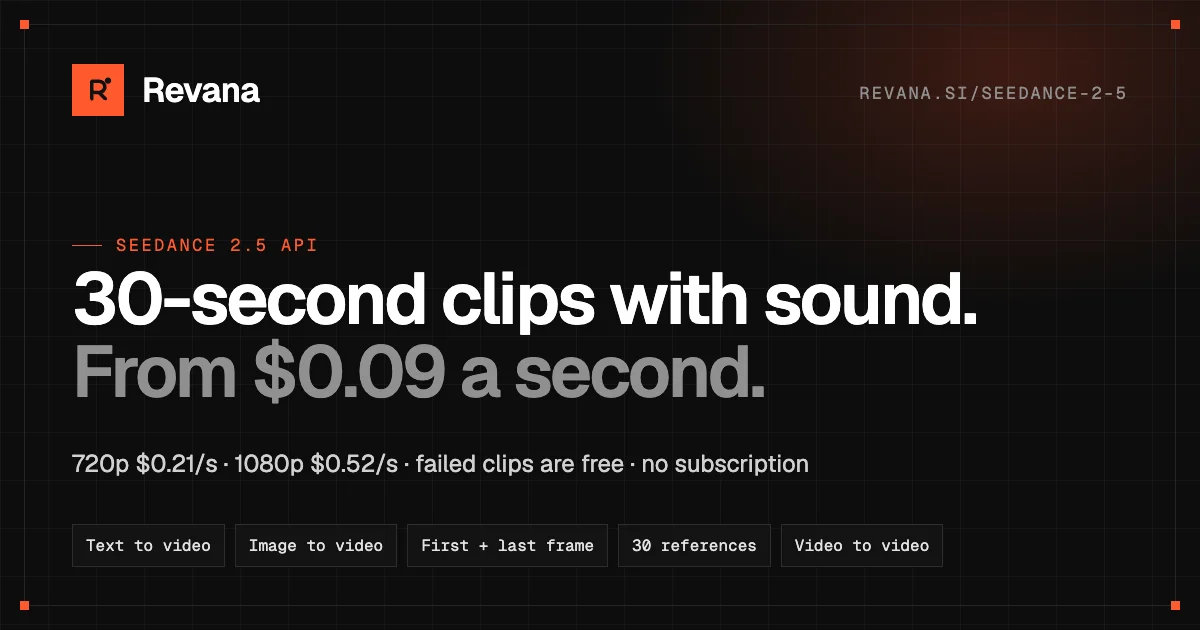
As competition heats up in the AI video generation market to deliver high-definition video clips with synchronized audio, developers and creators need granular cost and control data. Through the third-party unified API platform Revana, which aggregates major AI models under a single developer interface, we can directly compare the pricing and capabilities of Kuaishou's Kling 4.0 and ByteDance's Seedance 2.5.
Image source: https://revana.si/blog/kling-4-0-vs-seedance-2-5
Image Credit: Revana
For developers and production teams integrating video generation into software or pipelines, per-second pricing and reference image limits are critical decision factors. Both models can produce clips up to 30 seconds long with sound in a single request, but they diverge significantly in cost-efficiency and precise control.
1080p Generation Pricing and Cost-Efficiency
Based on Revana's pricing structure, 1080p Full HD video generation is substantially cheaper with Kling 4.0 at $0.20 per second, compared to $0.52 per second for Seedance 2.5—representing a 62% savings.
At 720p, Kling 4.0 costs $0.135 per second against Seedance 2.5's $0.21 per second, making Kling 36% less expensive. For example, rendering a 10-second 1080p clip costs $2.00 on Kling 4.0 versus $5.20 on Seedance 2.5.
Conversely, Seedance 2.5 offers a budget 480p low-resolution option starting at $0.09 per second, which Kling 4.0 does not provide. When using video input (editing mode) at 720p, Kling 4.0 is priced at $0.08 per second and Seedance 2.5 at $0.15 per second.
Character Consistency Control and Reference Limits
Beyond raw pricing, the two models excel in different control scenarios for maintaining visual continuity:
- Seedance 2.5: Accepts up to 30 reference images and reference audio input. This makes it ideal for commercial and character-driven projects where a product, logo, or specific character must remain precisely identical across multiple shots, as well as for lip-synced speech from reference audio.
- Kling 4.0: Supports up to 10 reference images and clip lengths ranging from 3 to 30 seconds. Stereo sound options are always included in the base pricing without extra charges, delivering immersive audio right out of the box.
Single API Key Integration and Workflow Tips
The Revana platform simplifies development by allowing both models to be invoked using a single API key and identical request formats—only the model ID changes. This structure enables developers to use one model as a seamless fallback when the other fails, with failed jobs incurring zero charges.
For practical deployment, creators looking for budget-friendly 1080p generation with built-in stereo sound can rely on Kling 4.0, while projects requiring rigorous character and logo consistency across up to 30 reference images will benefit from Seedance 2.5.