Open-Source LLM Evaluation and Testing Tools That Check Whether Your AI Actually Works
A roundup of essential open-source tools — DeepEval, Promptfoo, Ragas, Opik, and Arize Phoenix — for hallucination checks, RAG quality measurement, execution tr
On October 3, 2026, the X account @RodmanAi (Leonard Rodman) posted a roundup of "10 GitHub repos to find out if your AI actually works" — open-source tools for testing, evaluating, and monitoring LLM and AI agent systems. The premise is simple: measuring AI quality matters as much as building it. This article covers the five core tools verified at the desk (DeepEval, Promptfoo, Ragas, Opik, and Arize Phoenix): what each does and where it fits in practice.
DeepEval: Unit Tests for LLMs, Pytest-Style
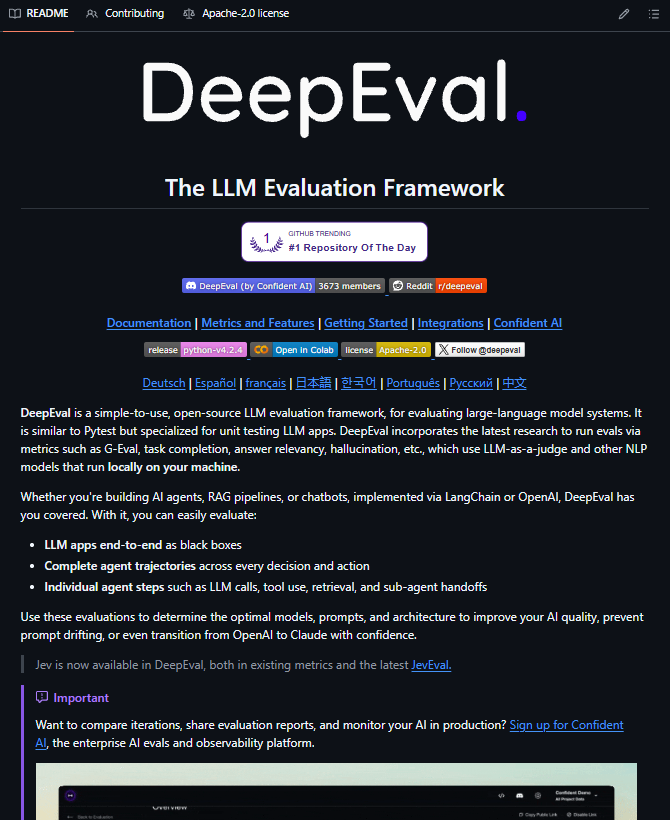
DeepEval (confident-ai/deepeval) is an open-source LLM evaluation framework with a Pytest-like interface for unit-testing LLM applications. It scores hallucination, answer relevancy, RAG pipeline quality, and agent decision trajectories — including individual steps such as LLM calls and tool use — with evaluation models that run locally on your machine.
Whether you build chatbots, RAG pipelines, or AI agents on LangChain or OpenAI stacks, it covers black-box end-to-end evaluation through full agent-trajectory tracing. The original post summed it up in one line: "pytest for LLMs."
Promptfoo: Prompt and Model Comparison, Red-Team Scanning, CI/CD Regression Tests
Promptfoo (promptfoo/promptfoo) is a CLI and library for comparing prompt and model performance and running red-team vulnerability scans. Declarative configs plus the command line drive automated evaluations, and CI/CD integration turns them into regression tests and security checks. It supports side-by-side comparison across models including GPT, Claude, Gemini, and DeepSeek.
In the original post's framing, it "catches failures before users do." Per its repository description, it is used by OpenAI and Anthropic, and it remains MIT-licensed open source after joining OpenAI.
Ragas: Measuring Faithfulness, Relevancy, and Retrieval Quality in RAG
Ragas (explodinggradients/ragas) is an evaluation tool purpose-built for retrieval-augmented generation (RAG) systems. It quantitatively measures whether generated answers stay faithful to retrieved evidence, whether questions and answers are relevant to each other, and whether retrieval quality itself is good enough.
For any RAG chatbot, the key question is "the answer sounds plausible — but is it grounded?" That is exactly the spot Ragas covers. The original post introduced it along the same three axes: faithfulness, relevance, and retrieval quality.
Opik and Arize Phoenix: Tracing, Evaluation, Observability
Opik (comet-ml/opik) traces AI workflows, evaluates outputs, and helps debug LLM applications. Arize Phoenix (Arize-ai/phoenix) provides open-source observability and evaluation for LLM and agent applications.
Both belong to the "don't just ship it — watch what runs" layer: seeing what happens in production and finding problems. Replies to the original post echoed this, calling Opik useful for debugging AI workflows and mentioning production-monitoring tools such as Evidently alongside it.
Practical Caveats
- Limits of LLM-as-a-Judge: the judge model itself can introduce bias and token costs. Pairing semantic scoring with rule-based checks (regex, keywords) is the recommended setup.
- CI/CD cost control: test-case counts and model-call frequency drive API cost and rate-limit pressure. Gating the full suite on changes to prompt or eval files, rather than running it on every PR, is the realistic pattern.
Sources
- Leonard Rodman (@RodmanAi) original post: 10 GITHUB REPOS TO FIND OUT IF YOUR AI ACTUALLY WORKS
- DeepEval: confident-ai/deepeval
- Promptfoo: promptfoo/promptfoo
- Ragas: explodinggradients/ragas
- Opik: comet-ml/opik
- Arize Phoenix: Arize-ai/phoenix