LlamaIndex Launches OpenDocRouter, a Unified API for Document Parsing
LlamaIndex launched OpenDocRouter, placing 10 document parsing models behind one API. One-line model swaps and ParseBench quality/cost scores are the core of th
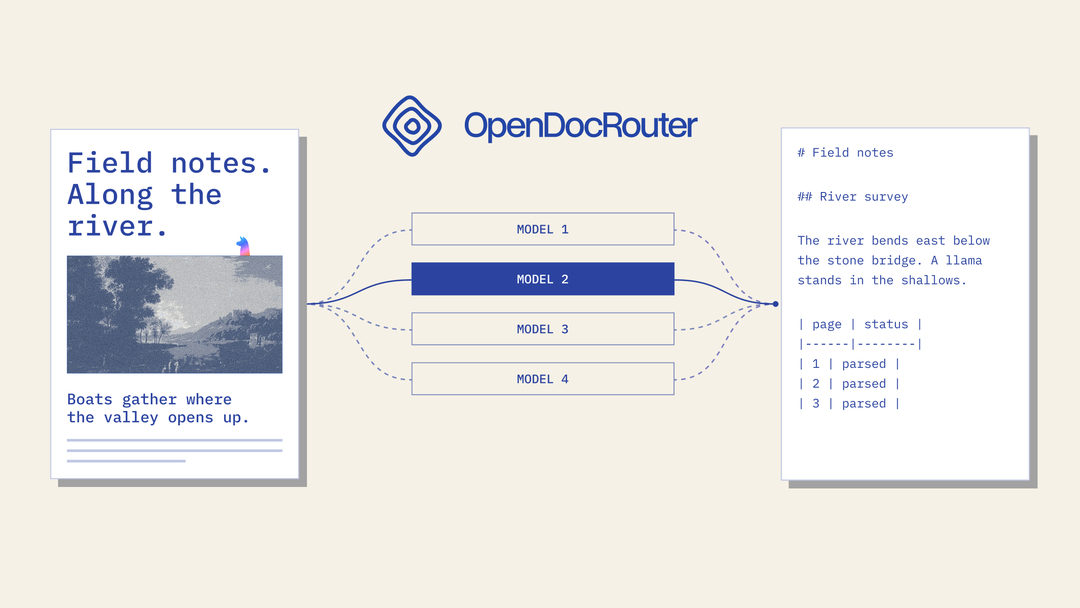
LlamaIndex announced OpenDocRouter on October 7, 2026 through its official blog post "Introducing OpenDocRouter: every document model under one API." The service puts document-to-Markdown parsing behind a single request format, covering both frontier and open-source models.
Image source: LlamaIndex
The stated rationale is model churn: thousands of OCR models sit on Hugging Face, and frontier labs release document-capable models nearly every month. LlamaIndex argues that whatever parses best today may not hold that position next quarter, so the deciding factor is how fast a team can switch — not which model it picks first.
One-line swaps with the same Markdown output
According to LlamaIndex, switching models means changing one line: the same request, the same Markdown output shape, with no new prompts or integrations. That claim is the centerpiece of the launch.
The launch lineup covers 10 frontier and open-source models. The five named directly by the official @llama_index account are Claude Opus 5.5, Gemini 3.8 Flash, GPT-6 Luna, MinerU2.5-Pro, and PaddleOCR-VL-1.6. The remaining five names are not present in the verified official evidence collected here, so they are left unnamed.
Secondary reporting from Unite.AI adds that each run operates under a versioned parsing recipe. In other words, prompts, processing, and settings are pinned per recipe, so the call signature stays stable while the underlying model changes.
ParseBench scores and traceable layout output
Every model is scored on ParseBench for quality and cost. LlamaIndex presents those scores as the basis for choosing a parser for a given document set, though the scoring method and per-document-type rankings fall outside the evidence available here.
The original announcement also claims that setting 'layout: true' returns traceable output with grounded bounding boxes. The implication is that positional information ships regardless of model choice, but how that works for models without native support is not confirmed by official evidence, so no stronger claim is made here.
Python library and confirmed limits
PyPI hosts the official Python library opendocrouter v1.0.0. It supports Python 3.9 and above and provides synchronous and asynchronous clients built on httpx. Install commands, key issuance, hosting pricing, supported file types, size caps, and sync/async specifics are outside the verified scope and are not stated here.
The confirmed limits are clear. The full 10-model roster, pricing and billing units, and response-mode conditions cannot be fixed from the official evidence on hand. The original tweet text is truncated mid-post, so pricing and availability wording is also excluded as an official claim. Per-page figures and minimum top-ups carried by Chinese-language secondary outlets lack official blog evidence and are omitted from this article.
For teams feeding parsed documents into a RAG pipeline, the notable part is the interface: lower switching cost between parsers. Before adopting it, checking the official blog's model list, ParseBench scores, and the Python library documentation directly is the prudent next step.
Sources
- LlamaIndex official blog: Introducing OpenDocRouter: every document model under one API
- LlamaIndex on X (@llama_index): Original OpenDocRouter announcement
- PyPI: opendocrouter v1.0.0
- Unite.AI: LlamaIndex Launches OpenDocRouter, a Unified API for Document Parsing