Liquid AI d1-omni Runs in a Browser 47 Minutes After Release
After Liquid AI released open-weight decision models d1-3B (text plus vision) and experimental d1-omni-600M (text plus vision, or text plus audio), a ruNNtime-b
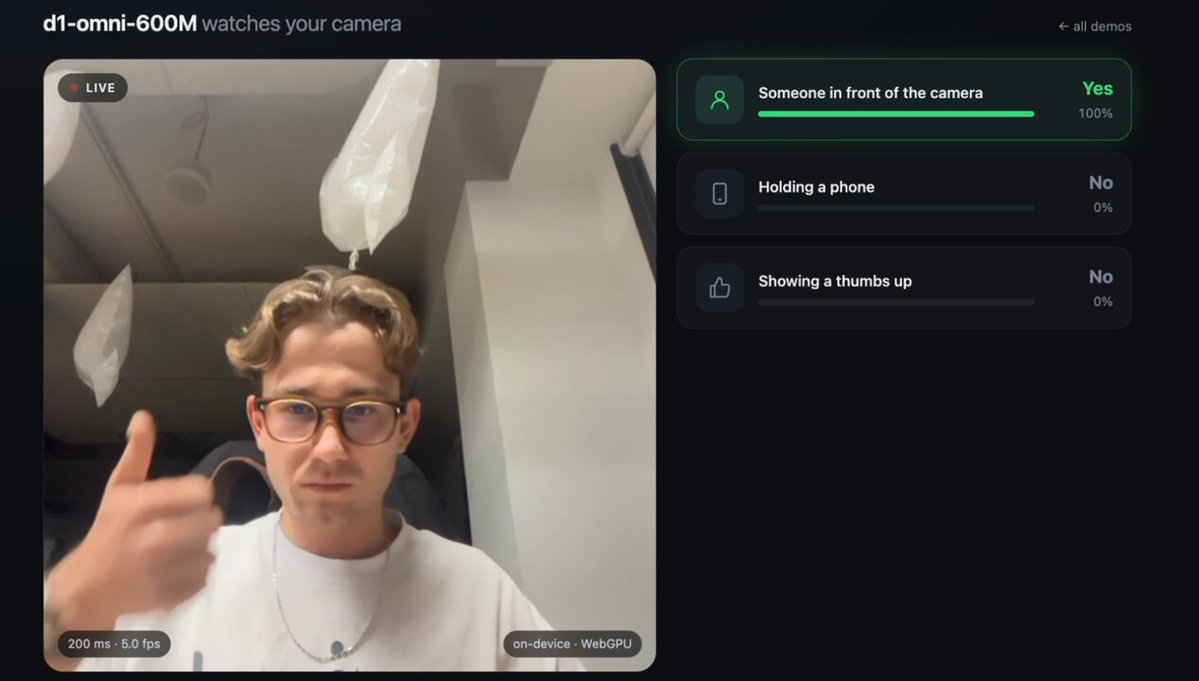
On October 7, 2026 (US time), Liquid AI released two open-weight decision models, and developer Jakub Chmura (@_jakubchmura) posted a screen-recorded demo of d1-omni-600M running in a browser on X. The post timestamp is 02:50 KST on October 8, 2026 — about 47 minutes after the d1-omni release, in the author's own words.
Image source: @_jakubchmura / X (demo video still)
The demo uses ruNNtime, Software Mansion's browser inference library. The author states that one of its main goals is making AI model ports to browsers hassle-free and agent-friendly. Software Mansion's official account replied to the post with "forget day 0 support, this is minute 47 support."
Two released models: d1-3B and experimental d1-omni-600M
According to Liquid AI's official "Open d1" blog post, the two open-weight releases have clearly separated input scopes.
- d1-3B: a decision model accepting text and vision inputs.
- d1-omni-600M: an experimental model accepting text paired with either vision or audio — not all three modalities at once.
Liquid AI published both checkpoints on Hugging Face, targeting real-time decisions across the NVIDIA stack, from DGX servers to RTX workstations to Jetson boards at the edge. Decision models generate no output tokens; they return calibrated, typed answers in a single forward pass. The blog explicitly describes d1-omni-600M as an early research release under active development.
Liquid AI's Ramin added that the series is an open-weight multimodal decision-model release in collaboration with NVIDIA, and that the 600M omni model processes images, audio, and text. In a separate post, Maxime Labonne noted that an interactive Hugging Face game space is available.
What the browser demo shows — and its current limits
The demo itself is a short screen recording with no published quantitative metrics. Sticking only to confirmed facts and the author's own replies:
- Runtime: the author says it can run anywhere with WebGPU, and that React Native and Electron builds are possible too.
- Current state: the author describes the demo as "pretty barebones," confirms context caching for multiple questions is not yet supported, and says the team will work on it before the package release.
- Undisclosed metrics: first-token latency, post-quantization download size, and audio-input performance were not published, and related questions in the replies went unanswered.
So at this point, what is generally available is limited to the demo-video level, and the ruNNtime package release remains announced but not shipped. There is no evidence yet to judge perceived speed or load cost in the browser.
Why it matters: decision models fit the browser well
The d1 family does not generate long text; it returns a judgment on the input in one pass. That structure suits lightweight environments such as browsers and edge devices: no sequential output-token generation means a simpler latency profile, fitting tasks like classification, routing, and privacy filtering.
The author also describes ruNNtime as plain TypeScript on top of TypeGPU — models written directly from core ops (matmul, attention, norms, elementwise pieces) with weights loading straight from Hugging Face safetensors. That description comes from a separate mirrored post, so it should not be assumed identical to this 47-minute demo's exact setup.
Given that d1-omni-600M is an experimental release, the point of this demo is porting speed rather than proven performance. The news is that the path from open-weight release to a working browser runtime already functions.
Sources
- Liquid AI official blog: Open d1: Edge decision models for text, vision, and audio
- Jakub Chmura demo original (@_jakubchmura): 47 minutes since the release of d1 omni...
- ruNNtime repository (Software Mansion): software-mansion/runntime
- Ramin post (NVIDIA collaboration, 600M omni note): Ramin @ramin_m_h
- Maxime Labonne post (d1-3B / d1-omni-600M input scopes, HF space): Maxime Labonne @maximelabonne