Learn Harness Engineering: 14 Lectures and Hands-on Guide to Building Reliable Coding Agent Harnesses
An open-source harness engineering course designed to help AI coding agents like Codex and Claude Code persist state across sessions and enforce independent ver
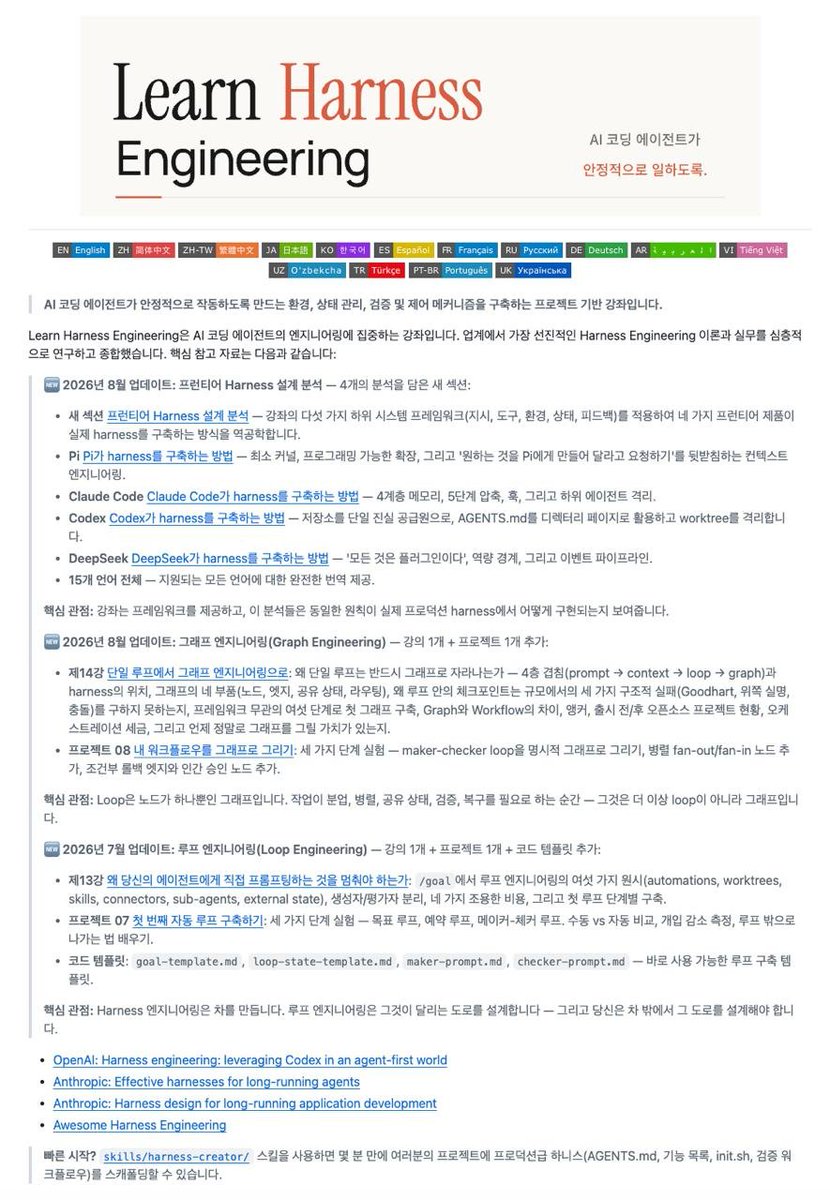
When integrating autonomous AI coding agents such as Codex and Claude Code into real-world software workflows, the primary operational bottleneck is rarely a deficiency in raw model intelligence. Instead, teams consistently encounter task derailment, context loss between sessions, and unverified code regressions. To address these systemic challenges, 'Learn Harness Engineering' has been launched as an open-source, hands-on curriculum focused on constructing closed-loop external control environments (harnesses) that keep coding agents bounded, consistent, and provably verified. The course is publicly available alongside an official Korean localized documentation portal (https://walkinglabs.github.io/learn-harness-engineering/ko/).
Image source: @AI_Caffeine (X)
The Core Philosophy of Harness Engineering and Closed-Loop Systems
Harness engineering moves beyond superficial prompt engineering, focusing on designing and deploying the external architectural scaffolding required for AI coding agents to operate reliably.
An agent's reasoning capability and agency stem directly from foundation model training. However, even the most capable model quickly succumbs to hallucinations, scope creep, or context amnesia without structured external orchestration. If the model is the driver, the harness is the vehicle. Rather than writing code for the agent, the harness establishes a deterministic closed-loop operational environment through:
- Deterministic Boundaries and Guardrails: Restricting unconstrained agent autonomy by enforcing explicit repository rules and directory access limits.
- Executable Feedback Loops: Replacing self-reported agent assertions with verifiable signals from code execution, linters, and automated test runners as inputs for subsequent decisions.
- Persistent State Synchronization: Maintaining structured, filesystem-based state records so that critical context survives session terminations or context window compactions.
14 Lectures and 8 Hands-on Projects: Building the 5 Core Subsystems
The curriculum comprises 14 lectures, 8 hands-on projects, and a comprehensive library of ready-to-use resources. Learners iteratively evolve a single Electron desktop application while directly constructing the 5 core control subsystems:
- Instructions: Explicit progressive disclosure files, such as
AGENTS.mdandCLAUDE.md, that define operational hierarchies, constraints, and sequencing rules. - State Management: Durable tracking artifacts—including
progress.md(orclaude-progress.md),feature_list.json, and git commit history—that persist progress across sessions, allowing fresh agent instances to immediately resume unfinished work. - Verification Systems: Bypassing conversational completion claims by requiring objective verification evidence, such as unit test passes, lint cleanups, type checks, and executable pipeline exit codes.
- Scope Control: Bounding each cycle strictly to a single feature with an unambiguous "Definition of Done," preventing unsolicited refactors or sprawling code changes.
- Session Lifecycle: Standardizing each session across three structured phases—initialization (environment inspection), execution (minimal atomic changes), and cleanup (verification and state updating)—to eliminate loose ends.
These five subsystems operate in tight concert: instructions provide direction, state ensures continuity, verification proves results, scope restricts overreach, and the session lifecycle guarantees clean task completion.
Independent Dual-Agent Reviews, Parallel Execution, and Failure Rollbacks
'Learn Harness Engineering' goes beyond basic rule files to teach advanced agent collaboration patterns encountered in production:
- Dual-Agent Review: Recognizing that authoring agents often exhibit self-verification bias, the workflow decouples implementation from auditing by having a separate, context-isolated review agent independently review and verify the implementation.
- Parallel Workflows and Rollback Gates: When orchestrating concurrent subtasks, defensive rule sets automatically revert repository state to previous git checkpoints or request explicit human approval if automated tests fail.
- Production-Ready Starter Templates: The course provides reusable starter templates for
AGENTS.md, environment setup scripts, progress tracking schemas, and custom skill manifests ready for immediate adoption in production repositories.
Practical Implementation Considerations and Stack Portability
Before adopting harness engineering into production environments, teams should evaluate several technical realities:
- Distinction from Model Intelligence: A harness cannot enhance the foundational reasoning or coding intelligence of an LLM. It serves as an operational safety harness, meaning high-level system architecture and business logic validation remain the core responsibility of human engineers.
- Adapting Beyond the Electron Baseline: Because the primary hands-on exercises center on an Electron desktop app, engineering teams building web full-stack applications (Next.js, Vite) or backend microservices must adjust test runner commands, directory structures, and build scripts to match their specific target stacks.
Sources
- Learn Harness Engineering Official Korean Documentation: walkinglabs.github.io/learn-harness-engineering/ko/
- AI Caffeine Official X Announcement (@AI_Caffeine): Course Introduction and Practical Resource Post