Learn Harness Engineering: Open-Source Guide to AI Coding Agent Environments
An open-source curriculum synthesizing OpenAI and Anthropic research to guide developers through environment design, state management, and verification loops fo
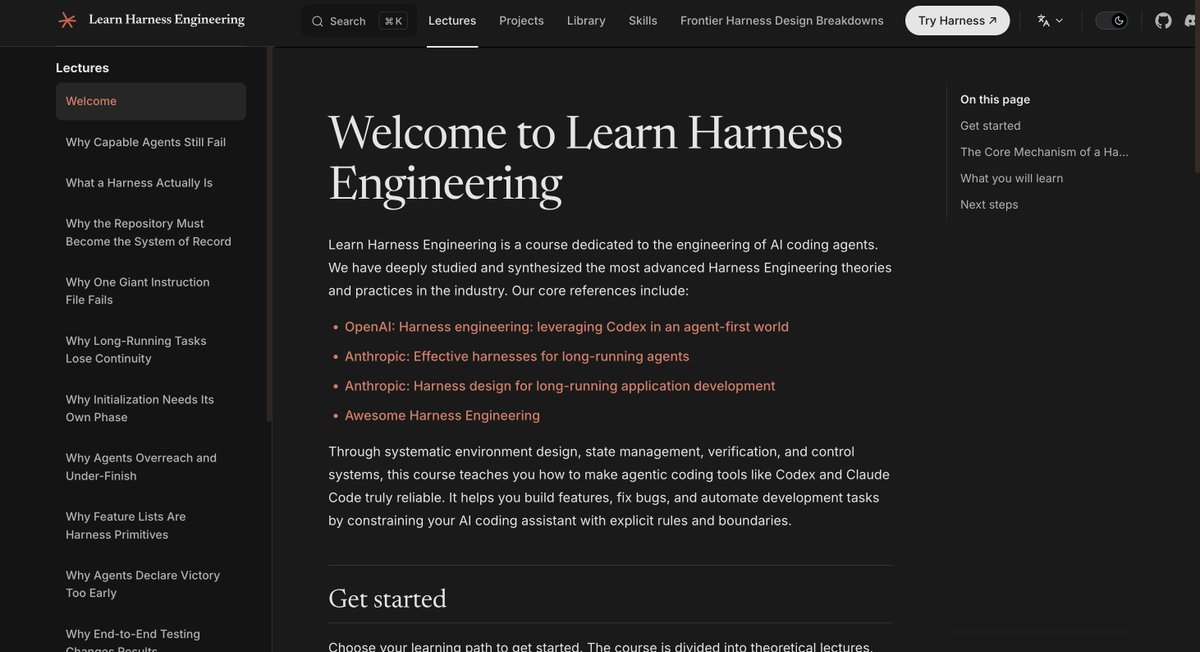
Open-source development group walkinglabs has released 'Learn Harness Engineering', a comprehensive curriculum designed to build reliable runtime environments and verification loops for AI coding agents. Surpassing 14,000 stars on GitHub, this project shifts the engineering focus away from isolated prompt tweaking and toward harness engineering—the systematic design of context initialization, state management, and automated feedback mechanisms that govern agent execution.
Image source: X @khushiirl / walkinglabs
Beyond Prompting: The Core Philosophy of Harness Engineering
As teams deploy autonomous coding agents into real software projects, reliance on single-turn prompt crafting has shown clear limitations in maintaining consistency across multi-step tasks. 'Learn Harness Engineering' addresses this challenge around a central thesis: "The Model Is Smart, The Harness Makes It Reliable."
Harness engineering focuses on architecting the full operational boundary around foundation models. Rather than treating the LLM as an isolated black box, the discipline structures what information an agent receives before execution starts (feedforward context), how errors and drift are intercepted during execution (automated feedback loops), and how workspace invariants persist across separate turns.
The curriculum grounds its principles in leading industry research, synthesizing insights from OpenAI's 'Harness engineering: leveraging Codex in an agent-first world' and 'Unrolling the Codex agent loop', Anthropic's 'Effective harnesses for long-running agents' and 'Harness design for long-running application development', as well as architectural analyses from Martin Fowler (Thoughtworks) and the Cursor team.
Curriculum Structure: 13 Lectures, 7 Hands-On Projects, and Ready Templates
The guide is organized into three distinct tiers that take developers from foundational architecture to applied production workflows:
- 13 Conceptual Lectures: Detailed explorations of harness design principles and five architectural subsystems (L03–L12), covering structured context hierarchies, deterministic gating, and agent evaluation frameworks.
- 7 Hands-On Projects: Practical exercises centered on an Electron application, guiding developers through building an agentic workspace from scratch with layer enforcement, custom linter boundaries, and phase gates.
- Resource Library: A collection of copy-ready repository templates—including
AGENTS.md,feature_list.json, andinit.sh—that ensure every AI session initializes with deterministic project state and instructions.
In addition to documentation, the repository includes the harness-creator skill to scaffold production-grade harness configurations within minutes, alongside audit-harness.sh, a zero-dependency shell audit script that validates existing repositories against all core harness subsystems.
Multilingual Accessibility and Practical Implementation Considerations
To support international adoption, 'Learn Harness Engineering' provides official translations in 15 languages, including English, Korean, Japanese, Simplified and Traditional Chinese, Spanish, German, and French. The entire repository is published under the permissive MIT License.
Developers adopting the guide should note that it functions as an architectural framework and practical template library rather than an all-in-one executable binary or SaaS platform. Effective implementation involves tailoring its starter templates and verification checks to the specific agent toolchain (such as Claude Code, Cursor, or Aider) and existing continuous integration workflows used by each team.
Sources
- GitHub Repository: walkinglabs/learn-harness-engineering
- Documentation Website: Learn Harness Engineering Documentation
- Original Signal: X @khushiirl Post