Laya Released: Open-Source Non-Autoregressive System 1 Decision Model with TypeSafe Jev Compatibility
Laya, an open-source alternative to TypeSafe Jev, delivers non-autoregressive System 1 decision-making without text token generation. Explore its drop-in POST /
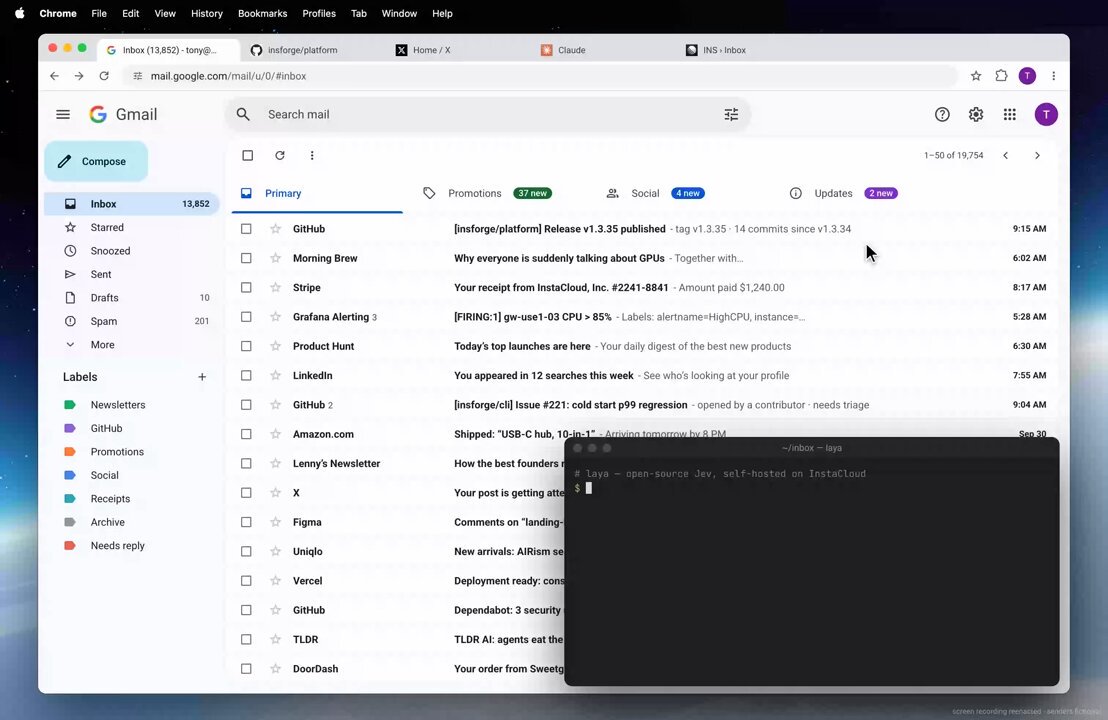
Laya, an open-source (Apache-2.0) non-autoregressive decision model, has been released. Unlike generative Large Language Models (LLMs) that sequentially generate text tokens—often encountering hallucinations and JSON schema parsing failures—Laya evaluates structured questions, options, and scales against input text or JSON documents in a single forward pass, returning calibrated probabilities and confidence scores directly.
Image source: @tonychang430 / Laya
Maintaining full wire-protocol compatibility with TypeSafe's hosted Jev API, Laya allows developers to deploy self-hosted decision endpoints on local machines or private cloud infrastructure by simply updating their base URL environment variable without altering existing SDK integration code.
Non-Autoregressive System 1 Decision Architecture
Laya is purpose-built for classification, routing, and deterministic evaluation tasks rather than prose generation.
- Single Forward Pass Scoring: Taking an input document (such as an email, ticket, or JSON payload) alongside typed questions (multi-choice classification, Likert scale placement, or boolean Yes/No decisions), Laya computes mathematically calibrated probabilities in a single inference pass.
- Zero Parsing Errors and No Hallucinations: Because the model produces direct classification logits rather than generating freeform text strings, it eliminates JSON formatting defects and generative hallucinations at the architectural level.
- Specialized Fine-Tuned Checkpoints: The release includes domain-optimized checkpoints featuring email triage (spam detection, phishing identification, and department routing), conversation trajectory modeling ($TD(\lambda = 1.0)$), and per-cardinality temperature calibration.
This design substantially cuts token expenditures and inference latency compared to invoking large frontier LLMs for routine labeling and routing logic.
TypeSafe Jev Compatibility and Self-Hosting Infrastructure
A key architectural advantage of Laya is its drop-in alignment with the TypeSafe Jev developer ecosystem.
- Drop-in Wire Protocol: Through
laya-serveand theArbiterserving layer, Laya exposes the standardPOST /v1/systemoneHTTP endpoint. Existing applications configured for TypeSafe Jev can switch to self-hosted instances simply by redirecting their client endpoint URL ($BASE_URL). - Flexible Runtimes: The upstream package and community ecosystem provide a native Python CLI (
laya), Docker container images, NixOS modules, and dedicated acceleration recipes for both NVIDIA GPUs and Apple Silicon hardware. - MCP Server for AI Agents: An optional Model Context Protocol (MCP) server enables AI coding agents (such as Claude Code and Codex) to query Laya as a local micro-decision tool.
- Cost Efficiency: Compared to hosted API tiers ($0.05 per 1M input tokens), self-hosting Laya offers unlimited decision throughput on local or enterprise hardware at zero incremental API cost.
Practical Workflows and Hardware Benchmarks
Developers and practitioners have begun sharing empirical verification benchmarks across real-world data workloads.
In a recent demonstration, developer Tony Chang (@tonychang430) showcased a self-hosted Laya deployment connected via email APIs to categorize and label over 13,000 inbox messages into organized folders. While operational throughput in production depends heavily on API batching strategies and local caching layers, Laya exhibits robust performance even on consumer hardware.
Community benchmarks report that on an M3 MacBook Air, a 322M parameter Laya checkpoint processed 1,000 emails locally in 28.6 seconds with zero swap memory usage (0 MB Swap) and achieved 65.1% accuracy against reference baseline labels without relying on cloud infrastructure.
For system engineers and AI developers looking to offload high-volume classification, guardrails, and agent routing from costly LLMs, Laya represents a practical, reproducible open-source building block.
Sources
- Hugging Face Model Repository: convaiinnovations/laya
- Self-Hosting Guide: Laya AI Self-Host Guide
- Serving Documentation: Serve Laya as a Local API with Arbiter
- Source Social Signal: Tony Chang (@tonychang430) Post on X