jevgrep: Semantic Code Search CLI for Coding Agents Powered by Jev
jevgrep (jg) is an open-source CLI that uses TypeSafe AI's Jev decision model to locate repository code and extract verbatim snippets from natural-language desc
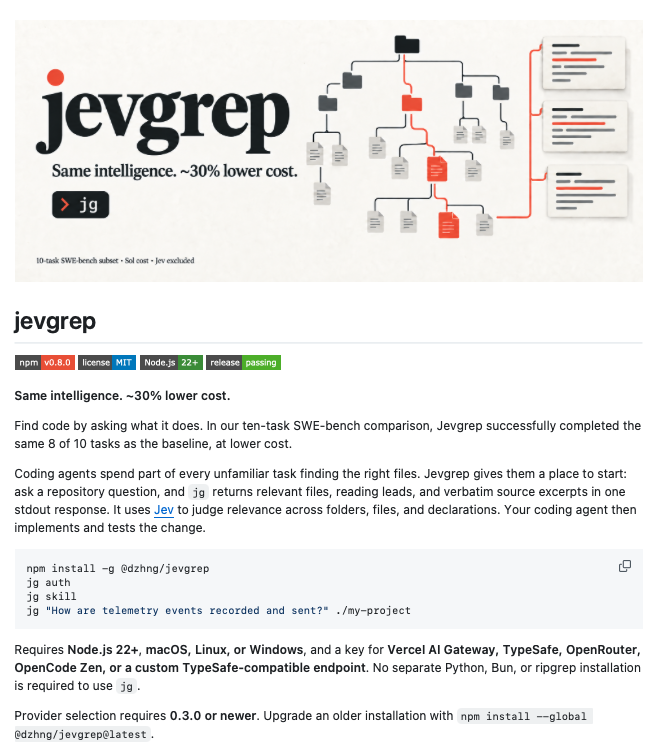
Open-source CLI tool jevgrep (command jg), created by developer dzhng, utilizes TypeSafe AI's System One decision model Jev as a search evaluation engine, allowing developers and coding agents to locate relevant code and verbatim snippets across a repository using natural-language behavioral descriptions rather than exact symbol names or known file paths.
Image source: X @Sumanth_077
The tool directly addresses a major bottleneck for AI coding agents: the substantial context and token overhead spent opening and reading dozens of unfamiliar files during initial exploration of large codebases.
Live Semantic Code Search Without Precomputed Vector Indexes
The defining characteristic of jevgrep is that it operates without vector databases, precomputed embedding caches, or background daemons.
Traditional semantic search tools typically require chunking the entire repository in advance, computing embeddings, and storing them in a local vector database, often leading to stale indexes and synchronization drift as code changes. In contrast, jevgrep directly navigates the live repository tree and evaluates relevance on the fly.
- On-Demand Structure Evaluation: The tool evaluates directory structures, file previews, and function or class declarations along relevant branch paths.
- Verbatim Excerpt Retrieval: Rather than returning a bare list of filenames,
jevgrepprints exact file paths, line number ranges, and the verbatim source excerpts directly to standard output. - Single-Pass Non-Autoregressive Judgments: By querying TypeSafe AI's lightweight decision model Jev, candidate code snippets are evaluated in single non-autoregressive passes, delivering fast and responsive search results.
Users and agents can execute queries such as jg --all "where are expired CLI tokens rejected?" apps/web in the terminal to immediately identify the exact file location, line range, and implementation logic responsible for token validation.
Automated Coding Agent Integration and 28.6% Cost Reduction on SWE-bench
jevgrep is designed from the ground up for seamless interoperability with autonomous coding agents such as Claude Code, Codex, and OpenCode, in addition to standalone human developer use.
Running the built-in jg skill command detects the agent running in the current workspace and installs a dedicated agent skill manifest. This skill teaches the agent when to invoke jg during unfamiliar tasks and how to interpret returned excerpts.
- Clear Separation of Concerns:
jevgrephandles repository-level search and snippet extraction, while the primary coding agent reads the returned source context, plans changes, modifies files, and executes test suites. - Measured Exploration Cost Reduction: In a reported 10-task SWE-bench test run, both
jevgrepand the no-Jev baseline solved 8/10 tasks, while coding-agent API costs (excluding Jev inference costs) dropped from $7.62 to $5.44—an approximate 28.6% cost reduction achieved by narrowing down the files the agent needed to inspect.
Environment, Provider Setup, and Practical Considerations
Released as an open-source project under the MIT license, jevgrep runs on Node.js 22 and above across macOS and Linux environments.
- Runtime Environment and Target Projects: Built for Node.js 22+ environments on macOS and Linux, evaluating directory hierarchies and function/declaration structures in codebases such as TypeScript/JavaScript.
- Inference Providers: The
jg authcommand supports direct credentials for TypeSafe AI as well as routing through OpenRouter and Vercel AI Gateway.
When integrating jevgrep into production agent workflows, several practical considerations apply:
- Complementary Use with Exact String Search: When exact function names, error strings, or identifiers are already known, traditional text search utilities like
ripgrep(rg) remain faster and more deterministic. - Semantic Relevance vs. Call-Graph Verification: Semantic matches reflect textual and behavioral similarity but do not guarantee that the identified snippet is the active codepath in a complex execution graph. Agents should verify surrounding context and call hierarchies before making edits.
- Source Code Transmission and Privacy: Because evaluated code fragments are sent to the configured remote inference provider, teams should ensure proper
.gitignoreand--excluderules are in place to prevent leaking sensitive secrets or unwanted directory trees.
Sources
- GitHub Repository: dzhng/jevgrep
- X (@Sumanth_077): jevgrep Announcement and Demo