AI's 'Internet Moment': A Guide to Using Jev, a Decision Engine Up to 193x Faster and 444x Cheaper
In the era of Claude Fable 5.1 and GPT-6 Astra, Jev offers an agent architecture that separates intelligence from execution, boosting decision speed through a 1
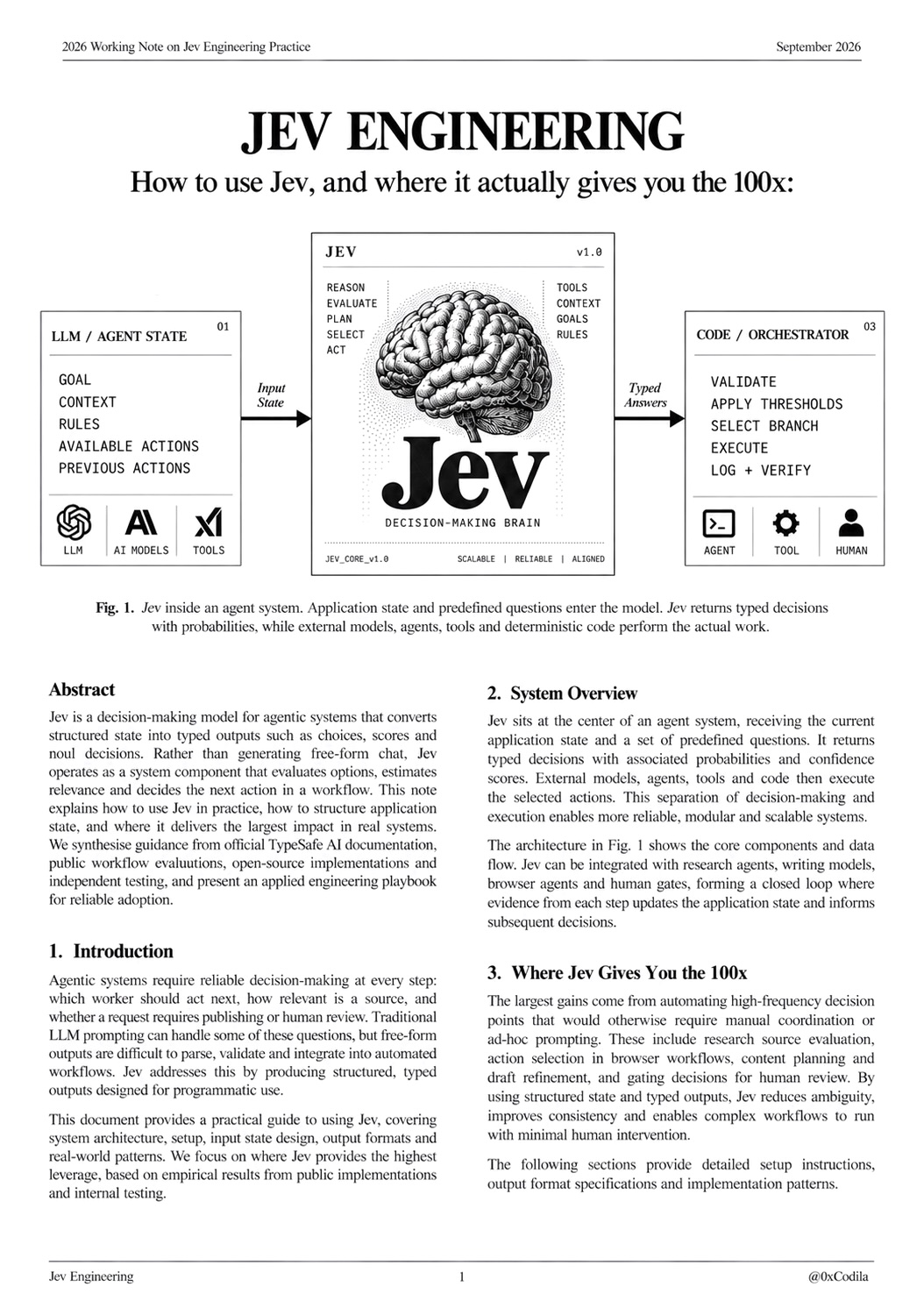
Jev, shared by @0xCodila, fundamentally redefines how AI agents make decisions. Tests in environments like Claude Fable 5.1 and GPT-6 Astra indicate it can be up to 193x faster and 444x cheaper than traditional methods.
The Core Principle: Separating Intelligence from Execution
Jev clarifies the structure of agent workflows by separating 'intelligence'—where the LLM writes the plan—from 'execution,' where the agent acts, with Jev deciding the next move. This architecture is designed to optimize complex agent workflows.
The key approach involves transforming every fork in an agent's path into three primitives:
- Choice: Selects one route.
- Score: Measures a defined scale.
- Noul: Returns the probability of a "yes."
A 10-Step Strategy for Architecting Efficient Agents
@0xCodila’s 10-step strategy for leveraging Jev is as follows:
- Meet Jev: Understand the structure where the LLM plans, the agent acts, and Jev chooses the route.
- Define Primitives: Transform every agent fork into Choice, Score, and Noul primitives.
- Setup for Jev: Use official adapters for OpenAI, Anthropic, or xAI to integrate Jev without rebuilding the underlying graph.
- Initial Setup: Initialize Jev by setting one state, three parallel decisions, and risk-based thresholds.
- Batch Decisions: Use batch processing instead of serial execution to maximize speed and cost efficiency.
- Strategic Placement:
- Benchmarking: Measure performance in tasks like browser use or mobile actions.
- Scope Optimization: Reduce unnecessary skill loading and improve precision through Jev.
- System Patterns: Design systems in the order of State → Question → Action → Verification.
- Limit Application: Use Jev for structural decision branches rather than math or complex writing tasks.
Practical Benchmarks and Performance Results
Tests showed that batching 13 questions at once was 10x faster and 12.2x cheaper than serial execution. Browser Use reached Google Flights in 7.1 seconds, and Hermes skill load errors dropped from 16.8% to 7.3%, demonstrating significant performance improvements.