image-blaster: Open-Source Claude Code Toolkit for Generating Explorable 3D Worlds and Assets from a Single Image
An overview of 'image-blaster', an MIT-licensed Claude Code toolkit that orchestrates World Labs Marble 1.1, Tencent Hunyuan 3D, and ElevenLabs SFX to transform
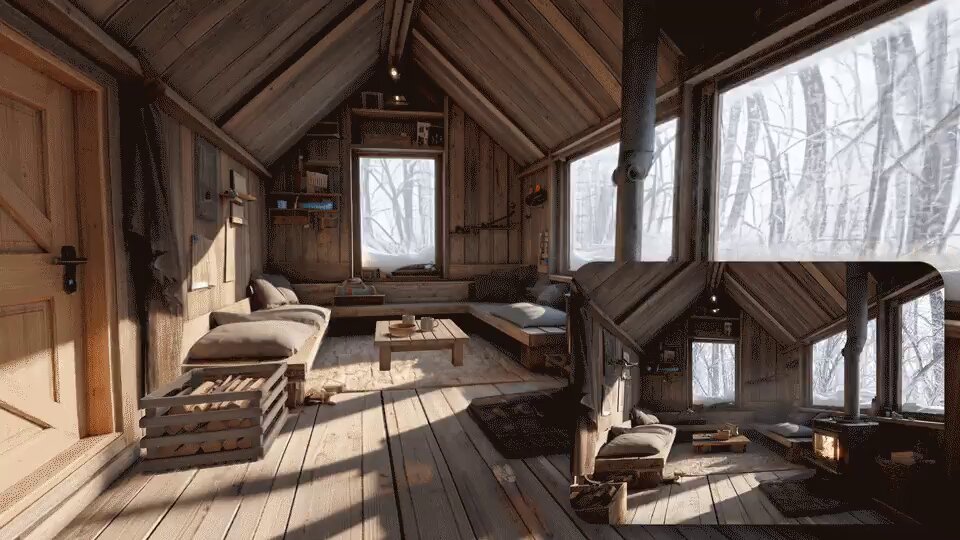
Neilson Koerner-Safrata from the World Labs design team has released 'image-blaster' (neilsonnn/image-blaster), an open-source 3D scene prototyping toolkit that converts a single 2D photograph into an explorable 3D Gaussian splat environment, isolated 3D object meshes, and synchronized spatial audio in under five minutes. Distributed under the permissive MIT license, the project leverages Claude Code's agentic Skills framework as an orchestration layer to coordinate multiple commercial generative AI models into a unified local workflow.
Image source: @lucian__03 / X
While traditional image-to-3D tools have typically focused on extracting isolated single-object meshes (.glb) or producing non-interactive depth estimations, image-blaster approaches the problem from a comprehensive scene level. By decomposing a single photograph into static background spaces, interactive dynamic props, and matching ambient soundscapes, it generates a complete asset bundle ready for immediate drag-and-drop integration into major game engines and digital content creation (DCC) software suites.
Multi-Model Orchestration: Transforming a Single Image into Scene, Meshes, and Audio
At the architectural core of image-blaster is a sequential multi-model pipeline orchestrated entirely through Claude Code. When a user supplies an input image, the system coordinates specialized generative APIs in four synchronized stages:
- Dynamic Object Segmentation and Clean Plate Generation (Nano Banana / GPT Image 2): The pipeline identifies rigid, movable items within the scene—such as chairs, baskets, lamps, and tabletop objects. It separates these elements from the background plate and in-paints the occluded areas to construct a clean, unobstructed static plate.
- Static Gaussian Splat Reconstruction (World Labs Marble 1.1): Utilizing the in-painted background plate, World Labs' Marble 1.1 model reconstructs the full 3D spatial geometry as an explorable 3D Gaussian Splat (.spz file), allowing camera movement and viewpoint exploration without flat projection distortion.
- Standalone 3D Mesh Extraction (Tencent Hunyuan 3D via FAL): Each segmented dynamic object is passed to Tencent's Hunyuan 3D model hosted on FAL, outputting fully textured 3D meshes (.glb and .obj). Rather than remaining planar decals, these objects exist as standalone assets that can be freely repositioned or simulated.
- Ambient and Physics Audio Synthesis (ElevenLabs SFX): To complete scene immersion, ElevenLabs SFX generates a looping ambient background track and distinct physics-triggered impact and interaction sound effects (.mp3).
The entire pipeline executes through Claude Code via a simple natural language prompt: blast it and confirm each step with me, ensuring the developer retains step-by-step confirmation over segmentation boundaries and asset generation.
Granular Hunyuan 3D Mesh Controls and Cross-Engine Compatibility
For the object generation phase, image-blaster exposes granular command-line arguments to tune Tencent Hunyuan 3D's output to project requirements:
- Target Face Count (
--face-count): Developers can specify mesh resolution between 40,000 and 1,500,000 faces. While the upstream Hunyuan API defaults to 500,000 faces, image-blaster defaults to 50,000 faces for optimal runtime and real-time engine performance. - PBR Material Generation (
--enable-pbr): Physically Based Rendering (PBR) texture generation is enabled by default (true), ensuring consistent lighting response across different rendering viewports. - Mesh Styling Presets (
--generate-type): Users can toggle between fully textured models (Normal), polygon-reduced meshes (LowPoly), and untextured structural geometry (Geometry). In LowPoly mode, the--polygon-typeflag can be set to eithertriangleorquadrilateral.
The resulting files (.spz Gaussian splats, .glb and .obj meshes, and .mp3 audio) adhere to industry-standard specifications, enabling immediate import without manual conversion across:
- Game Engines: Unity, Unreal Engine, Godot
- DCC Suites: Blender, Autodesk Maya, 3ds Max
- Web and Desktop Runtimes: Three.js web applications and Electron runtimes
Installation Workflow, Target Use Cases, and Practical Constraints
Setting up image-blaster requires cloning the repository and launching Claude Code:
# Clone the repository and navigate into the directory
git clone https://github.com/neilsonnn/image-blaster
cd image-blaster

# Launch Claude Code (if not installed: curl -fsSL https://claude.ai/install.sh | bash)
claude
Once running, provide your personal API keys for World Labs, FAL, and ElevenLabs. Place the target photograph into the input/ directory and instruct Claude Code to begin processing.
Before deploying the tool into production pipelines, developers should account for key practical and technical constraints:
- Commercial API Consumption Costs: While the image-blaster codebase is open-source and free, the underlying generation APIs (World Labs Marble, FAL, and ElevenLabs) require paid commercial API credits. A full scene conversion typically costs between $2.00 and $4.00 per processed image.
- Single-View Reconstruction Hallucinations: Because reconstruction relies on a single 2D viewpoint, unobserved angles, hidden object backsides, and complex outdoor topologies depend on model interpolation. Geometric hallucinations and surface blurring can occur in occluded or distant areas.
- Recommended Production Scope: The toolkit is best suited for rapid scene blockout, concept prototyping for indie game developers, virtual location scouting, and early architectural pre-visualization. It functions as a high-speed draft generator rather than a replacement for final production-ready hero assets.
Sources
- GitHub Repository: neilsonnn/image-blaster
- World Labs Showcase: Image Blaster | Community Showcase
- Original Post (X @lucian__03): Post on X