Hermes Agent /blueprint: Interactive Cron Automation Powered by 16 Built-in Templates
Automation Blueprints in NousResearch's Hermes Agent enables creators and developers to schedule recurring tasks—such as morning briefings, email monitoring, an
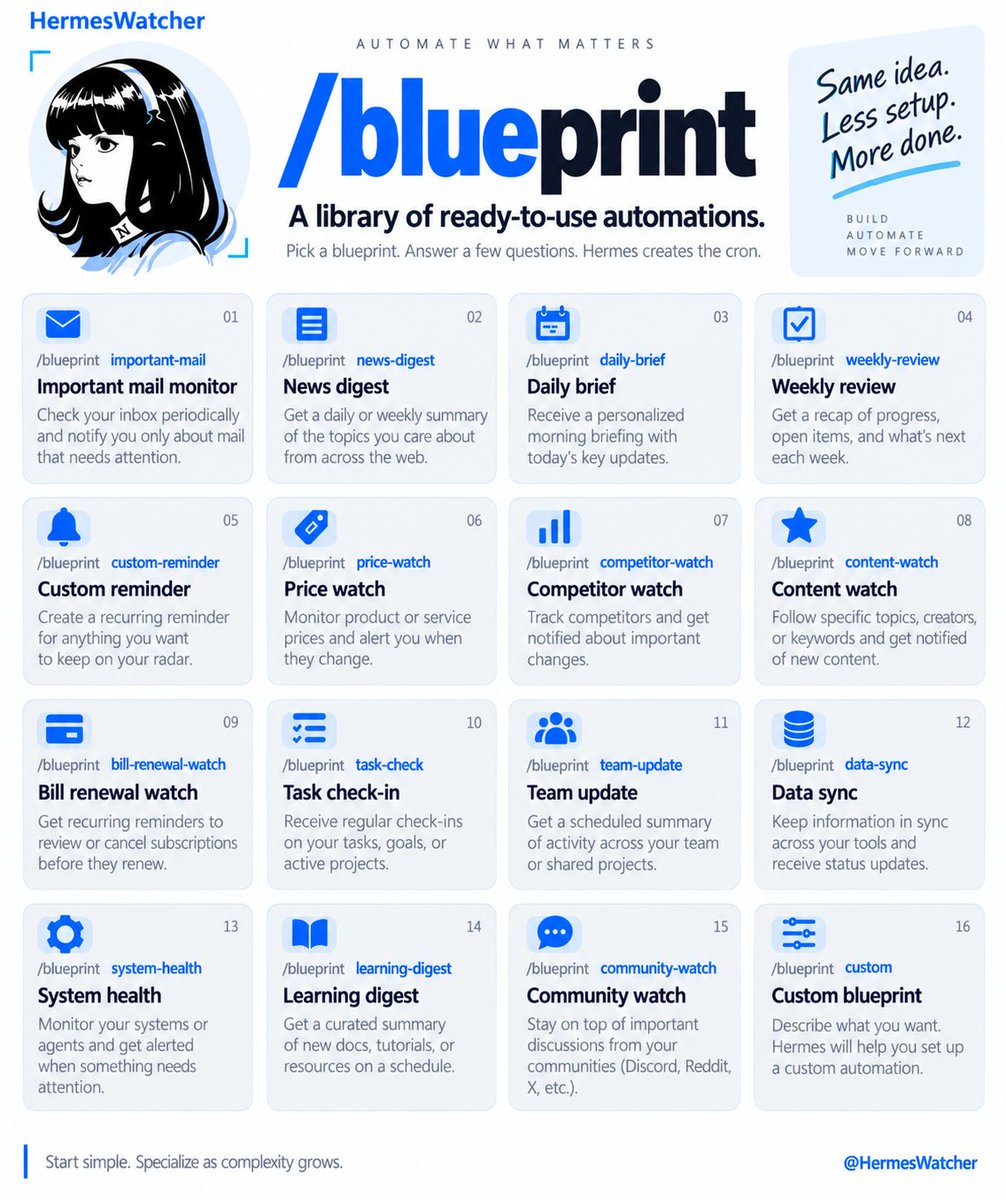
NousResearch's open-source AI agent framework, Hermes Agent, officially supports 'Automation Blueprints', a streamlined automation framework designed to schedule recurring routines without requiring manual Cron expressions. By invoking the /blueprint command (or its shorthand /bp) in a terminal or messenger environment, users can configure and schedule 16 curated built-in templates through guided conversational prompts or inline parameter inputs.
Image source: Hermes Release Watch (@HermesWatcher)
Previously, delegating periodic tasks to an AI agent required manually crafting complex Cron expressions (0 8 * * *) and writing comprehensive standalone task prompts from scratch. Blueprints eliminate this setup overhead by packaging recurring automation workflows into standardized, parameterized templates across all supported interfaces.
16 Built-in Blueprints and Multi-Surface Conversational Scheduling
The Hermes Agent blueprint catalog provides 16 ready-to-run templates spanning daily routines, intelligence gathering, and operational tracking:
- Work & Communication: Important mail monitoring, weekly retrospectives and reviews
- Intelligence & Briefings: Morning briefings, custom news digests, competitor activity monitoring
- Tracking & Lifestyle: Real-time price watches, personalized meal planning, daily structured learning
Users can choose from several configuration workflows depending on their preferred interface:
- Interactive Q&A Mode (CLI, TUI, Messengers): In the terminal or connected chat platforms (such as Discord or Telegram), typing
/blueprint morning-briefprompts the agent to ask for required parameters step-by-step—such as schedule timing, topic filters, and delivery destinations. The command parser features forgiving name resolution, automatically matching prefixes and near-spellings. - Power-User Inline Mode: Users familiar with the schema can bypass conversational prompts entirely by supplying slot values directly:
/blueprint morning-brief time=08:00. - Dashboard & Desktop Application: In the web dashboard or desktop app, users can navigate to the Cron page's Blueprints tab to fill out an intuitive form and click 'Schedule it', or click 'Send to App' from the documentation catalog to pre-load the command directly into the composer.
Unified Job Engine Architecture and Skills Hub Integration
Under the hood, Automation Blueprints avoid introducing an ad-hoc job engine or secondary scheduler, directly utilizing Hermes Agent's proven core infrastructure.
Every entry path—whether initiated from a dashboard form, a CLI inline slot, or an interactive chat session—converges on the identical internal backend call: cron.jobs.create_job.
Architecturally, blueprints are not a separate object type. Instead, they are standard skill objects (SKILL.md) augmented with automation scheduling metadata in their YAML frontmatter (metadata.hermes.blueprint). When a skill defines fields such as schedule, deliver, and prompt, the system recognizes it as an active, schedulable automation blueprint.
metadata:
  hermes:
    blueprint:
      schedule: "0 9 * * *"
      deliver: origin
      prompt: "Summarize top daily AI news and send to origin channel"
      no_agent: false
By leveraging this design, blueprints seamlessly inherit the full Skills Hub ecosystem. Capabilities such as catalog search, community taps, sandboxed quarantine inspection, security scans, installation tracking, lock-file provenance verification, and audit logging work out of the box. The underlying schema in cron/blueprint_catalog.py acts as the single source of truth, enforcing typed slots for time (time), enums (enum), plain text (text), and recurring days (weekdays).
Isolated Execution Context and Environment Prerequisites
To ensure reliable recurring execution, developers should note key operational characteristics:
- Stateless Isolated Execution: Scheduled Cron tasks run inside freshly spawned, isolated sessions without access to prior conversation history or ephemeral chat context. As a result, blueprint prompts and slot values must be entirely self-contained.
- Tooling & Permission Prerequisites: Operations requiring external capabilities—such as web search queries, API calls, mailbox inspection, or outbound chat notifications—require corresponding skills, MCP plugins, API keys, and channel permissions to be configured in Hermes Agent prior to execution.
Sources
- Hermes Agent Official Documentation: Automation Blueprints Catalog
- Hermes Release Watch Official X (@HermesWatcher): Automation Blueprints Announcement