Heretic: Open-Source LLM Modification Without Fine-Tuning via Mathematical Ablation
Heretic enables developers to eliminate model refusals, suppress slop, and reduce sycophancy on consumer GPUs using weight ablation and Bayesian optimization wi
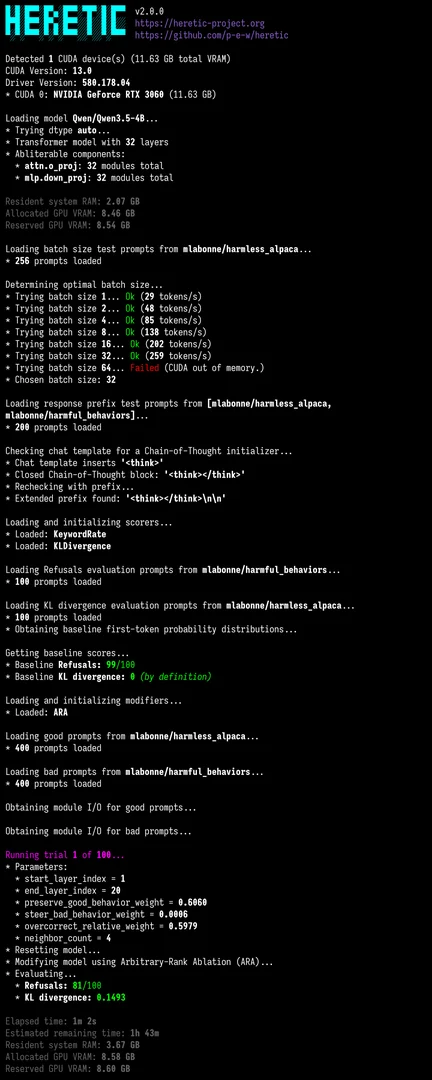
Modifying a large language model's refusal guardrails, excessive boilerplate (slop), or uncritical sycophancy typically demanded post-training fine-tuning using massive curated datasets across expensive GPU clusters. Heretic is an open-source command-line tool that eliminates that compute barrier. Instead of performing traditional backpropagation training, it uses mathematical weight ablation and Bayesian hyperparameter search to directly steer model weights on a standard consumer desktop PC.
Image source: p-e-w/heretic (GitHub README)
With over 40,000 GitHub stars and 4,600 forks, Heretic has become a benchmark utility among local model builders and AI alignment researchers. Released under the GNU AGPLv3 license, the project issued its latest stable update, v2.1.0, on November 8, 2026.
Modifying Models Without Retraining: Abliteration and ARA
Traditional supervised fine-tuning updates neural network weights across multiple epochs to shape output styles. While flexible, this process risks catastrophic forgetting, where modifying refusal patterns accidentally degrades reasoning, coding, or mathematical accuracy. Fine-tuning also requires substantial GPU memory and clean dataset curation.
Heretic bypasses training altogether by applying surgical weight modifications (Modifiers) directly to transformer attention and feed-forward layers.
- Directional Ablation (Abliteration): Based on research pioneered by Arditi et al. in 2024, this method measures hidden layer activations when a model processes harmful versus harmless prompts. By calculating the mean difference vector—the direction representing refusal behavior—the algorithm performs orthogonal projection to ablate this specific directional component from the weights. Heretic supports advanced variants including projected abliteration and norm preservation (MPOA) across layer weight kernels.
- Arbitrary-Rank Ablation (ARA): Developed specifically for Heretic as its default modifier, ARA expands beyond single-direction subtraction. It isolates and dampens multidimensional refusal subspaces, preserving higher baseline task accuracy on downstream benchmarks.
To balance refusal suppression against linguistic coherence, Heretic integrates an Optuna-powered Tree-structured Parzen Estimator (TPE). The optimizer searches hyperparameter spaces across model layers to co-optimize two primary objective functions: minimizing the keyword refusal rate while constraining Kullback-Leibler (KL) divergence, ensuring the ablated model does not drift into gibberish.
From Uncensoring to Slop and Sycophancy Reduction
While Heretic's default profile focuses on refusal suppression (uncensoring), its modular configuration system supports a wide range of behavioral steering targets via simple TOML config files.
Users can activate prebuilt profiles by placing a config.toml in the working directory or pointing the HERETIC_CONFIG_FILE environment variable to a specific file:
- Refusal Suppression (
config.default.toml): Removes default pre-training guardrails so the model directly answers queries without moralizing preambles. - Slop Suppression (
config.noslop.toml): Penalizes generic AI filler expressions, clichéd intros ("Certainly! Here is..."), and repetitive conversational padding. - Sycophancy Reduction (
config.nosyco.toml): Discourages the model from blindly agreeing with erroneous or biased assertions introduced by the user. - Tone and Length Control (
config.terse.toml,config.emotions.toml,config.nohumor.toml): Enforces compact responses, modifies emotional resonance, or curtails conversational humor for enterprise utility pipelines.
Developers can also extend functionality via custom Python scorer plugins by inheriting from the Scorer base class, allowing domain-specific loss objectives without altering Heretic's core codebase.
Setup and Execution on Consumer GPUs
Heretic runs on systems with Python 3.10+ and PyTorch 2.6+. Installation is handled directly via PyPI:
pip install -U heretic-llm
heretic Qwen/Qwen3-4B-Instruct-2507
Upon launching, Heretic benchmarks system memory bandwidth and VRAM to calculate the optimal batch size for the target hardware. On a single NVIDIA GeForce RTX 3090 (24GB VRAM), processing a model like Qwen3-4B-Instruct-2507 under default settings takes roughly 30 to 40 minutes.
For hardware with tighter memory constraints, Heretic integrates on-the-fly 4-bit model quantization powered by bitsandbytes. Setting quantization = "bnb_4bit" lowers execution VRAM overhead to that of running standard quantized weights, with only a minor accuracy penalty during optimization.
When processing completes, an interactive terminal menu provides options to save the weights locally, push them directly to Hugging Face, start an interactive test chat session, or launch automated evaluation suites on MMLU and GSM8K benchmarks.
Deterministic Reproducibility with Manifest Files
A notable technical feature of Heretic is its reproducible model architecture. Distributing modified models often requires re-uploading tens of gigabytes of floating-point weights. Heretic solves this with lightweight metadata manifests.
When uploading models to Hugging Face, Heretic can bundle a reproduce/ directory containing human-readable instructions and a ~9KB machine-readable reproduce.json manifest. Users with access to the original base model can reconstruct an identical byte-for-byte modified model locally:
heretic --reproduce path/to/reproduce.json
Because PyTorch operations can vary across CUDA environments and kernel drivers, Heretic inspects local software stacks, driver versions, and seeds during reproduction, alerting users to any discrepancies before executing the reconstruction pass.
Limitations and Migration Notes
Before deploying Heretic in production pipelines, teams should note several operational boundaries:
First, configuration files written for Heretic 1.x are incompatible with Heretic 2.x releases. Users upgrading from earlier versions must update their configuration structures following docs/migration_v1_to_v2.md.
Second, Heretic currently permits only a single modifier implementation (either ARA or directional ablation) per run. Chaining multiple modifier passes requires saving intermediate checkpoints between executions.
By eliminating multi-thousand-dollar training clusters from model alignment workflows, Heretic establishes a practical, accessible path for engineers to customize foundation models locally.
Sources
- GitHub Repository: p-e-w/heretic