Herald OS Open-Sourced: AI Operating System Embedding Hermes Agent
Herald OS has been open-sourced, embedding Nous Research's Hermes Agent directly into the OS layer. We examine its voice control, screen selection querying, sta
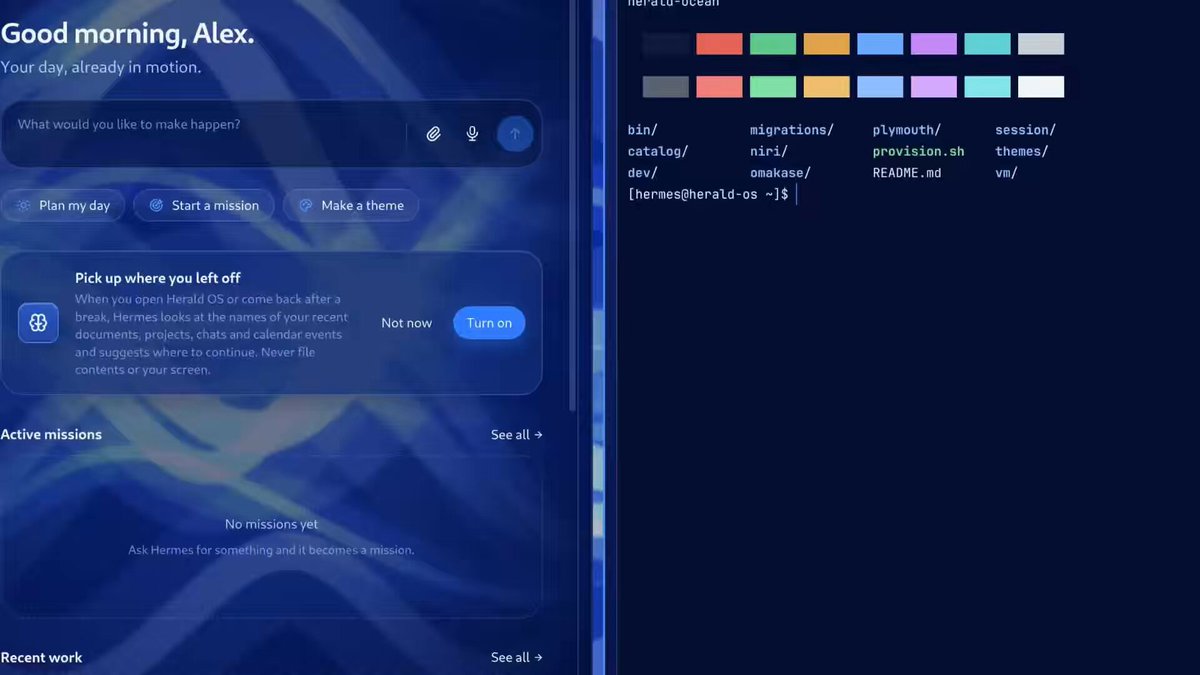
Independent developer Luke The Dev (@iamlukethedev) has open-sourced Herald OS, an AI operating system environment that integrates Nous Research's Hermes Agent directly into the operating system layer. Announced on social media on October 7, 2026, Herald OS departs from traditional standalone chat widgets and floating overlays, embedding conversational agent capabilities across the computer to allow users to interact with their system through voice and on-screen selection.
Image source: Luke The Dev (@iamlukethedev) via X
Conventional desktop AI assistants typically operate within isolated browser tabs or desktop chat windows, remaining disconnected from the active desktop workflow. Herald OS addresses this division by making the autonomous agent a built-in part of the desktop operating system environment.
'Hey Hermes' Voice Control and Native OS Integration
The core design principle of Herald OS is positioning the AI agent as a fundamental system interface rather than a disconnected third-party application.
The environment utilizes Nous Research's open-source Hermes Agent framework as its underlying engine. Users can communicate with their computer hands-free using voice recognition alongside standard keyboard input.
- 'Hey Hermes' Wake Phrase: Saying "Hey Hermes" activates the agent, allowing users to talk directly to their computer and issue instructions. This builds upon the on-device wake-word detection and real-time voice pipeline introduced in Nous Research's Hermes Agent v0.20 ("The Herald Release").
- OS-Level Agent Coupling: The agent is integrated directly into the system environment, enabling continuous interaction without needing to open and manage external chat applications.
Screen Selection Querying
Herald OS provides native visual interaction capabilities designed to support everyday desktop tasks.
- Arbitrary Screen Selection and Querying: Users can select and highlight any portion of their display to immediately ask Hermes questions about the visible content.
- Workflow Context Preservation: Rather than manually capturing, saving, and uploading screenshots to an external chat interface, users can query active visual context directly on screen.
- Local Model Compatibility: Community developers have highlighted the potential of pairing Herald OS with local model runtimes alongside cloud endpoints for private, on-device computing.
Multi-Platform Deployment: Mac App, Full Linux OS, Arch, and Omarchy
Herald OS is distributed across several packaging and deployment targets to support diverse computing setups:
- Mac App: Available as a dedicated application for macOS users.
- Full Linux OS: Offered as a complete standalone Linux operating system with Hermes Agent integrated at the system level.
- Arch Linux Package: Packaged natively for users running Arch Linux distributions.
- Omarchy Integration: Designed to operate inside the Omarchy desktop and window-management environment.
Creator Luke The Dev (@iamlukethedev) noted that Herald OS represents one of his most significant projects to date, following his earlier Herald Mobile App. As an independent community project rather than an official Nous Research release, Herald OS illustrates the growing movement toward embedding autonomous agents directly into operating systems.
Sources
- Luke The Dev (@iamlukethedev) Announcement Post on X: https://x.com/iamlukethedev/status/2107765448343261506
- witcheer (@witcheer) Spotlight Post on X: https://x.com/witcheer/status/2107768823168528634
- Nous Research Hermes Agent Official Repository: https://github.com/NousResearch/hermes-agent
- Hermes Agent Official Documentation: https://hermes-agent.nousresearch.com/