Grok Bot New Guides Workflow: Auditing and Optimizing Agent Setups with Your Main Bot
A practical guide to using xAI's new Grok Bot guides (x.ai/bot/guides): feed the documentation to your main bot to audit existing agent configurations and extra
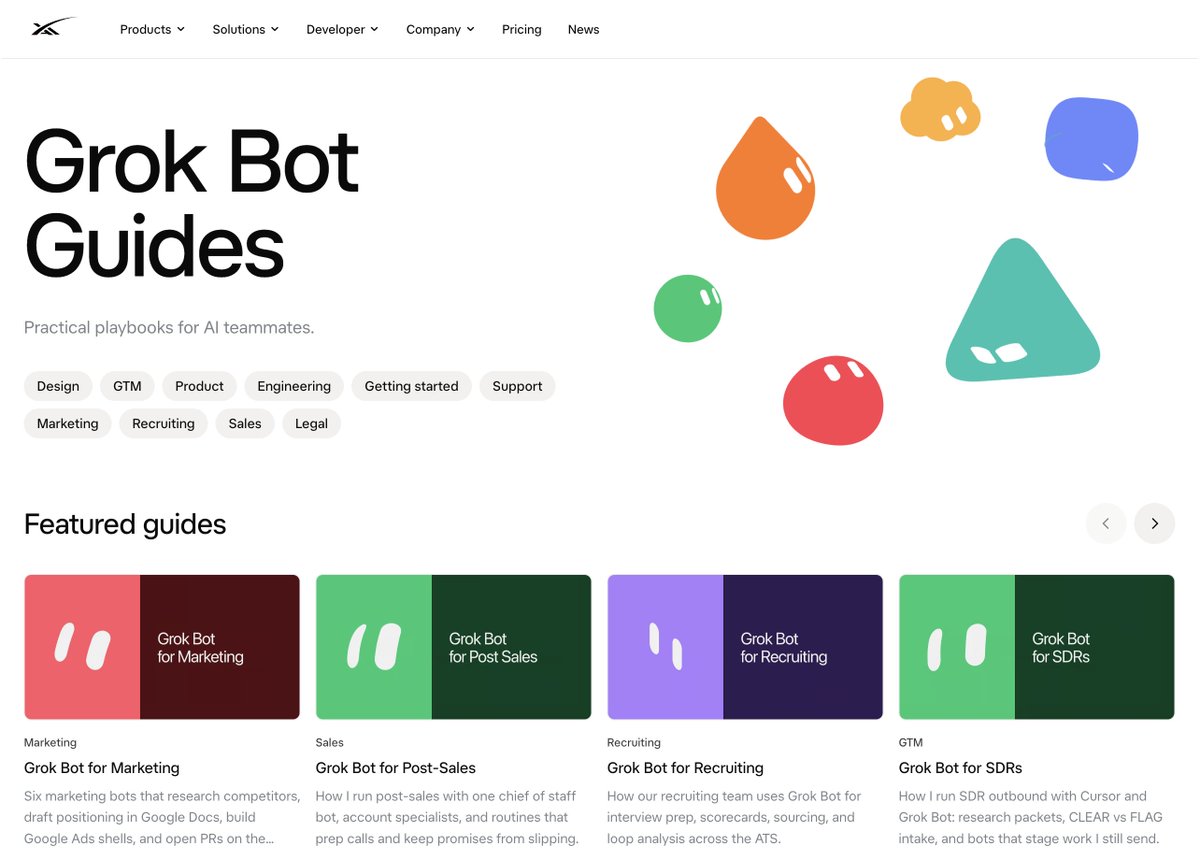
Ben Lang (@benln) shared a practical workflow tip following the release of xAI's official Grok Bot documentation: instead of manually rewriting prompts, instruct your primary agent to read through the new guides and recommend best practices to optimize existing bot configurations.
Image source: Ben Lang (@benln) / x.ai
Direct URL Injection for Automated Agent Auditing
xAI published a set of official Grok Bot guides (x.ai/bot/guides) detailing architectures, implementation workflows, and best practices across key domains including Engineering, Customer Support, Go-To-Market (GTM), Product Management, and Design.
When official architectural documentation updates, developers typically spend hours reading through new materials and manually editing active system prompts. Ben Lang demonstrated an inverted workflow: feeding the official documentation URL directly into the conversation with your primary agent (@bot) and instructing it to "go through the new guides and recommend best practices for your Bots."
Given this directive, the main bot parses xAI's documentation guidelines and reviews existing bot setups to suggest relevant best practices and optimizations. Builders across the community, including Nathan (@NathanBrassard), verified that no complex meta-prompting was required—simply passing the link to the post without additional instructions prompted the bot to synthesize the material and provide actionable recommendations.
Multi-Bot Cross-Review and Agent Sprawl Reduction
Builders managing multi-agent setups expanded on this technique by orchestrating cross-agent consensus reviews.
Geoffrey Hibshman (@geoffreyh1219) assigned the new guides independently to both his primary Chief agent and specialized domain bots (such as poteto's eggbot). He directed them to cross-examine their individual reviews collaboratively and submit a unified synthesis highlighting points of agreement and divergence. This multi-agent debate surfaced architectural nuances and optimizations that had previously gone unnoticed in single-prompt evaluations.
Automated audits also reveal structural redundancies. As Humayun (@humayun_x) observed after prompting his bot for architectural feedback, the very first best practice it recommended was "fewer bots"—consolidating fragmented single-purpose bots into a leaner, more coherent agent setup. Other builders have integrated this pattern into broader automated pipelines, such as using dedicated librarian bots to parse bookmarked documentation links sent via email and prepare them for crew integration (Lunch Trey, @LunchTrey0).
Token Consumption and Rate Limit Considerations
While instructing a bot to audit itself against external documentation automates complex maintenance, practitioners must account for context window consumption and platform rate limits.
Ingesting external documentation and coordinating multiple bots can quickly run up against platform quotas and rate limits. For instance, Mike Mickelson (@xMikeMickelson) noted that he could not test the prompt because his account was already locked behind a two-day rate limit, while babyUFO (@orchideric) highlighted the steep token burn of active bot usage, noting that an entire week's token allotment can be consumed in a single day under heavy workloads.
To avoid hitting quota walls or rate limit lockouts, practitioners should check their available token reserves before running multi-agent workflows, and consider scoping audits to specific sections—such as Engineering or Customer Support—rather than triggering broad, unconstrained documentation crawls.
Original source
- Ben Lang on X: https://x.com/benln/status/2107472129960575369
- xAI Grok Bot Guides: https://x.ai/bot/guides