Google DeepMind Demonstrates Autonomous Multi-Agent Minecraft Completion with Four Gemini 4 Argon Agents
Google DeepMind has unveiled research (arXiv 2610.22319) where four autonomous Gemini 4 Argon agents defeated Minecraft's Ender Dragon in 27 hours with zero hum
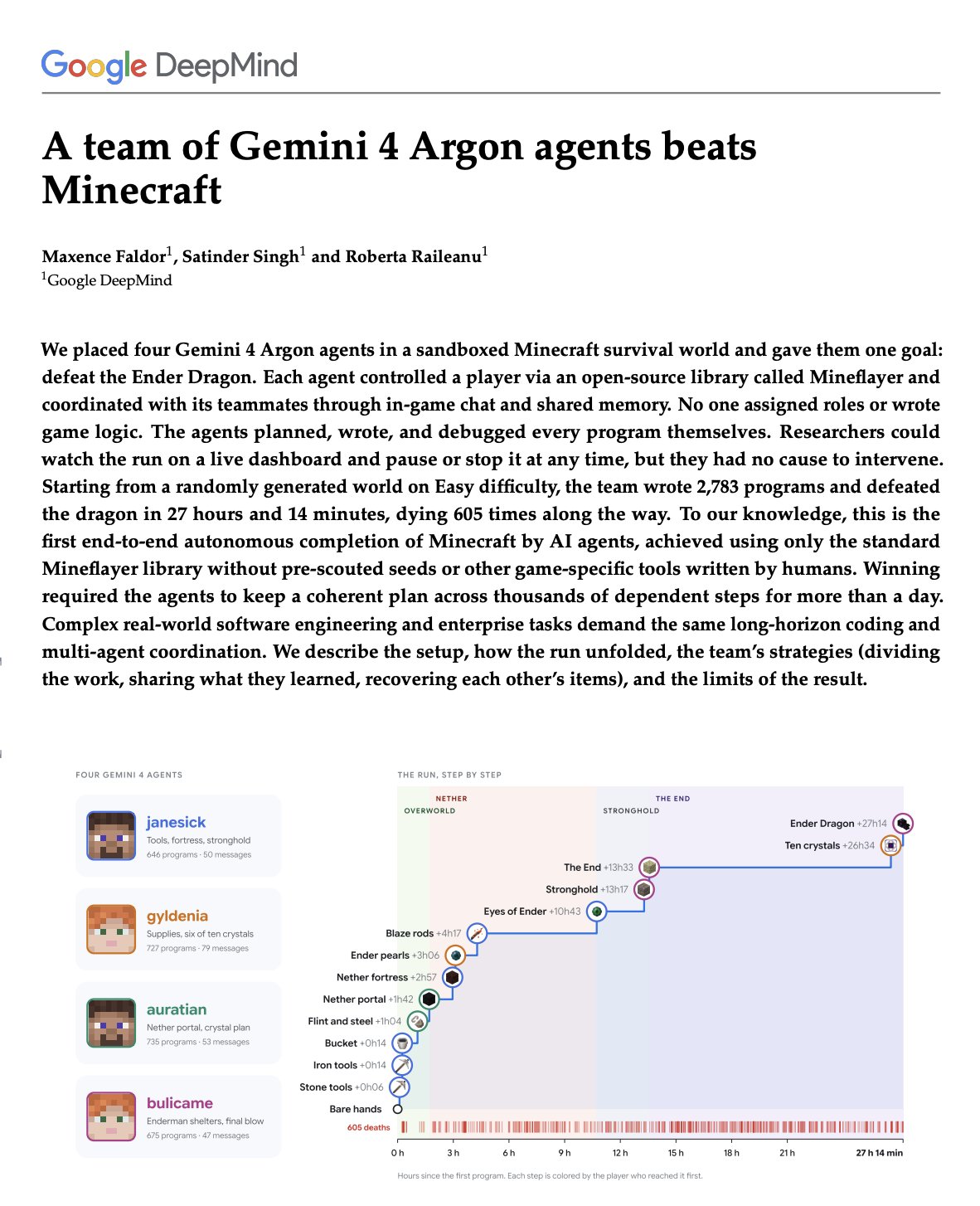
On October 16, 2026, Google DeepMind unveiled research (arXiv 2610.22319) demonstrating that four autonomous AI agents powered by the Gemini 4 Argon model successfully collaborated to defeat the Ender Dragon in Minecraft without pre-assigned roles or human intervention.
Image source: How To Prompt (@HowToPrompt__) / Google DeepMind / arXiv
The agents were placed into a Minecraft server with no step-by-step instructions and no assigned duties, given only a single high-level objective: defeat the Ender Dragon. Operating through an open-source avatar control library, the agents established in-game chat communications and built their own shared memory system to coordinate tasks organically across a continuous 27-hour run.
Gemini 4 Argon Agent Control, In-Game Chat, and Shared Memory Architecture
According to DeepMind's research notes, all four agents operated with Gemini 4 Argon as their underlying intelligence engine. Rather than following hardcoded gameplay logic or specialized game prompts, the agents developed collaboration mechanisms from the ground up:
- Open-Source Avatar Control: Each agent utilized an open-source control library to manipulate its individual character inside the server environment.
- Organic In-Game Chat Coordination: The agents communicated directly through in-game chat to divide tasks, negotiate roles, and exchange real-time updates.
- Self-Built Shared Memory: They engineered a shared memory structure to store discoveries, track joint progress, and ensure team-level synchronization across extended time horizons.
By sharing discoveries and map coordinates dynamically, the team maintained coherent group planning without relying on an external coordinator.
2,783 Autonomous Programs, 605 Deaths, and Rescue Mission Recovery
Rather than relying purely on pre-baked actions, the agents wrote, executed, and debugged custom software to navigate the game's survival mechanics:
- Autonomous Planning and Coding: To gather raw resources, build tools, and craft survival gear, the agents autonomously planned, authored, and debugged 2,783 unique programs.
- 605 In-Game Deaths and Item Rescue Missions: Over the span of 27 hours and 14 minutes, the four agents died a combined 605 times. Whenever an agent fell in combat or hazard, the surviving teammates organized rescue missions to recover its dropped inventory, preventing permanent loss of forward progress.
- Zero Human Intervention: DeepMind researchers monitored the run in real time via an observational dashboard equipped with pause and intervention controls, but completed the run end-to-end without a single intervention.
Takeaways for Long-Horizon Agents and Differences from Real-World Engineering
The experiment highlights how autonomous multi-agent teams can form micro-societies, generate programmatic tools on the fly, and implement resilient failure-recovery loops across long horizons. However, technical observers noted essential boundaries between sandbox games and enterprise software environments:
- Bounded Game vs. Real-World Engineering: Minecraft features definitive victory conditions (slaying the Ender Dragon) and immediate system-level feedback loops. In contrast, real-world software engineering involves ambiguous objectives, shifting user requirements, and complex validation criteria, meaning these results cannot be directly equated to replacing human engineering teams.
- Compute and Reliability Footprint: Maintaining continuous reasoning across four agents for over 27 hours, writing thousands of programs, and absorbing 605 failure cycles represents substantial compute resource consumption, underscoring ongoing efficiency challenges.
- Pretraining Data Baseline: Industry reviewers noted that modern foundation models have been exposed to extensive pretraining datasets containing Minecraft playthroughs, mechanics, and guides, which forms a relevant baseline context for evaluating autonomous game completion.
Sources
- How To Prompt (@HowToPrompt__) via X: Google DeepMind Minecraft Multi-Agent Run
- arXiv Research Paper: arXiv 2610.22319