CoreWeave Corporate Bonds Sink Below 80% of Par into Distressed Territory Amid AI Debt Concerns
CoreWeave corporate bonds dropped below 80% of face value and its stock fell 15.5% on October 14, 2026. According to FINRA TRACE, bond yields neared 15% as mark
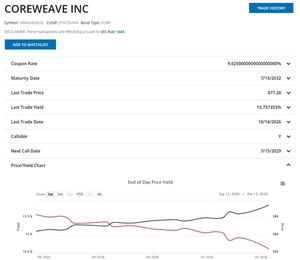
On October 14, 2026 (local time), corporate bond prices of CoreWeave, the specialized AI cloud computing provider, fell below 80% of par value, entering distressed territory according to transaction data from the Trade Reporting and Compliance Engine (TRACE) operated by the Financial Industry Regulatory Authority (FINRA).
Image source: 연합인포맥스
On the same day in New York trading, CoreWeave shares closed at $65.8, down 15.5% from the prior session after sinking 16% to 17% intraday. As corporate bond yields approached the 15% mark, financial markets have sharply escalated caution over the balance sheet health and debt servicing capability of neo-cloud providers that relied heavily on debt financing to fund rapid AI data center and GPU cluster expansion.
FINRA TRACE Data: Bond Yields Near 15% as Prices Breach Par Thresholds
Transaction data from FINRA TRACE confirmed that CoreWeave's corporate bond prices dropped below 80% of par value. In fixed-income markets, trading below 80 cents on the dollar typically designates bonds into the 'distressed' category, reflecting elevated credit risk and heightened default or restructuring expectations.
Concurrently, CoreWeave's bond yields surged by more than 5 percentage points in just four months, approaching 15%.
- Surging Risk Premium: The sharp yield climb within four months demonstrates a steep widening in the credit spread demanded by bond investors.
- Persistent Macro Pressures: Stubborn inflation signals alongside expectations of sustained elevated policy rates have directly weighed on highly leveraged corporate balance sheets facing escalating interest expenses.
The combination of diving bond prices and mid-teens yields points to an urgent reassessment among institutional credit investors regarding the safety and timeline of CoreWeave's debt obligations.
15.5% Equity Drop Highlights Vulnerabilities of Leverage-Driven AI Buildout
Equity markets reflected similar distress on October 14. CoreWeave stock experienced intraday declines of up to 16% to 17% before finishing the trading session down 15.5% at $65.8.
CoreWeave has been a prominent beneficiary of the generative AI boom, leveraging secured allocations of Nvidia GPUs to expand specialized data center capacity. However, a capital structure heavily reliant on debt financing rather than operational cash flows has exposed the firm to severe macro headwinds in an enduring higher-rate environment.
- Debt-Backed GPU Procurement: The model of financing substantial hardware purchases via debt secured against future customer cloud contracts is undergoing rigorous market stress testing.
- Refinancing and Interest Expense Headwinds: With interest rates remaining elevated, the financial cost of servicing maturing loans and rolling over obligations has become a central point of concern for investors.
Market Implications: Revenue Expansion vs. Near-Term Debt Service and Contagion Risks
The coordinated slide across CoreWeave's bonds and equity underscores key structural challenges confronting the broader AI infrastructure financing ecosystem.
- Growth vs. Credit Risk Divergence: While customer demand for AI compute continues to drive top-line revenue expansion, the immediate burden of servicing large-scale debt backed by GPU usage agreements poses a tangible short-term credit risk.
- Sector Volatility Contagion: CoreWeave's deep interconnections with semiconductor manufacturers like Nvidia—spanning GPU allocations and strategic equity investments—have transmitted equity price volatility across neighboring semiconductor and neo-cloud segments.
- Tighter Project Financing for AI Infrastructure: Emerging AI data center operators that rely on debt capital face rising coupon rates and more restrictive debt covenants, raising the capital threshold for ongoing and future compute buildouts.