Google DeepMind Introduces 'Evo2': Co-Evolving Agent Harnesses and Model Weights
Google DeepMind has introduced 'Evo2', a co-evolution framework that trains models using harness edit logs. Coupling proposer-reflector loops with SFT and inter
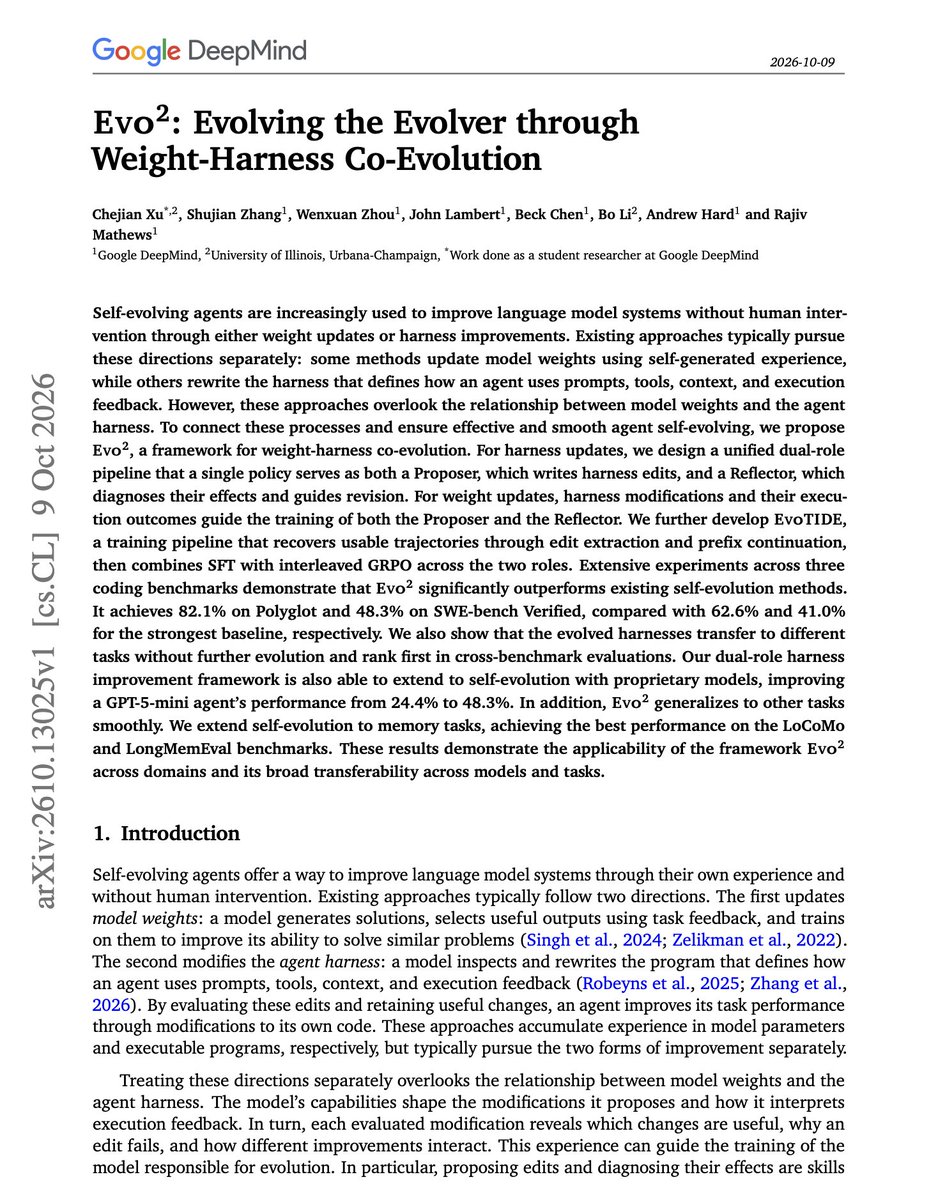
On October 13, 2026, researchers at Google DeepMind introduced 'Evo2', a co-evolution framework designed to advance both an AI agent's execution harness and its underlying model weights simultaneously by turning harness modification logs into training data for subsequent learning passes.
Image source: @omarsar0 (via X) / Google DeepMind
Conventional agent development has typically followed two disconnected tracks: either pairing static, frozen weights with human-authored scaffolding and tool harnesses, or fine-tuning model weights inside rigid, unyielding execution environments. Evo2 demonstrates that an agent's harness code and policy weights can mutually reinforce one another, establishing an automated feedback cycle where runtime scaffolding updates drive model learning.
The Proposer-Reflector Loop: Co-Evolving Harnesses and Weights via SFT and GRPO
At the heart of Evo2 is an architecture where a single policy alternates between two complementary roles, generating its own modification history and diagnostic evaluations.
- Proposer Role: Formulates concrete source code edits and diffs targeting its own execution harness.
- Reflector Role: Inspects runtime execution outputs, terminal traces, and benchmark delta metrics following an edit to diagnose the causal impact of each change.
The resulting pairs of harness diffs and diagnostic evaluations form structured training trajectories. Evo2 trains both roles using Supervised Fine-Tuning (SFT) to establish baseline modification syntax, followed by interleaved Group Relative Policy Optimization (GRPO) to iteratively reinforce productive harness modifications and accurate diagnostic critiques.
Crucially, the worker model performing benchmark tasks can remain entirely frozen while only the meta-policy responsible for editing and diagnosing the harness undergoes training, offering practical utility even when operating with fixed proprietary models.
Benchmark Gains: 48.3% on SWE-bench Verified and Cross-Model Transfer
Empirical evaluations presented in the research demonstrate measurable performance gains across demanding software engineering benchmarks.
- SWE-bench Verified: Evo2 achieved a 48.3% resolve rate, surpassing the strong baseline of 41.0% by 7.3 percentage points.
- Polyglot Benchmark: On the multi-language Polyglot evaluation, Evo2 reached 82.1%, outpacing the 62.6% baseline by a significant margin.
- Closed-Model Harness Transfer: The performance benefits of evolved harnesses extend to closed third-party foundation models where weight retraining is unavailable. On a 60-task SWE-bench Verified subset, pairing the evolved harness with a GPT-5-mini agent boosted task success from the best baseline (SICA at 24.4%) to 48.3% (reporting the better of Evo2's top two harnesses).
Furthermore, the researchers confirmed that harnesses evolved on one evaluation benchmark successfully generalized and transferred to distinct task suites without catastrophic collapse.
Structured Logging Requirements and Model-Dependent Variances
The paper's supplementary analyses, alongside technical reviews from the research community, highlight key operational nuances and prerequisites for harness co-evolution.
- Model Family Sensitivity: According to Table 3 of the paper, the dramatic performance leap observed on GPT-5-mini was less pronounced on other architectures. With Haiku 4.5, the gain was more modest, moving from a 45.0% baseline to 47.8% (a 2.8 percentage point increase), showing that harness evolution sensitivity depends heavily on base model reasoning characteristics.
- Structured Logging Considerations in Practice: Technical discussions in the community highlighted that rather than relying on unparsed stdout dumps, practical harness training benefits from structured logging—such as tagging harness events with unique IDs and file/line metadata—to preserve clean causal signals for learning.
- Concerns Over Potential Regressions: Feedback within the technical community also raised the concern that harness edits improving target benchmark scores could inadvertently introduce regressions elsewhere that risk being baked into model weights, underscoring the need for careful multi-suite validation.
While Evo2 currently remains an academic research publication without an open-source turnkey installation package, it establishes a pragmatic foundation for engineering teams to systematically transform routine agent execution logs into durable model improvements.
Sources
- Elvis Saravia (@omarsar0 via X): Google DeepMind Evo2 Research Announcement
- Google DeepMind Research: Evo2: Weight-Harness Co-Evolution Paper