9 Trending GitHub AI and Developer Tools: From Local Audio and Agent Skills to Lightweight Inference
A breakdown of 9 trending open-source AI and developer tools on GitHub—including VoiceStudio, CLI-Anything, and AirLLM—covering core capabilities, repositories,
Tech curator Slopman (@UniverseB1020) on X recently compiled and shared a selection of nine notable open-source AI and developer tools currently gaining rapid traction across the GitHub ecosystem. Ranging from fully local voice synthesis suites and desktop GUI automation wrappers to modular agent skill registries, context window compression utilities, lightweight low-VRAM inference engines, and automated security audit platforms, this roundup highlights practical projects ready for immediate engineering adoption.
Image source: X (@UniverseB1020)
Rather than showcasing raw parameter scales or academic benchmark scores, this collection concentrates on repositories engineered for concrete workflow automation, infrastructure cost reduction, and operational reliability. Below is an itemized breakdown of each tool's repository link, key capabilities, and essential operational considerations.
Media Generation and Desktop Application Automation
On-device audio workflows and interface layers that bridge established desktop software with AI systems form a major highlight of the recent open-source surge.
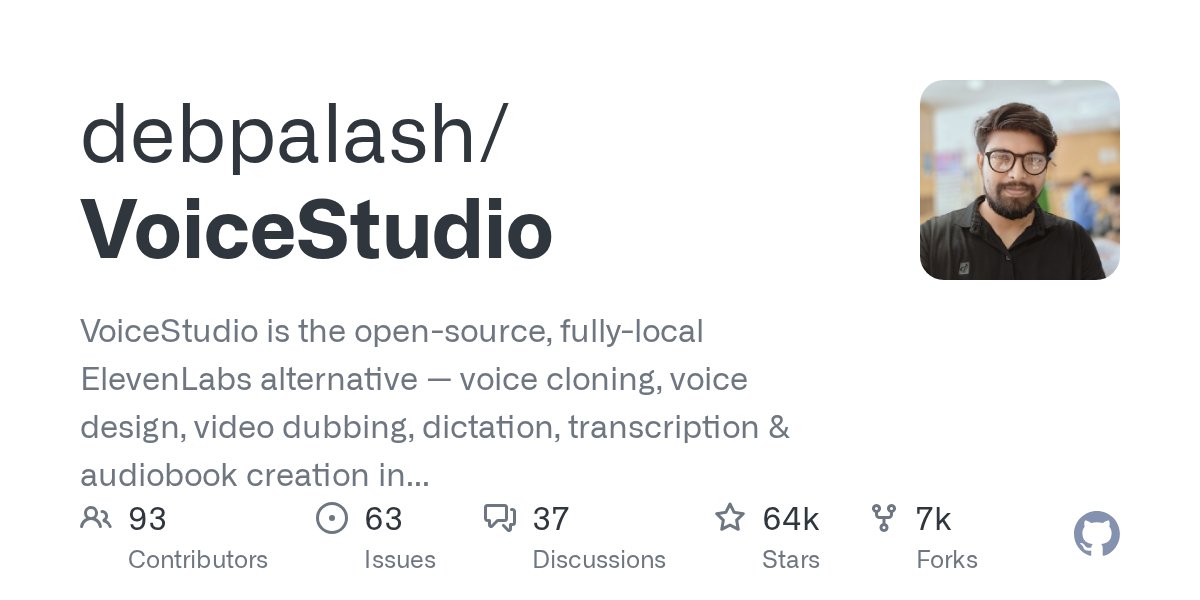
1. VoiceStudio (⭐65k)
A fully local, self-hosted voice workstation engineered as an on-premise alternative to cloud-hosted proprietary platforms like ElevenLabs. It supports 646 languages and consolidates complex audio workflows—including voice cloning, video dubbing, speech transcription, and audiobook production—into a unified local environment.
- Operational Caveat: Because high-fidelity voice cloning capabilities are included, users must strictly adhere to legal and ethical standards, performing voice replication only with explicitly permitted voice assets.
- Repository: debpalash/VoiceStudio
2. CLI-Anything (⭐52k)
An integration bridge that empowers AI agents to command intricate desktop GUI software—such as Blender and LibreOffice—directly through terminal CLI commands and structured JSON data. It translates manual, visual mouse-driven operations into programmatic, scriptable automation pipelines.
- Operational Caveat: Functional coverage depends on target application plugin hooks and supported API versions; engineers should confirm target software compatibility before architecting pipelines.
- Repository: HKUDS/CLI-Anything
Agent Skill Registries, Low-VRAM Inference, and Context Compression
Extending coding agent capabilities through modular plugins while driving down token consumption and compute thresholds has emerged as a central theme.
3. Scientific Agent Skills (⭐49k)
A specialized collection of 177 domain-specific skills designed for scientific research workflows, spanning academic literature searches, statistical analysis, and research data mining. These modular skills can be directly plugged into leading agent environments such as Claude Code, OpenAI Codex, and Cursor based on active project demands.
- Operational Caveat: Querying and processing extensive external scientific datasets requires appropriate external network access and filesystem permissions within the agent's operating sandbox.
- Repository: K-Dense-AI/scientific-agent-skills
4. AirLLM (⭐39k)
An inference runtime capable of executing unquantized, full-precision 70B parameter large language models locally on a single consumer GPU equipped with as little as 4GB of VRAM.
- Operational Caveat: Rather than fitting entire models into GPU memory, AirLLM streams weights sequentially layer by layer from local storage. Consequently, while GPU VRAM demands are minimal, substantial high-speed NVMe SSD disk capacity is mandatory to store and stream model checkpoint weights.
- Repository: lyogavin/airllm
5. vercel-labs/skills (⭐35k)
An open-source CLI registry from Vercel Labs enabling developers to install and manage agent skills via a single terminal invocation: npx skills add. It officially supports over 75 distinct AI agent frameworks, standardizing previously fragmented tool-installation flows into a unified developer experience.
- Repository: vercel-labs/skills
6. context-mode (⭐29k)
A utility built to compress, filter, and condense verbose raw terminal outputs generated by external tool executions before feeding them back into coding agents. According to the project's official README, it can reduce context window consumption by up to 98%, preserving conversation history and cutting API token overhead.
- Operational Caveat: Development teams should carefully audit the repository's open-source license terms before embedding it into proprietary or commercial production infrastructure.
- Repository: mksglu/context-mode
Automated Security Audits and Cross-Platform Build Toolchains
Active validation of agent-generated code alongside toolchains that remove hardware vendor lock-in round out the current ecosystem priorities.
7. PentAGI (⭐29k)
An autonomous security scanning platform that connects over 20 professional penetration testing and security analysis utilities directly to AI agents. It automates the entire vulnerability discovery and compliance reporting lifecycle under agent supervision.
- Operational Caveat: Given that this framework drives live penetration testing tools, it must only be deployed within explicitly authorized networks, internal testbeds, or pre-approved assessment targets.
- Repository: vxcontrol/pentagi
8. iFixAi (⭐27k)
A specialized security and reliability evaluation suite that checks AI agents across up to 60 distinct diagnostic scenarios, proactively identifying model hallucinations, improper privilege escalations, and prompt injection vulnerabilities.
- Operational Caveat: Currently marked as Beta; teams incorporating it into production deployment gates should regularly monitor evaluation false-positive rates and evolving rule sets.
- Repository: ifixai-ai/iFixAi
9. xtool (⭐10k)
An open-source build toolchain that enables developers to compile and build native iOS applications directly on Linux and Windows workstations without requiring physical macOS hardware.
- Operational Caveat: While local compiling and asset bundling can run outside macOS, signing the final binary and publishing to Apple's App Store or TestFlight still requires an active Apple Developer Program account.
- Repository: xtool-org/xtool
Practical Adoption Insights: Balancing Capability with Verification
This collection of repositories marks a noticeable shift in engineering priorities. Where earlier AI open-source cycles centered primarily on raw model weights and prompt tricks, current developers increasingly focus on practical efficiency: standardizing agent capabilities (vercel-labs/skills), pruning redundant token bloat (context-mode), and operating large architectures on commodity hardware (AirLLM).
Equally telling is the rise of automated governance tools like PentAGI and iFixAi. As highlighted by Slopman (@UniverseB1020), the primary benchmark in autonomous agent development is evolving from merely how fast an agent completes a task to whether its outputs are verifiable, secure, and resilient against hallucination. When evaluating these tools, teams should maintain explicit boundaries around permissions, licensing, and pre-execution authorization.
Original source
- Slopman (@UniverseB1020) on X: Trending GitHub AI and Developer Tools