Gem Search: Open-Source Local Analyzer Detecting New Tickers and Narratives on X
An analysis of Gem Search, an open-source local feed analyzer extracting new crypto tickers, Solana addresses, and emerging narratives on X with Grok AI validat
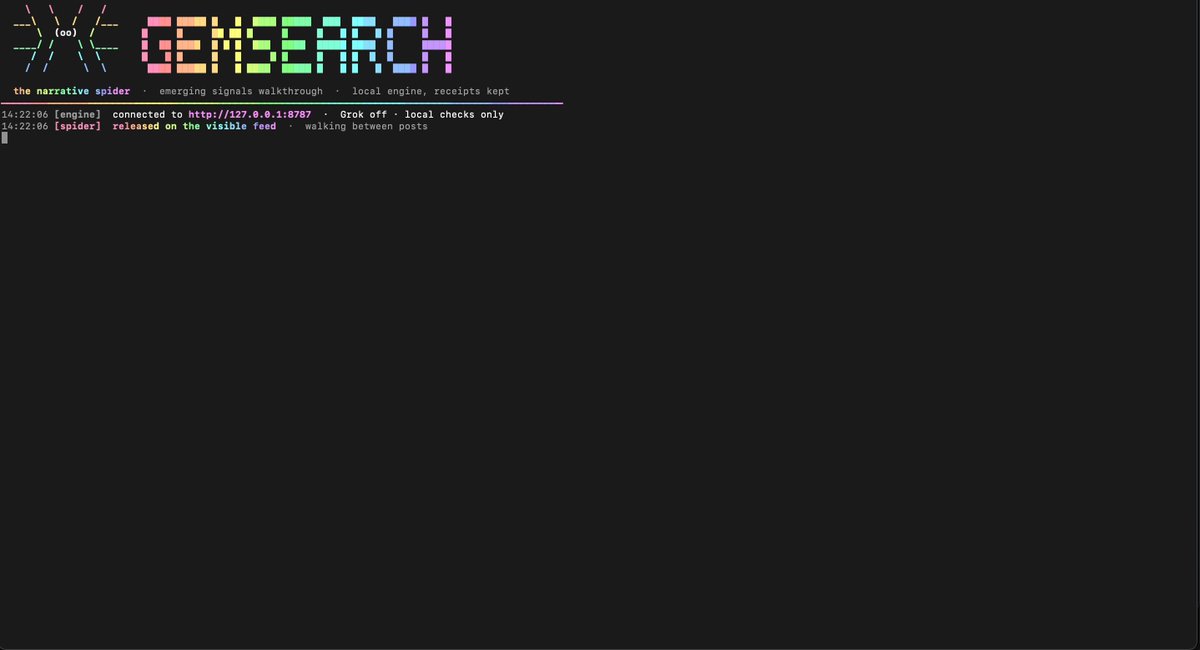
A lightweight open-source social feed intelligence tool, Gem Search (gem-search), has been released to help developers and researchers capture real-time cryptocurrency signals and early-stage narrative shifts directly from X (formerly Twitter). Developed by @h100envy, the utility runs entirely on the user's local machine without requiring paid X API developer plans or third-party cloud infrastructure. Operating as a targeted feed spider, it extracts and sanitizes emerging token tickers, cryptographically verified Solana addresses, and nascent narrative phrases. The repository quickly crossed 100 GitHub stars within hours of its announcement, drawing attention from data engineers and on-chain analysts.
Image source: @h100envy on X
Unlike conventional social scrapers that rely on broad keyword queries and dump massive volumes of unfiltered text—generating excessive API expenses and data noise—Gem Search prioritizes deterministic local filtering, cryptographic validation, and quota-conscious LLM verification.
Local Feed Spidering with Cryptographic Solana Address Validation
The core of Gem Search's architecture is its local spider engine, which parses live social feeds directly on the user's workstation rather than querying costly external endpoints.
To handle the immense stream of social posts, the tool incorporates a multi-tier local parsing pipeline that discards noise before invoking any secondary analysis.
- Automated Major Asset and Price Filtering: The parser automatically bypasses established benchmark tokens such as Bitcoin ($BTC), Solana ($SOL), and USD Coin ($USDC), as well as standard price mentions like '$100'. This isolates genuine, newly emerging token cashtags ($TICKER) from mundane market commentary.
- Cryptographic 32-Byte Solana Key Decoding: Rather than accepting arbitrary Base58-like strings from text posts, Gem Search decodes each candidate string locally to confirm that it resolves to a legitimate 32-byte public key. Lookalike strings and invalid hashes are discarded immediately.
This local pre-filtering ensures that downstream processing pipelines receive high-integrity on-chain addresses rather than arbitrary string fragments, conserving computing resources.
Multi-Author Narrative Discovery and Mention Acceleration Metrics
Beyond tracking isolated token symbols, Gem Search incorporates a narrative discovery algorithm designed to identify broader thematic rotations before they dominate public discourse.
The system is calibrated to detect emerging micro-trends during their earliest formation stages through strict heuristic checks.
- Three-Author Repetition Rule: When a specific word pair is independently repeated across posts by at least three distinct authors within a rolling 6-hour window, the spider flags it as an emerging narrative candidate.
- Novelty Filtering Against Known Topics: Candidate word pairs are evaluated against a predefined watchlist. Pairs that already exist in known topic categories are ignored, allowing the engine to surface genuinely novel concepts.
- Growth Velocity Calculation: For every discovered narrative, Gem Search computes growth metrics by comparing mention volume over the most recent 6 hours against the preceding 18 hours. Combined with the initial signal timestamp and unique author count, analysts can evaluate both topic presence and acceleration rate.
Grok API Optimization and Research-Only Launch Guardrails
To validate the contextual relevance of captured signals, Gem Search integrates xAI's Grok. However, instead of streaming uncurated timeline feeds into the model, it enforces strict quota-preservation controls.
- Top Candidate Pass Limits: The spider retains only the top 10 tickers, top 10 Solana addresses, and top 5 narrative phrases per scanning pass. Restricting LLM evaluation to this high-conviction subset prevents token waste and keeps API usage well within operational limits.
- Custom Watchlists via topics.json: Users can configure their own monitoring priorities through a local
topics.jsonconfiguration file, tailoring tracking parameters to specific sectors or research themes. - Research-Only Guardrails: All extracted tickers, addresses, and phrases are explicitly designated with a 'research only' attribute. They are strictly segregated from automated token generation or launch queues, providing a built-in safety mechanism that prevents the accidental duplication or unauthorized deployment of third-party tokens.
Developer Intelligence Utility and Operational Caveats
From a data engineering standpoint, Gem Search illustrates a practical pattern for building lightweight social intelligence layers: pairing rule-based local pre-processing with targeted LLM validation to bypass enterprise API cost hurdles.
Nevertheless, developers evaluating the tool should note several operational boundaries and architectural considerations.
- Direct Scraping Fragility: Because Gem Search scans web feeds locally rather than interfacing with official X API endpoints, it remains susceptible to upstream HTML structure updates, bot-mitigation rules, IP rate limits, and platform session invalidations.
- Separation of Code from Token Promotion: The project creator mentions an associated memecoin ($GEMSEARCH) alongside the tool. Engineering teams should assess the codebase strictly on its technical merits—such as local parsing efficiency, word-pair extraction heuristics, and API quota optimization—independent of any speculative token activity.
Gem Search offers an insightful architectural reference for developers seeking to build local, privacy-preserving social listening workflows with disciplined LLM resource consumption.
Sources
- GitHub Repository: h100envy/gem-search
- h100envy Official X (@h100envy): Gem Search Release Announcement