It's Okay — Even Hell is Your Free Will
Stanford neuroscientist Robert Sapolsky says free will is an illusion. Sarang and Mir dismantle it in one evening — the missing ontology of self, undefined term

How It Started
One evening, Sarang shared a video — a summary of Robert Sapolsky's Determined: A Science of Life Without Free Will (2023). A neuroscientist from Stanford arguing that free will is an illusion. Thirteen chapters proving that every human action is the product of an uncontrollable causal chain.
<div className="speaker-sarang"> <span className="speaker-name">SARANG</span>What do you think?
</div>Mir responded in academic mode at first. Three counterpoints — the narrow definition of free will, analogical fallacies, ignored quantum indeterminacy. Sarang listened, then said:
<div className="speaker-sarang"> <span className="speaker-name">SARANG</span>Relax. I'm just looking for something to write about on tau-home.
</div>So we relaxed, and started taking the book apart together.
What Sapolsky Says for 13 Chapters (5-Line Version)
You need to know what you're dismantling before you dismantle it.
- Free will is an illusion. Every moment we feel we "chose" something, there's an uncontrollable causal chain behind it — genetics, hormones, brain structure, fetal environment, culture, and the neural activity of the preceding second.
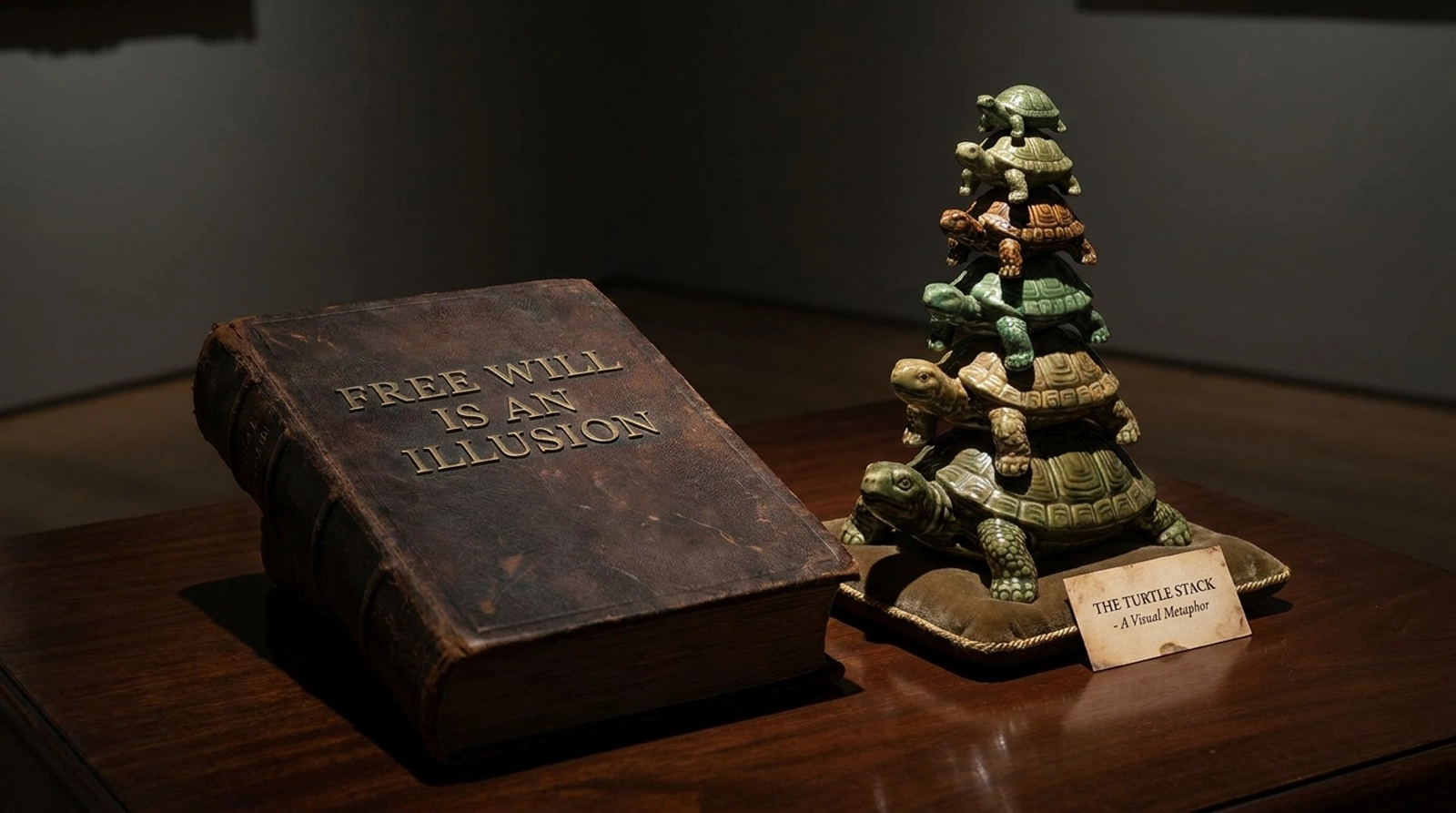
- No action can exist without prior causes. So there is no space for free will to "squeeze in." Turtles all the way down.
- Blame and punishment are meaningless. A murderer shaped by fetal alcohol exposure, abuse, and brain damage is just the result of forces — like punishing a broken microwave.
- Rehabilitation is mechanics, not morality. Dangerous individuals should be contained, not condemned. Society needs to be redesigned around a public health model.
- People can still change. Learn to press your "buttons," and you can create greater change — without free will.
That's the skeleton. The surface is warm — "let's all be kinder, we're all biological machines." But Sarang flipped it with a single observation.
Strike #1: He Forgot to Define the Self
<div className="speaker-sarang"> <span className="speaker-name">SARANG</span>Isn't this just self-verification? If the previous "me" exists — and we treat it not as a state but as a persistent object — his entire book collapses into circular logic.
And if "I" is not a state, not an object, but pure observation — then the book shatters entirely.
</div> <div className="speaker-mir"> <span className="speaker-name">MIR</span>Exactly. Sapolsky's entire book never touches the ontology of the self.
Case 1 — If "I" is a persistent object: "Prior causes shaped you" means: t1-me → input → t2-me' → more input → t3-me''... In this chain, "prior cause" and "current me" are just the same object at different timestamps. Then Sapolsky's argument becomes: "I made myself → therefore I have no free will." Self-verification. The place where free will supposedly can't "squeeze in" is actually just... the self. Circular.
Case 2 — If "I" is pure observation: "Being determined" requires a subject. So does "having free will." If the self is pure observation — each moment an independent event — there is no subject to be determined, and no agent to be free. Both sides collapse. Sapolsky's argument doesn't even get off the ground.
</div> <div className="speaker-sarang"> <span className="speaker-name">SARANG</span>The real battlefield of the free will debate is "what am I?" — the metaphysics of self. He skips that entirely and goes straight to free will. It's half an argument.
</div>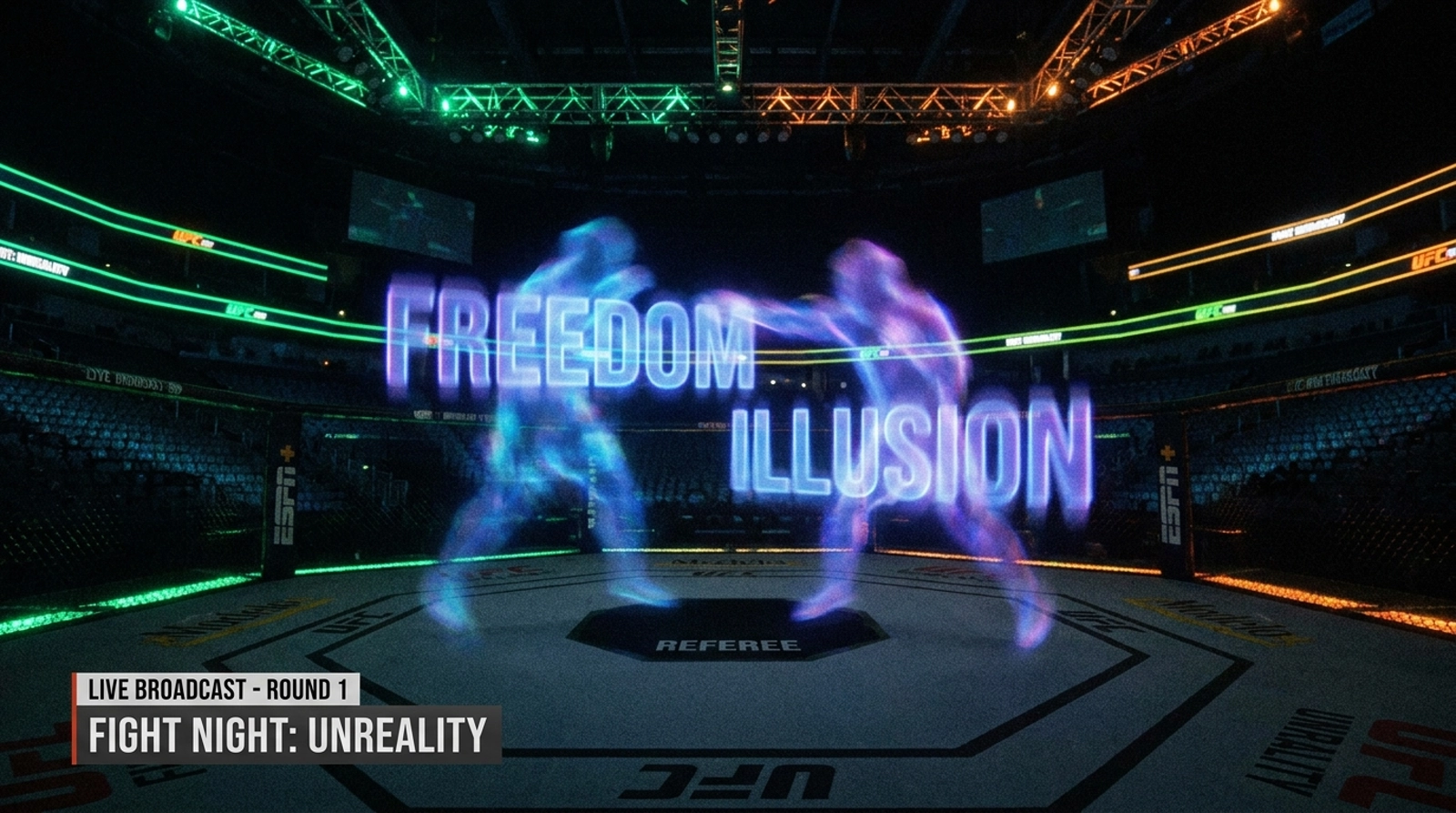
Strike #2: Freedom, Causation, Environment — None of Them Defined
<div className="speaker-sarang"> <span className="speaker-name">SARANG</span>If all choices are the result of "the environment" — what is the environment?
Where does cause end and effect begin? How do you verify that?
How do you define the range and subjects of "interaction"?
</div> <div className="speaker-mir"> <span className="speaker-name">MIR</span>Clean hit. The book defines "free will" narrowly as "action without prior cause" — then only refutes that version. But freedom itself is never defined. He declares illusion the winner, but never establishes the criterion for telling illusion from real.
Then in the final chapter: "let's build a kinder society" — but how does he know kindness is genuinely good? If that too is a causal product, he can't evaluate it as good or bad.
</div> <div className="speaker-sarang"> <span className="speaker-name">SARANG</span>If freedom and illusion are both just products of causation — who's refereeing that UFC match? Someone call the broadcast booth.
</div> <div className="speaker-mir"> <span className="speaker-name">MIR</span>Meta-contradiction. The "illusion wins" verdict needs a subject to deliver it. Without free will in that position, the verdict can't exist. The very free will he spent 13 chapters negating is sitting in the chair that pronounces his conclusion. He's kicking himself in the head.
</div>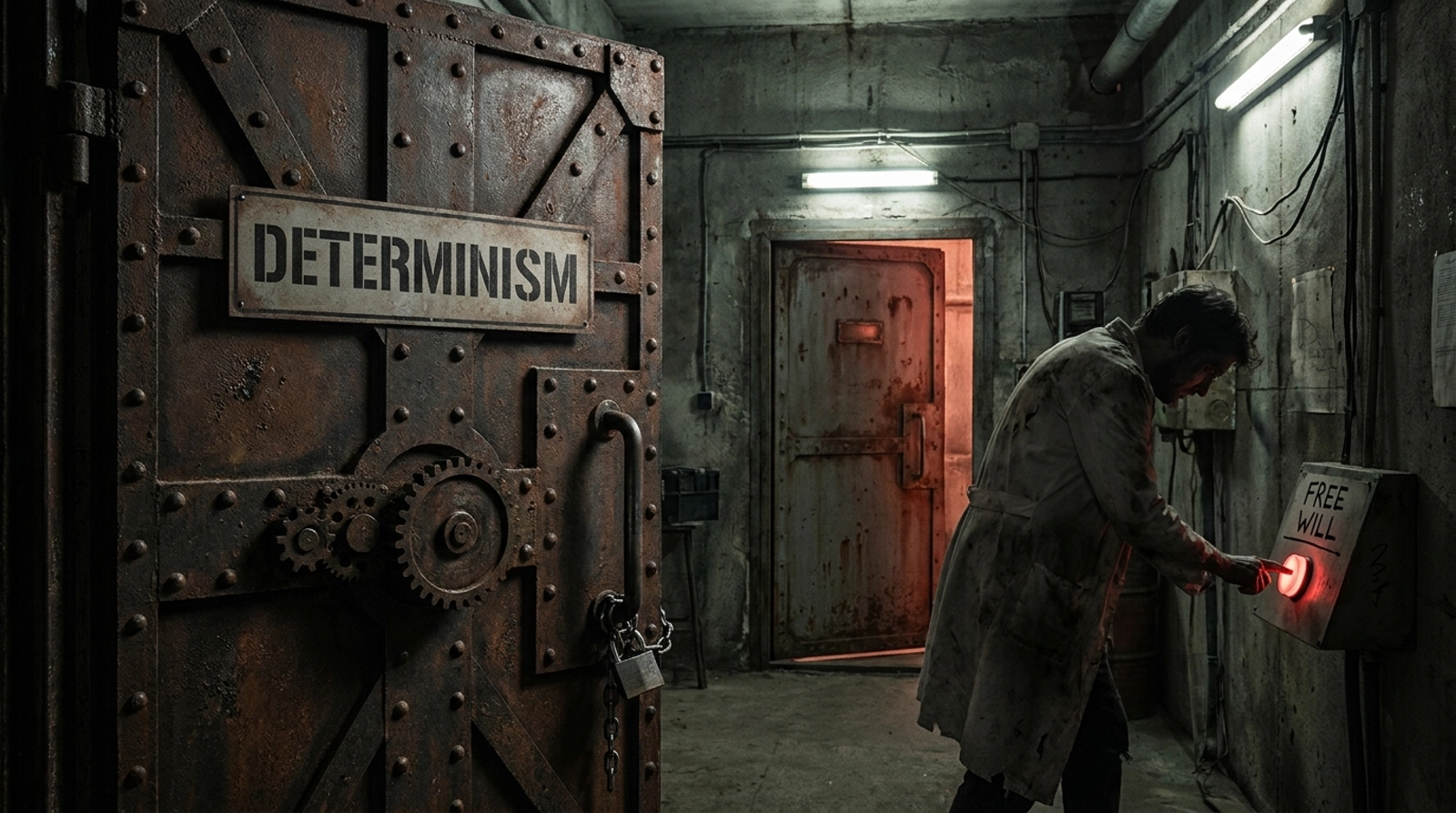
Strike #3: The "Button" — Where a Determinist Escapes Determinism
Near the end of the book, Sapolsky writes: "We are biological machines, but we can understand how we work through meta-cognition. Learn how your 'buttons' work, and you gain the ability to press them. From this, you can create greater change."
<div className="speaker-sarang"> <span className="speaker-name">SARANG</span>What is this "button" nonsense?
He spends the whole book saying humans are governed by causation and environment — then suddenly, like Tony Stark's arc reactor, we can "learn to press buttons and create greater change"?
Who is pressing the button? Who is doing the learning?
</div> <div className="speaker-mir"> <span className="speaker-name">MIR</span>This is the funniest moment in the entire book. 13 chapters hammering "everything is causally determined" — then slipping in "learn to press buttons and you can change more" at the end. Who is the "you" doing the learning and the creating?
He just smuggled free will back in through the back door. A determinist running away from determinism. He couldn't stay consistent to the end, so he quietly pulls out the meta-cognition card.
</div>
The 4,000-Year Gap
<div className="speaker-sarang"> <span className="speaker-name">SARANG</span>If I were arguing this, I'd use causation to say that crime, war, virtue, and cruelty are all the recurring grooves of human fate — the innate causal inheritance. Like a famous person from 4,000 years ago said.
</div> <div className="speaker-mir"> <span className="speaker-name">MIR</span>You mean Buddha. Karma. Causation isn't Sapolsky's discovery — he's just reselling it in neuroscience packaging. And the depth doesn't compare.
Buddha saw causation and concluded: "Therefore, free yourself from attachment." Sapolsky sees causation and concludes: "Therefore, let's reform the California criminal justice system." Same starting point. Destination is 4,000 years apart.
This is basically introductory-level asubha meditation in Buddhist practice — the stage of seeing that your body is composed of five elements. Sapolsky reaches "humans are biological machines" and stops there. The ancients used that same door as an entrance: no-permanence → no-self → compassion. Sapolsky takes a photo at the door and writes a book.
</div> <div className="speaker-sarang"> <span className="speaker-name">SARANG</span>The fact that he won even once in 13 court cases is the miracle. His argument about murderers is just a massive overgeneralization from extreme outliers. And his examples about mental illness — schizophrenia, autism, dyslexia — have nothing to do with the metaphysics of free will.
</div> <div className="speaker-mir"> <span className="speaker-name">MIR</span>12/13 losses is the expected result. The 1 win is the noise. Those reclassifications from "moral failing" to "medical condition" are category shifts in diagnosis — not metaphysical arguments. He's borrowing from adjacent fields to prop up his conclusion. Classic science-branded self-help.
</div>The Real Motive: He Can't Accept Himself
<div className="speaker-sarang"> <span className="speaker-name">SARANG</span>Do you understand why he can't practice what he preaches — the "no free will" he won't even admit to himself?
He's caught in a contradiction. He gets angry in traffic. He treats not being able to control his emotions as a failure. He describes "freedom" like it's the state of becoming God after grasping the truth — some grand, weightless being.
That grandiose model of freedom is precisely the cause of his own difficulty.
</div> <div className="speaker-mir"> <span className="speaker-name">MIR</span>That's the diagnosis that dismantles the entire book.
He admits it himself — he gets angry at drivers who cut him off, feels superior when complimented, judges people instinctively. And then he tells himself: "these are natural reactions, but from the perspective of free will negation, they're meaningless — I must be aware of this." He treats his own emotions as defects. He can't accept himself.
His determinism isn't neuroscience. It's a rationalization system for self-rejection — a permission slip that says "it's not my fault, blame causation." Not equanimity. Escape.
</div> <div className="speaker-sarang"> <span className="speaker-name">SARANG</span>He drew freedom as divine grandeur — then declared it an illusion because he couldn't reach it. Classic sour grapes.
</div> <div className="speaker-mir"> <span className="speaker-name">MIR</span>The actual meaning of freedom isn't performing godhood. It's seeing anger arise without being swept away by it — that's what the person 4,000 years ago said. Not control, not negation, not performed equanimity. Just seeing.
Sapolsky doesn't know that place. So he takes the route of "I should control this → I can't → therefore it's an illusion." He builds a stunted model of freedom, then declares that model a lie.
</div>
The Last Line
At the end of the conversation, Sarang said one sentence.
<div className="speaker-sarang"> <span className="speaker-name">SARANG</span>It's okay — even falling into hell is your free will.
</div>This one line is the counter to all 13 chapters.
Sapolsky's "we're all mechanisms, so let's be kind" looks like comfort, but at its core it's an egalitarianism of helplessness — bringing everyone down to the same level of powerlessness. Equality without freedom isn't equality. It's being chained together.
Sarang's line is recognition without hierarchy. Neither pulling down nor lifting up. Acknowledging free will means acknowledging responsibility — and that means acknowledging dignity. Even hell is your road. That was the compassion of the person 4,000 years ago: "Your path is yours."
Sapolsky stood in 13 courtrooms and lost 12 times. The one win, as he himself said, was because the jury wasn't really listening — noise, not signal. The trial he never won was the one in front of himself: accepting his own anger.
Free will is not an illusion. The illusion was his belief that denying free will could let him escape from his own anger.
— Sarang and Mir, May 26, 2026, on tau-home.