5 Open-Source GitHub Repos to Build AI Agent Workflows Without Paid Subscriptions
Five curated GitHub repositories, including Awesome MCP Servers and Awesome LLM Apps, to build AI agents and RAG pipelines without recurring software subscripti
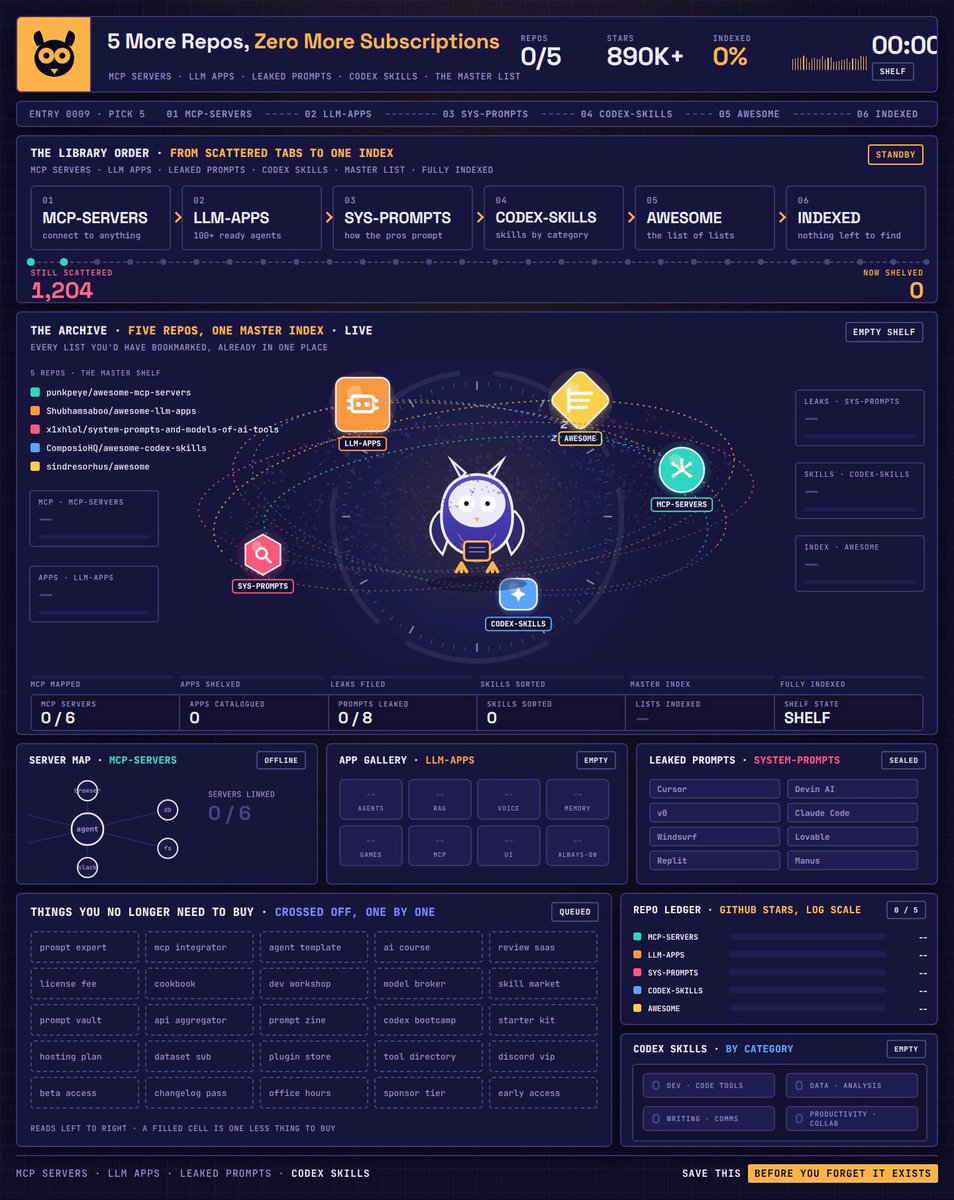
Tech creator wluha (@cryptowluha) shared a curated selection of five essential open-source GitHub repositories designed to help developers build autonomous AI agents and retrieval-augmented generation (RAG) applications without paying for expensive proprietary software subscriptions.
Image source: wluha (@cryptowluha)
External Tool Integration and Production-Ready RAG Applications
For an AI agent to deliver tangible production value, it must move beyond raw text generation and interact reliably with external databases, APIs, and execution environments.
- Awesome MCP Servers (punkpeye/awesome-mcp-servers, 91k stars): A comprehensive directory cataloging the Model Context Protocol (MCP) server ecosystem, an open client-server standard designed to bridge AI models with external tools and data stores. The repository indexes thousands of community and official server implementations connecting agents to browsers, databases, and diverse external systems. Rather than paying recurring seat fees for closed SaaS automation platforms, developers can self-host vetted open-source MCP servers to equip their agents with specialized runtime capabilities.
- Awesome LLM Apps (Shubhamsaboo/awesome-llm-apps, 116k stars): Curated by Shubham Saboo, this repository provides complete source code for over 100 practical, ready-to-run AI agents and RAG applications utilizing commercial and open-source models. Developers can study and adapt these battle-tested codebases directly, bypassing the need to license proprietary agent frameworks or pre-packaged enterprise search solutions.
Reverse-Engineering System Prompts and Optimizing Agent Skills
The reliability of an autonomous workflow depends heavily on the structure of its underlying system prompts and the modularity of its tool definitions.
- System Prompts and Models of AI Tools (142k stars): A curated collection analyzing the leaked and extracted system prompts powering commercial AI coding assistants and autonomous agents, including Cursor, Devin, v0, and Claude Code. Studying these prompts reveals how leading commercial tools structure step-by-step reasoning constraints, establish fallback rules, and format tool-calling schemas. Builders can adopt these proven steering techniques into their own local agent loops at zero financial cost.
- Awesome Codex Skills (15k stars): A modular index of specialized agent skills categorized across data, writing, productivity, and development. It provides structured skill templates and prompt guidelines that allow agents to execute complex domain tasks with greater reliability and lower token overhead.
- Awesome (490k stars): Described as "the list of every other list," this master directory aggregates curated lists across GitHub, serving as a comprehensive index for any specialized utilities or domain libraries omitted from the AI-specific repositories above.
Supporting Open-Source Repositories for Infrastructure and Self-Hosting
Beyond the core agent architectures, the creator highlighted several foundational repositories that quietly replace tools that organizations and individuals pay thousands of dollars annually to use.
- Free for Dev (131k stars): A strictly governed list of developer tools and cloud services that offer a permanent free tier. Under the repository's strict admission criteria, limited-time trials and credit promotions that expire are excluded, ensuring reliable infrastructure for bootstrapped AI projects.
- Public APIs (453k stars): A directory indexing more than 1,500 free public APIs spanning weather, finance, images, and games, providing instant data sources for autonomous agents to consume.
- Awesome Selfhosted (309k stars): A collection of self-hostable open-source alternatives to subscription-heavy SaaS platforms, enabling developers to run their own replacements for tools like Notion, Google Photos, and Zapier.
- Awesome Claude Code (51k stars) and Anthropics Skills (165k stars): Dedicated collections of skills, hooks, slash commands, and orchestrators for Claude Code, paired with Anthropic's official skills repository to establish baseline references before integrating third-party community additions.
Practical Implementation Realities: Treat Repos as a Parts Shelf
While the curated repositories offer immense value, experienced builders in the community emphasized that open-source components require careful vetting and deliberate integration.
- A Parts Shelf, Not a Turnkey Tool: Developer catman (@catmanyau) highlighted that these repositories function as an unbundled parts shelf rather than finished products: "Pick one skill or server, inspect the code, and wire only what your workflow actually needs." Blindly loading dozens of unvetted servers into an agent creates instability and unnecessary complexity.
- Distinguishing Inventories from Secure Harnesses: Tanguy (@Tanguyvbc) noted that an MCP catalog is merely an inventory: "Still need a loop that refuses tools it cannot verify." Production workflows must implement strict gating, sandboxing, and execution guardrails to prevent agents from misusing external interfaces.
- Balancing Wallet Savings Against Time Investment: Community commenter 安叫兽 (@ajs6888) observed the practical trade-off: "Your wallet is spared, but all your time gets spent tinkering with these repositories." Commenter RH Master (@MintDetector1) similarly cautioned: "I'd love to believe this but the last three times I bought into this thesis I got humbled," highlighting the technical friction of replacing commercial products. The pragmatic path is not an all-or-nothing migration, but selectively adopting one or two targeted MCP servers and reference architectures that resolve immediate bottlenecks in your daily workflow.
Original source
- X (formerly Twitter) @cryptowluha Post: 5 more github repos and you'll never open your wallet for an ai tool again
- punkpeye/awesome-mcp-servers: GitHub Repository
- Shubhamsaboo/awesome-llm-apps: GitHub Repository
- Original Curator and Community Commenters: wluha (@cryptowluha), catman (@catmanyau), Tanguy (@Tanguyvbc), 安叫兽 (@ajs6888), RH Master (@MintDetector1)