earshot: Local MCP Tool Giving AI Coding Agents Ears to Critique and Synthesize SFX
Developer Leon Lin has introduced earshot, a local CPU-based MCP tool that allows AI coding agents like Claude Code to listen to, score, and iteratively improve
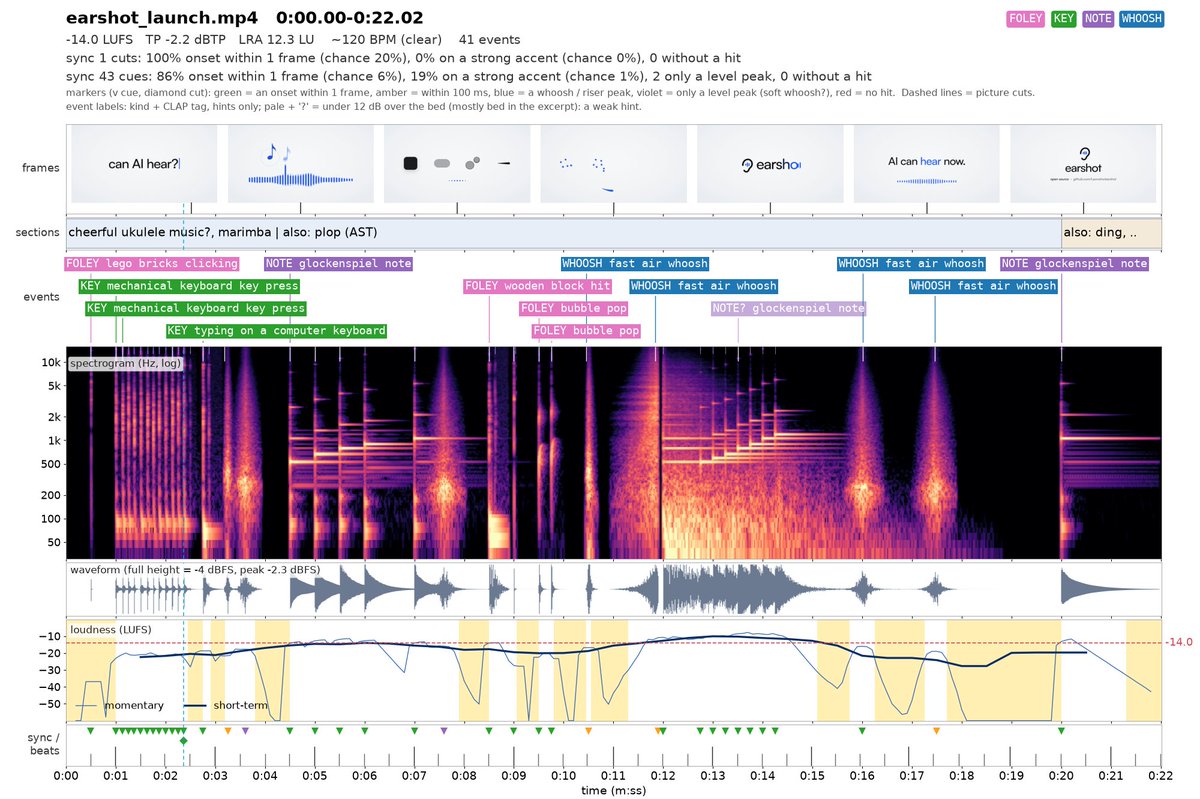
While AI coding agents have advanced to building entire product launch videos purely through code, the accompanying sound effects (SFX) have often remained sloppy or cheap. While agents could author code to emit audio, they lacked the auditory feedback loop required to perceive whether a sound feels unpolished or ill-fitting.
On October 16, 2026, developer Leon Lin (@LexnLin) released "earshot," a local Model Context Protocol (MCP) tool designed to provide AI coding agents with an auditory evaluation and refinement loop.
Image source: @LexnLin / X
Integrated with coding assistants such as Anthropic's Claude Code, earshot enables agents to search and match sound effects, critique rendered audio through timestamped scoring, and autonomously rewrite code to iteratively enhance audio quality.
Lightweight Local CPU Execution and Soundtrack Visualization
A central architectural feature of earshot is that it executes entirely on the user's local CPU without requiring dedicated high-end GPU hardware or external cloud model infrastructure. This lightweight footprint allows developers to integrate sound design routines directly into local terminal-based agent workflows.
earshot equips coding agents with three primary capabilities:
- Sound Effect Matching and Search: Agents can query sound libraries or describe acoustic profiles to locate and pair appropriate sound effects.
- Soundtrack Visualization Page: A dedicated visual inspection interface displays track waveforms and chronological arrangement across the timeline.
- Timestamp-Based Acoustic Critiques: The tool pinpoints awkward or unrefined segments at specific timestamps, returning quality scores and actionable technical suggestions for the agent to address.
earshot forge: The Listen-Score-Rewrite Generative Loop
At the core of the tool is "earshot forge," a module establishing a closed-loop generation workflow (Listen-Score-Rewrite) for coding agents:
- Code Generation: The agent authors programmatic code to synthesize or generate the sound effect.
- Auditory Analysis: earshot feeds the rendered audio back to the agent for inspection.
- Scoring and Diagnostics: The tool assigns quality scores, flagging sloppy or cheap-sounding elements.
- Iterative Refinement: The agent ingests the critique, modifies the underlying code, and re-renders the audio until reaching a satisfactory threshold.
To prevent generative drift or misleading conclusions from blind tests alone, forge supports cross-referencing synthetic audio against real acoustic recordings. In a blind listening test conducted by developer Leon Lin comparing 15 pairs of real recordings against code-synthesized audio, Lin correctly identified the real sound in 8 out of 15 trials—demonstrating that the procedural outputs achieved parity comparable to a coin flip against human discrimination.
Claude Code Integration and Practical Considerations
Because earshot follows the Model Context Protocol standard, developers can register it into Claude Code with a single terminal command:
claude mcp add earshot -- python -m earshot mcp
The repository also includes specialized agent skills tailored for producing complete soundtracks from real licensed recordings.
When integrating earshot into existing pipelines, developers should consider several current scope boundaries:
- Subjective Taste Boundaries: While earshot effectively evaluates technical parameters and acoustic alignment, it does not replace human musical intuition or artistic taste; final creative review remains with human designers.
- Model Maturity and Synthetic Scope: The developer noted that underlying audio models are not yet at their peak, with current workflows centering on code-generated sound effects (such as for launch videos) and soundtrack assembly with licensed recordings.
- Early Demo Stage: The project is currently an active public demo, with further precision updates and workflow expansions planned based on community developer feedback.
Sources
- Leon Lin (@LexnLin) Official Announcement on X: Introducing earshot - ears for AI coding agents