Google Harness²: Optimizing Agent Configurations with Frozen Model Weights
An overview of Google Harness², an open-source framework that refines prompts, tools, and memory without weight tuning to boost task benchmark performance.
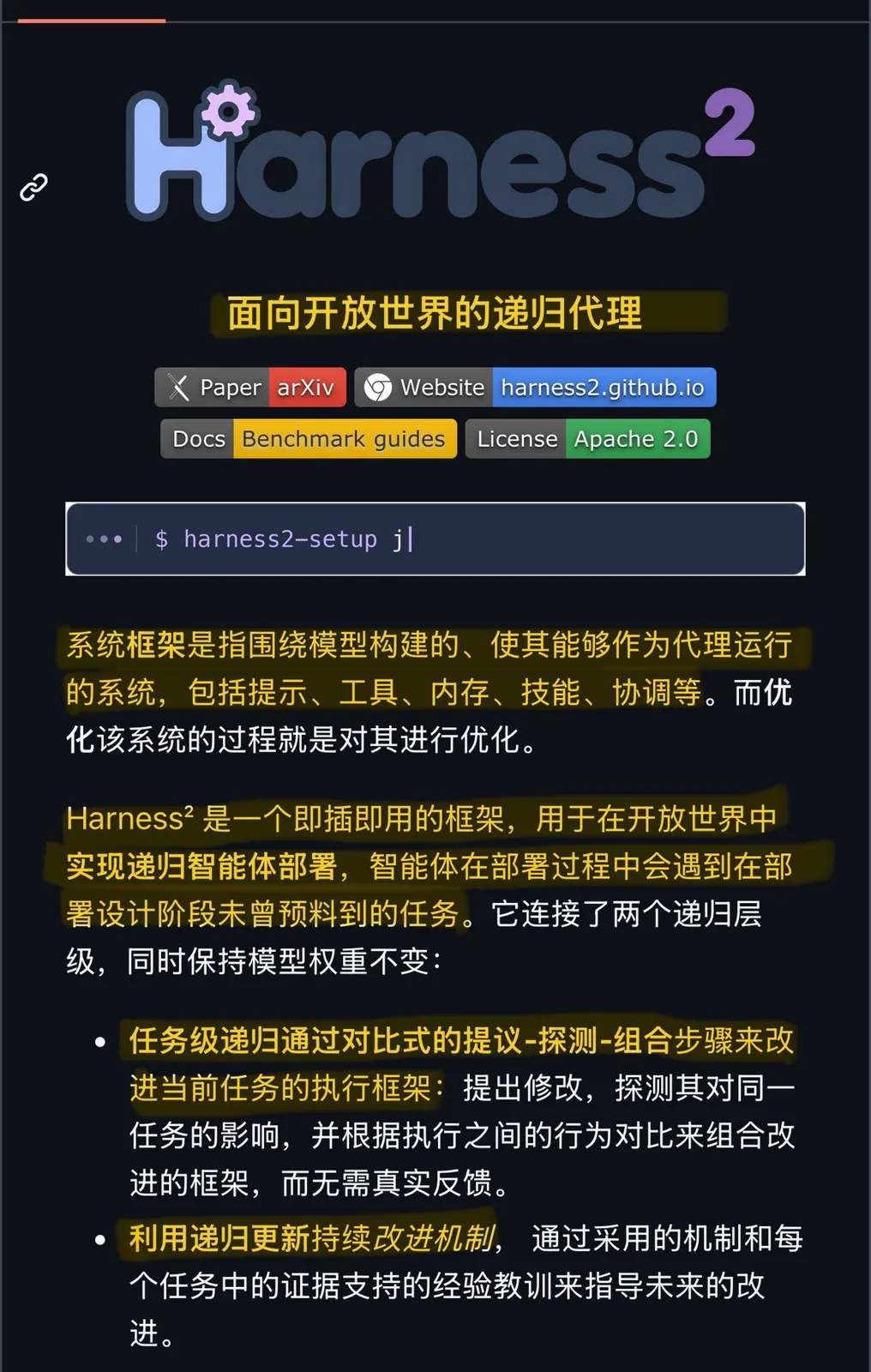
Image source: https://x.com/NFT_Chen/status/2111873617084756390 (@NFT_Chen)
In conventional LLM agent architectures, teams typically deploy static prompts, tools, and memory parameters, relying on manual auditing or model fine-tuning to elevate performance. Google’s open-source framework, Harness², introduces a practical paradigm by keeping model weights frozen while autonomously optimizing prompts, tool registries, memory schemas, and skills through self-directed iteration.
Weight-Frozen Self-Improvement Architecture
Harness² refines operational execution layers without requiring parameter weight changes. As shared by @NFT_Chen, when an agent encounters a new task, the framework synthesizes multiple candidate configuration versions covering prompt structures, tool bindings, memory schemas, and skills. It executes these variants against the task and compares their operational outputs. Crucially, this cycle requires neither ground-truth labels nor human grading; it synthesizes an improved configuration directly from comparative evaluation, reducing adaptation costs in open-ended workflows.
Cross-Task Experience Transfer and Domain Performance
Beyond isolated tuning, Harness² preserves proven configurations and retrospective lessons across tasks. Effective tool patterns and prompt constraints discovered during prior assignments remain stored, serving as foundational defaults for subsequent workloads. In benchmark tests across realistic office and legal environments shared by @NFT_Chen, agents surpassed original baselines in initial rounds, reaching a score gain of up to 11.5 points across multi-round iterations.
Environment Setup and Operational Caveats
The implementation shared by the original author relies on Python 3.12 and the uv package manager. Developers can configure the environment via uv venv --python 3.12 .venv && source .venv/bin/activate && uv pip install -e '.[render]' and test branching via harness2-demo --output runs/demo --k 2. In terms of caveats, the 11.5-point boost reflects specific office and legal tasks, so performance variance across general domains is expected. In addition, because the primary reference links were shared via t.co short URLs, independent inspection of the upstream repository is recommended before production use.