DeepSeek Harness Team Unveils Super-Agent Architecture and Verification Prototype
The DeepSeek Harness team has published a Super-agent system architecture featuring two-tier Router-Worker separation, three-tier execution decoupling (BYOM), a
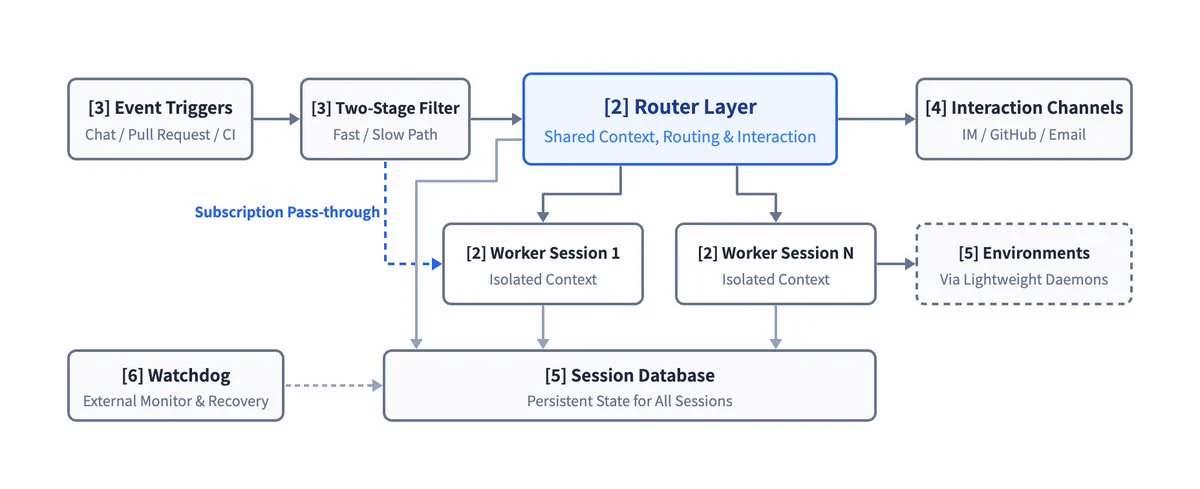
On November 1, 2026, the DeepSeek Harness team (including Yujia Qiao) published an architectural overview and an open-source verification repository, dsh-superagent-prototype, via its official X account (@DeepSeekHarness). The design targets structural bottlenecks that limit conventional single-session AI agents—specifically context saturation and response latency during long-running, multi-step tasks.
Image source: DeepSeek Harness / X (@DeepSeekHarness)
When a single conversational thread handles high-level planning, code execution, and external event monitoring simultaneously, accumulated logs gradually degrade reasoning speed and instruction adherence. To build a persistent, proactive, and durable agent system, the DeepSeek Harness team separated interaction management, task execution, and infrastructure state into distinct layers.
Two-Tier Router-Worker Separation and Bottleneck Mitigation
The core architectural shift splits user-facing coordination from background execution across two specialized tiers:
- Router Tier: Dedicated strictly to global user interaction and task dispatching. Because the Router does not execute heavy workloads directly, users can inject new instructions or redirect priorities mid-task without blocking the conversational interface.
- Worker Tier: Executes assigned tasks within isolated context windows. Each Worker retains only the context relevant to its specific job, preventing verbose execution logs from one task from polluting the reasoning accuracy of parallel tasks.
To keep throughput stable under continuous external signals, the architecture incorporates four supporting mechanisms:
- Event Filtering (Fast/Slow Path): Incoming signals are triaged into a Fast Path for lightweight responses or a Slow Path for deeper reasoning, avoiding unnecessary compute overhead.
- Thread Subscription and Pass-Through: Events from specific conversation threads or channels are routed directly to subscribed Workers, minimizing relay overhead.
- Inline and Spill Context Caching: Frequently accessed working data stays in fast inline memory while inactive history spills to external storage, keeping active context windows manageable.
- Asynchronous ReAct Loop (
start/stop): The Reasoning-and-Acting execution cycle is built to start and stop asynchronously rather than locking a synchronous request-response turn.
Three-Tier Compute, State, and BYOM Environment Decoupling
Maintaining a continuous agent workflow across personal workstations is often disrupted when a developer closes a laptop or disconnects from the network. The DeepSeek Harness architecture addresses this by decoupling runtime responsibilities across three layers:
- Compute: Runs inside cloud containers to sustain agent reasoning loops and scheduling.
- State: Persists task progress and context histories in an external database.
- Execution Environment (BYOM): Connects to a local daemon running on the developer's own machine (Bring Your Own Machine) only when local file operations or workstation commands are required.
Because compute and state reside in the cloud and database layers, an active agent session remains alive even when the local development machine is powered off or suspended.
Prototype Scope and Documented Limitations
Partial verification code for this architecture has been released on GitHub under github.com/deepseek-ai/dsh-superagent-prototype. Developers evaluating the repository should keep several documented caveats in mind:
- Verification Prototype, Not a Production Release:
dsh-superagent-prototypeis an experimental plugin intended to validate architectural concepts rather than an official, production-ready DeepSeek product. - Features Disabled by Default: Certain implemented capabilities, including asynchronous task execution, are present in the codebase but are not enabled out of the box.
- Unresolved Security and Prompt Injection Risks: Connecting a persistent cloud loop directly to a local workstation endpoint (the BYOM daemon) introduces significant attack surfaces; the authors explicitly note that security hardening and prompt injection defenses remain open challenges.
Taken together, pairing the two-tier Router-Worker model with three-tier BYOM decoupling offers a clear blueprint for combining cloud-level session durability with local developer control. However, given its early prototype status, disabled-by-default async features, and open security requirements around local daemon access, the repository is best approached as an architectural reference rather than a drop-in production tool.
Sources
- DeepSeek Harness Article: Super-agent Architecture Overview
- DeepSeek Harness Official X (
@DeepSeekHarness): 2026-11-01 Announcement Post - GitHub Repository: deepseek-ai/dsh-superagent-prototype