DeepSeek's Open GPU Kernel Collection DeepGEMM: What the Original Post Claims
X user @Ryrenz introduced DeepSeek's GPU operator library DeepGEMM as open source. This dev-tool brief summarizes the claimed components, the DeepJIT approach,
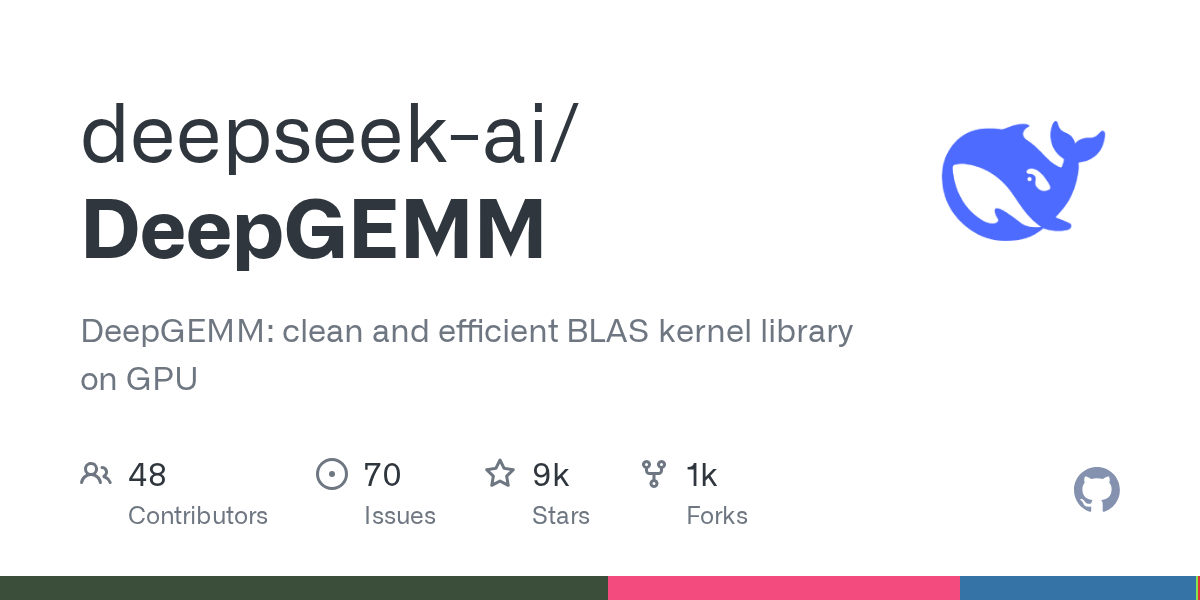
X user Ren (@Ryrenz) wrote on October 11, 2026 that DeepSeek had open-sourced DeepGEMM, the GPU operator library it uses for model training. According to the same post, the project had 8,909 GitHub stars and 1,401 forks at the time of writing, and an Ascend (Shengteng) version was released on September 30. Everything below summarizes claims made in that post; none of it has been independently verified against the repository.
What DeepGEMM is claimed to be
According to the post, DeepGEMM collects recurring GPU compute primitives for large-model inference into a single CUDA codebase, with the stated aim of reducing the work of maintaining separate kernels per precision and recompiling per architecture. The listed components are:
- FP8, FP4, and BF16 matrix-multiplication kernels
- Fused MoE kernels with overlapped communication
- The DeepSeek v3.2 lightning indexer scoring kernel
The author adds that the library borrows ideas from CUTLASS and CuTe while avoiding an overwhelming template structure, keeping modifications manageable. That assessment is the author's opinion, not an independent code review.
Claimed install and usage behavior
The post says all kernels compile at run time through DeepJIT, with no compilation step at install time, which the author frames as saved CUDA build waiting time.
The GitHub link in the post is an unexpanded t.co short URL, so this article does not assert a canonical repository address. It likewise gives no install commands, supported clients, license terms, or compatible GPU list. Developers should confirm the official repository page and its documentation before adopting anything.
Performance figures and verification limits
Performance is reported strictly as secondhand vendor-side claims: on par with or ahead of expert-tuned libraries across various matrix shapes, peaking at 1,550 TFLOPS on an H800. No measurement conditions or scope accompany the figure in the post, so it must not be read as a guarantee.
Reply reactions were reserved: one commenter wrote that real speedups depend on one's own inference setup, while another noted potential value for small-team MoE deployment and inference on Chinese domestic accelerators (Ascend). Those are expectations, not evidence.
In short, DeepGEMM can only be described here as a claimed inference-focused GPU kernel collection. The star and fork counts, the Ascend release, and the performance figures are all assertions from the original post. Interested developers should compare documentation and benchmark conditions once the canonical repository is confirmed.
Sources
- Ren (@Ryrenz) X post (2026-10-11): Original DeepGEMM introduction