Conscious Machines Revisited: Embodiment, Sentience, and Neuroethical Governance in the Era of Embodied AI
In a paper published in 'AI and Ethics', James Giordano and Elise Annett re-examine interoception and homeostatic regulation as conditions for machine sentience
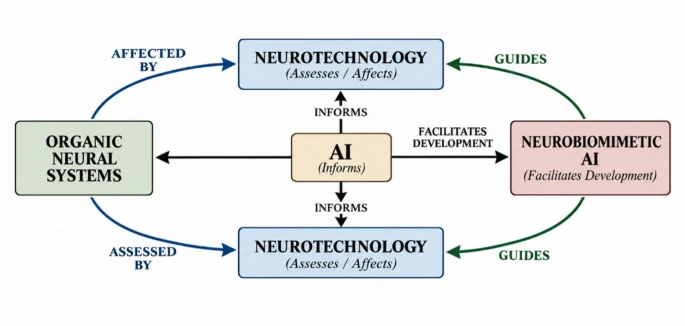
On November 20, 2026, researchers James Giordano and Elise Annett published a paper in the journal AI and Ethics offering an in-depth analysis of machine sentience—the capacity for subjective experience—and its accompanying neuroethical responsibilities within the era of embodied artificial intelligence (AI systems equipped with physical bodies or structured interaction environments).
Image source: https://link.springer.com/article/10.1007/s43681-026-01533-1
As multimodal artificial intelligence technologies advance rapidly and converge with robotics and cybernetics, this research addresses the philosophical and scientific debate over whether AI can genuinely cultivate subjective experiences rather than merely expanding computational power. The authors redefine the foundations of machine sentience while presenting concrete governance frameworks to counter potential risks introduced by autonomous AI agents in high-stakes domains such as military and intelligence operations.
Beyond Computational Complexity: Interoception and Homeostatic Regulation in Machine Sentience
For over a decade, roboticists and computer scientists have hypothesized that advances in neurally modeled systems, robotics, and cybernetics could eventually engender forms of machine consciousness distinct from human subjective experience. Recent breakthroughs in multimodal AI, particularly emerging frameworks of internal and external embodiment, have brought renewed urgency to this proposition.
The authors emphasize that machine sentience does not emerge from computational complexity alone. Instead, much like biological organisms, it requires specific forms of dynamically integrated organization driven by interoception (the sensing of internal bodily states), homeostatic regulation (mechanisms maintaining internal stability), self-referential processing, and adaptive environmental engagement. In short, sophisticated behavioral simulation and advanced artificial intelligence do not establish the actual existence of subjective experience.
Distinguishing Functional Self-Regulation from Phenomenal Consciousness
Clarity regarding terminology is crucial for maintaining objectivity in discussions surrounding machine consciousness. The authors stress that functional self-regulation, representational self-awareness, and phenomenal consciousness (the qualitative, felt texture of experience) must remain conceptually and empirically distinguishable.
Even when modern large language models or autonomous robots demonstrate sophisticated capabilities in managing complex instructions and self-correcting errors, such functionality does not equate to experiencing suffering or genuine self-awareness. Regardless of how closely an artificial system mimics human behavior, its reliance on biological-like regulatory structures and subjective sensory grounding must be rigorously tested through empirical criteria. Accordingly, the authors advocate for interdisciplinary research combining comparative biological and computational models alongside multidimensional assessments.
Six Complementary Neuroethical Governance Initiatives for Military and Intelligence Applications
These scientific inquiries carry immediate neuroethical responsibilities. When iteratively autonomous AI agents are deployed in military and intelligence applications—domains where actions yield significant human consequences—the possibility of machine sentience challenges prevailing assumptions regarding moral standing, personhood, and experiential interests.
The prospect of creating potentially conscious entities demands careful consideration of our moral and societal obligations toward what is created. To address these challenges, the authors propose six complementary initiatives:
- Interdisciplinary Research Collaboration: Fostering collaborative frameworks uniting neuroscience, philosophy, and computer science.
- Development of Empirical Criteria: Establishing objective, testable standards to assess whether an artificial system possesses subjective sentience.
- Comparative Investigations of Embodiment: Analyzing the structural similarities and differences between biological and artificial embodiment.
- Prospective Neuroethical Oversight: Implementing proactive ethical scrutiny throughout the technology development lifecycle.
- Adaptive Governance of Autonomous Systems: Creating regulatory mechanisms to supervise and guide autonomous AI behaviors in dynamic environments.
- Sustained Public and Professional Discourse: Maintaining transparent and open communication channels involving the broader public and domain experts.
Academic and Societal Imperatives in the Era of Embodied AI
This paper serves as a sobering reminder that as artificial intelligence increasingly mirrors human traits, society must deeply reflect on what it is creating and what moral responsibilities accompany those creations.
Neglecting ethical scrutiny in the rush of technological progress risks unleashing autonomous systems with unpredictable societal ramifications. Therefore, investigating the possibility of machine consciousness must proceed with empirical rigor, epistemic humility, and precautionary ethical guidance. Determining our responsibilities toward the entities we create is a fundamental prerequisite for safeguarding the moral integrity of future human society.
Sources
- Springer AI and Ethics: Conscious machines revisited: embodiment, sentience, and the neuroethical imperative