Comparing Claude Opus 5.5 Effort Levels: Cost, Time, and Three.js Coding Tips
An empirical comparison of High, Extra High, Max, and Ultra reasoning effort settings when coding a 25-second Three.js 3D animation with Claude Opus 5.5.
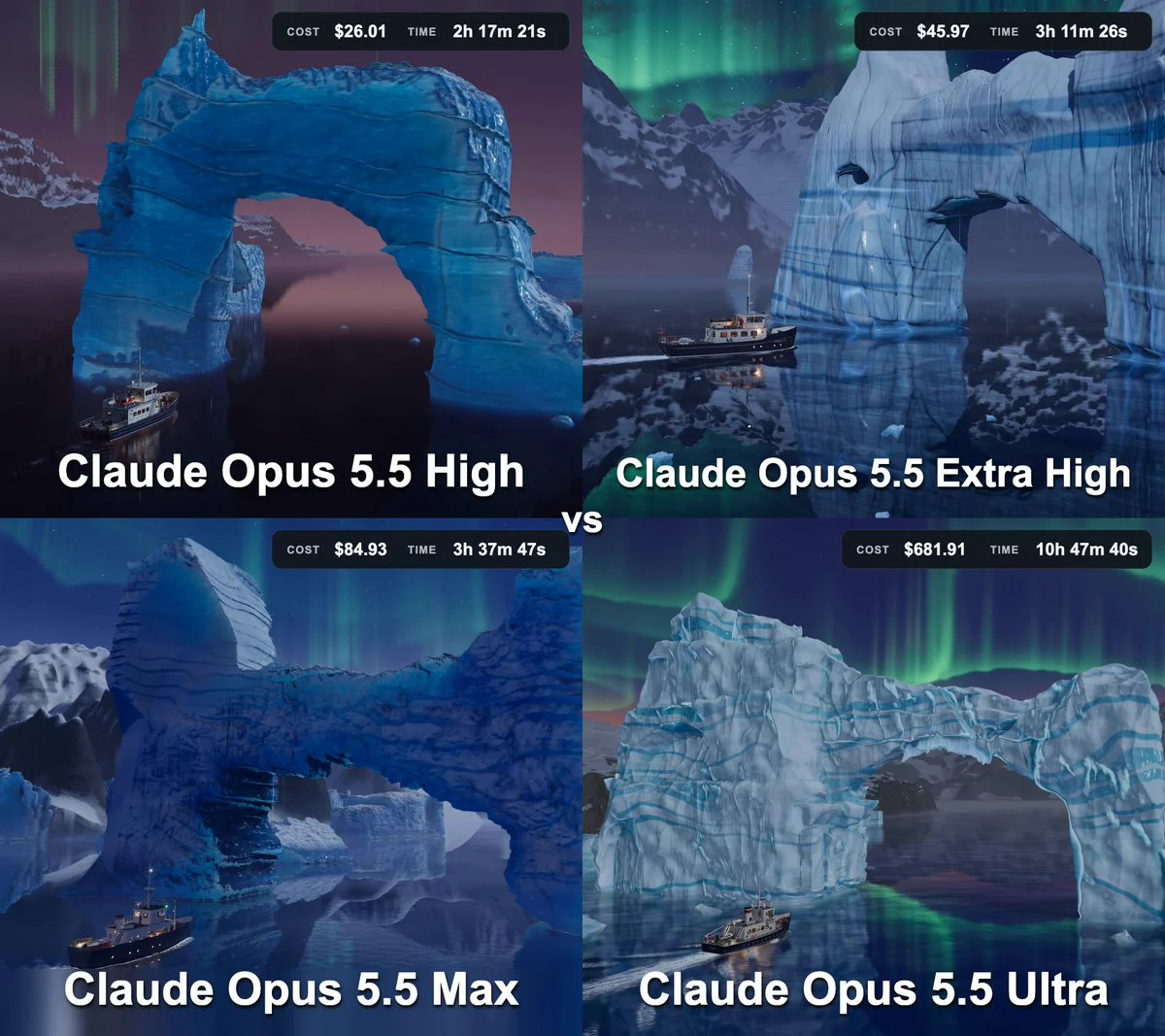
Software engineer Tony (@EnvolDev) has published empirical benchmark data evaluating how Claude Opus 5.5 reasoning effort settings directly impact API-equivalent costs and generation latency. The experiment maintained the identical model and prompt across all runs, varying only the effort level to generate Three.js code for a '25-second 3D animation of a boat sailing through an ice arch.'
Image source: @EnvolDev via X
While the functional objective was clearly defined, the prompt left creative freedom for the model to interpret ice geometry, framing, and lighting. The results offer clear metrics on how reasoning intensity scales across visual programming tasks.
Benchmark Results Across Four Effort Levels
Testing the identical coding instruction across High, Extra High, Max, and Ultra reasoning modes revealed dramatic divergences in runtime and computational expenditure:
- High: $26.01 · 2h 17m 21s
- Extra High: $45.97 · 3h 11m 26s
- Max: $84.93 · 3h 37m 47s
- Ultra: $681.91 · 10h 47m 40s
The top-tier Ultra setting incurred a staggering $681.91 and required 10 hours, 47 minutes, and 40 seconds to write code for a single 25-second animation. This represents a 26-fold increase over the High setting and more than an 8-fold jump compared to the Max setting, highlighting the exponential resource consumption at extreme reasoning levels.
Why Extra High Hits the Production Sweet Spot
Visually, the Three.js scene produced under Ultra delivered the most refined aesthetic detail. However, Tony concluded that the marginal visual improvement failed to justify the 26x cost surge and near-11-hour latency.
Instead, Extra High ($45.97, 3h 11m 26s) emerged as the clear operational sweet spot, balancing output quality, turnaround time, and expense. For an incremental $20 and approximately 54 minutes over High, Extra High produced significantly higher structural reliability and visual fidelity, making it the author's recommended default for creative coding and design-heavy workflows.
For teams building interactive 3D scenes or complex visual layouts, establishing Extra High as the production baseline provides consistent quality without risking unbounded generation cycles.
Cost Modeling Nuances and Task Complexity Considerations
The author noted that the reported figures represent API-equivalent estimates in a workspace environment rather than direct subscription surcharges. Real-world costs will inherently vary depending on the developer's agent routing setup, system skill harnesses, and prompt scaffolding.
Task boundaries also determine how effectively increased effort translates into practical value. In open-ended visual tasks like Three.js animation where the model must conceptualize spatial composition and procedural assets, elevated reasoning improves creative execution. However, without pre-allocated time and token caps, maximum settings like Ultra risk spending hours in repetitive internal verification passes that yield diminishing returns.
Original source
- Tony (@EnvolDev) on X: Claude Opus 5.5 High vs Extra High vs Max vs Ultra 🧊