ComfyUI: Open-Source Node-Based AI Engine Running on 4GB VRAM
ComfyUI is an open-source node-graph GUI and backend inference engine designed to execute cutting-edge diffusion models on local hardware using asynchronous wei
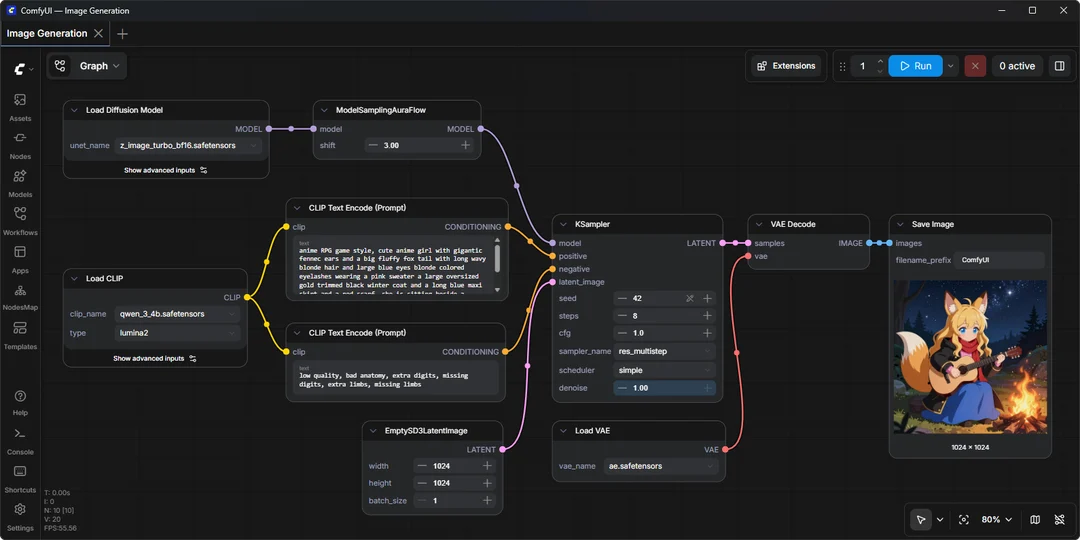
ComfyUI is an open-source diffusion model GUI and backend inference engine that gives creators modular node-graph control over image and video generation pipelines. It has become a cornerstone tool for artists, researchers, and developers seeking full control over generative workflows on local hardware without paying recurring cloud subscriptions.
Image source: Comfy-Org
First created in January 2023, the repository maintains an active weekly release cycle. As of November 10, 2026, the team released its latest stable update, v0.45.0, with the project surpassing 146,000 GitHub stars as an established backbone of the local AI generation ecosystem.
Asynchronous Weight Streaming and Consumer VRAM Optimization
The technical hallmark of ComfyUI lies in aggressive resource scheduling and its asynchronous weight streaming architecture.
- Memory Efficiency: By streaming weights asynchronously, the engine can run demanding open-source models on configurations as lean as 4GB VRAM and 8GB system RAM.
- Pipeline Granularity: Built-in support for model offloading, weight quantization, and partial graph re-execution keeps local GPU compute saturated while avoiding redundant passes.
- Hardware Agnostic: Beyond NVIDIA GPUs, ComfyUI supports AMD, Intel, Apple Silicon, and Ascend hardware across Windows, Linux, and macOS platforms.
Unlike earlier all-in-one WebUI wrappers that treated generative models as opaque single-step processors, ComfyUI breaks pipelines into distinct data nodes, minimizing memory spikes during complex multi-stage tasks.
Native Multimodal Support and Pure Offline Execution
ComfyUI maintains wide native compatibility across leading open-source generative architectures:
- Image Generation and Editing: Direct support for Flux.1, Flux.2, SDXL, SD3.5, and Hunyuan Image 2.1, with drag-and-drop nodes for LoRA blending, ControlNet conditioning, inpainting, and outpainting.
- Video Synthesis: Ready-to-use graphs for Wan 2.1/2.2, HunyuanVideo 1.5, and LTX-Video 2/2.3.
- Audio, 3D, and Multimodal Vision: Nodes spanning Hunyuan3D 2.1, TripoSplat, Stable Audio 3, MiniMax Music 3, and text/multimodal LLMs including Gemma and Qwen.
- Deterministic Offline Control: The core engine avoids external calls unless explicitly directed. Supplying the
--offlineflag fully isolates execution and disables optional partner API nodes, keeping workflows private and self-contained.
Installation Paths and Practical Trade-offs
Users can deploy ComfyUI through several primary paths based on technical requirements:
- Desktop Application: A packaged installer for Windows and macOS that simplifies dependency handling.
- Manual Portable / Source Installation: Setup via Git clone and virtual environments, suitable for customized developer environments and headless servers.
- API Integration: Workflows exported as JSON can be executed programmatically via local HTTP API endpoints, embedding node graphs directly into production software.
While lightweight streaming makes large model execution accessible on modest hardware, physical constraints remain. Generating high-resolution video frames or running multiple concurrent workflows on lower VRAM GPUs will inevitably take significantly longer compared to higher-end workstation GPUs. Furthermore, closed-source models accessible via partner nodes still require separate API credentials and network access.
Sources
- GitHub Repository: Comfy-Org/ComfyUI
- Official Website: Comfy.org