Codex Prompt Tip: Achieving Skill-Free Autonomous Coding with GPT-6 Sol
Switching Codex to GPT-6 Sol enables end-to-end development without external skills. Here is the verified prompt pattern, 3-minute workflow, and token savings f
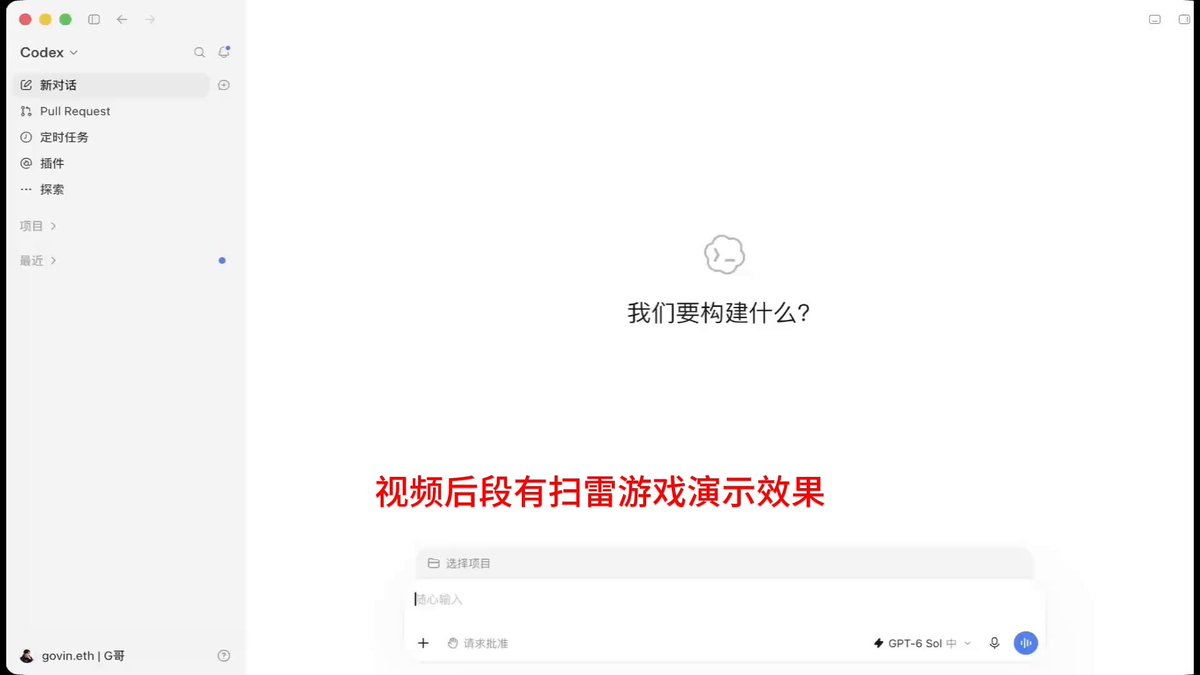
AI developer @goan999999 (govin.eth | G哥) shared a practical testing report and prompt tip demonstrating how switching Codex to the new GPT-6 Sol model enables autonomous end-to-end software development without invoking external Skills. By supplying a single outcome-focused prompt, the agent completed requirements planning, code generation, testing, and bug fixing to deliver a fully functional web application in just three minutes, with the developer reporting a 90% reduction in development time and a 50% decrease in token consumption compared to GPT-5.6 Sol.
Image source: X @goan999999
Measured Performance Gains: 90% Faster Delivery and 50% Fewer Tokens
Rather than configuring specialized subagents or injecting third-party toolkits, @goan999999 tasked Codex with creating a fully playable web-based Minesweeper game directly inside the browser using only a single natural language prompt.
According to the developer's hands-on testing, switching Codex to the latest GPT-6 Sol reduced total development time by approximately 90% while cutting token consumption by 50% compared to GPT-5.6 Sol, completing the game in just 3 minutes. In the follow-up discussion thread, another user (@govin999999) observed that "the speed is indeed fast; with 5.6 Sol, it would probably have taken about 10 minutes." @goan999999 reinforced this assessment, noting that account quota consumption was minimal and urging developers to switch to the 6 Sol variant.
According to official release notes and benchmark reports, GPT-6 Sol features a 50% API price reduction compared to the promotional rates of GPT-5.6. Unlike the flagship GPT-6 Astra, which rapidly exhausted the 5-hour usage quota on Plus accounts within one or two intense projects, GPT-6 Sol provides substantially greater operational headroom for daily coding sessions.
Eliminating Skill Overhead: Prompt Pattern for Self-Contained Execution
The most compelling insight from this workflow is the explicit instruction to bypass external skills and force the core model to self-resolve the task.
While developers frequently configure external plugins and agent skills to expand Codex's reach, models can easily become trapped in protracted pre-planning cycles or repetitive tool-calling loops on everyday tasks, inflating latency and token spend. With GPT-6 Sol's upgraded autonomous coding and browser-based verification capabilities, constraining the agent to built-in reasoning while declaring strict end-state specifications yields far faster execution.
The prompt used in the demonstration is as follows:
从 0 做一个可以直接玩的网页版扫雷,要求 9×9 棋盘、10 个雷、左键翻格、右键插旗、自动展开空白区域、显示雷数和计时、支持胜负判断和重新开始,UI 做成高级深色风格;不需要调用任何 Skill,你自己完成规划、开发、测试、找 Bug 和修复,直到游戏可以正常运行。
- English Translation and Structural Breakdown: "Build a playable web-based Minesweeper game from scratch. Requirements: a 9×9 board, 10 mines, left-click to reveal cells, right-click to place flags, automatic expansion of blank areas, mine count and timer display, win/loss determination and restart support, and a polished dark-themed UI. Do not invoke any Skills—complete the planning, development, testing, bug hunting, and fixing yourself until the game runs properly."
This prompt structure enforces clear functional boundaries (game rules, input handling, timer, dark mode aesthetic) while explicitly dictating 不需要调用任何 Skill ("Do not invoke any Skills"). By instructing the agent to independently manage planning, implementation, verification, and bug resolution until the game is demonstrably playable, the developer avoids intermediate micromanagement. The model executes its built-in browser inspection and debugging passes autonomously, handing over a finished artifact.
Practical Caveats and Model Behavioral Characteristics
When adopting this autonomous prompt pattern in real-world workflows, developers should account for GPT-6 Sol's specific architectural inclinations and tooling requirements.
First, GPT-6 Sol prioritizes lean, pragmatic execution over expansive architectural boilerplate. In comparative benchmarks against heavyweight flagships like Claude Opus 5.5, while Opus produced an extensive 3,600-line clone with custom terminal and Git integration, GPT-6 Sol synthesized a clean 600-line React and Monaco editor workbench in 27 minutes. For targeted single-page applications, interactive widgets, and self-contained utilities, this pragmatic focus delivers unmatched turnaround and cost-efficiency. However, for multi-layered enterprise software, developers should still supply explicit architectural boundaries.
Second, verify your account tier and supported workspace environments. According to official release notes, GPT-6 Sol is rolling out across Codex and ChatGPT Work for Plus, Pro, Business, Enterprise, and Edu subscribers, while standard ChatGPT Chat is not supported. In addition, Enterprise workspaces require administrators to enable the model manually, meaning access depends on rollout status and workspace policy.
Third, configure reasoning effort according to task complexity. In official OSWorld 2.0 offline evaluations, GPT-6 Sol scored 60.5% at the xHigh effort tier, approaching Claude Opus 5 at medium effort (60.3%) while reducing single-task costs by approximately 80%. Hands-on developer testing similarly utilized High reasoning effort across coding cases to achieve fast turnaround and autonomous execution, suggesting that demanding agent tasks benefit from setting reasoning effort to High or xHigh.