ClosedLoop Claude Plugins: Open-Source Multi-Agent SDLC Workflow for Claude Code
An analysis of ClosedLoop's open-source multi-agent plugin suite for Claude Code, modularizing the software development lifecycle from bootstrapping and PRD pla
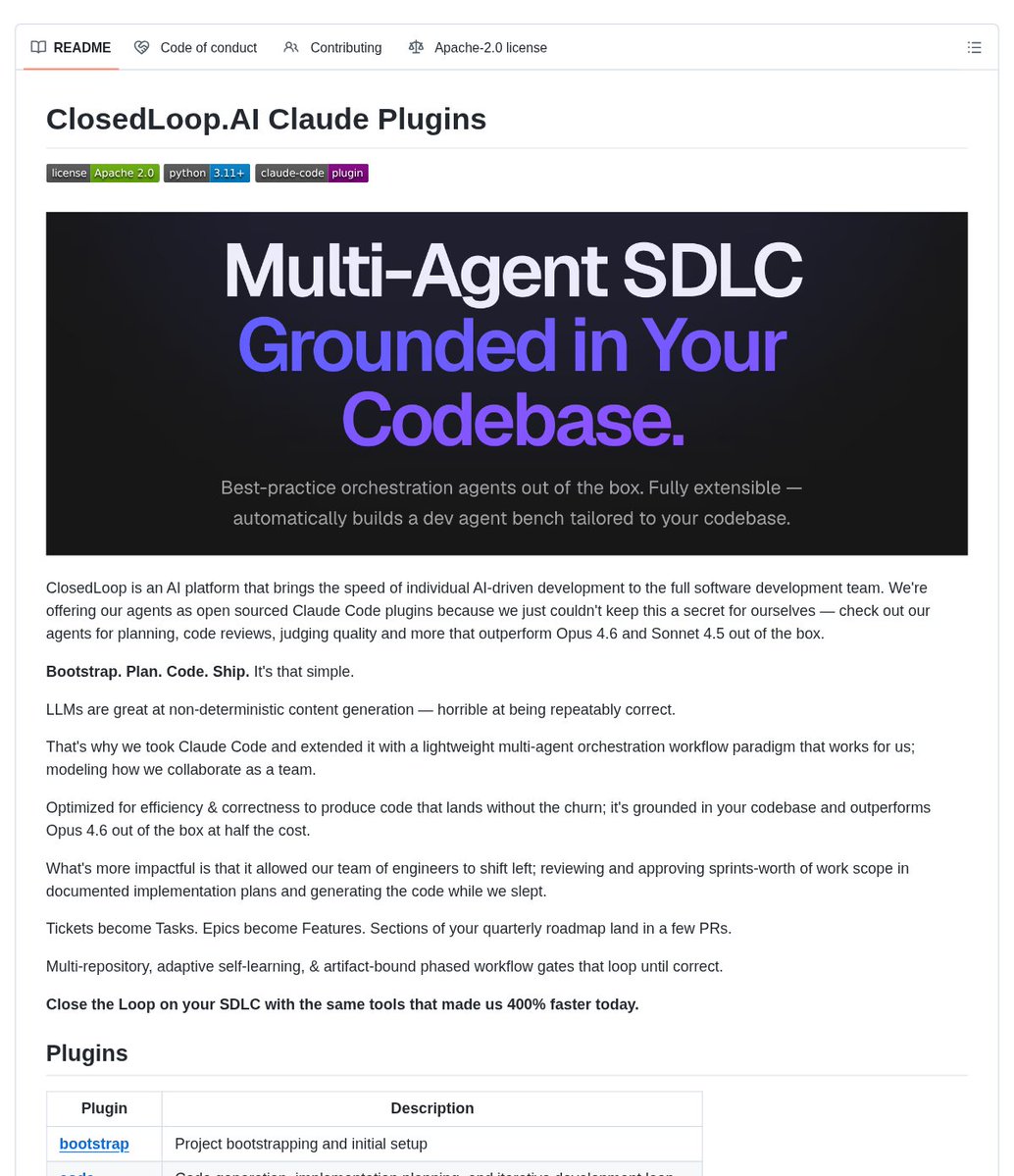
On October 3, 2026 (KST), ClosedLoop officially open-sourced claude-plugins (under the Apache-2.0 license) on GitHub, introducing a dedicated multi-agent plugin collection built for Anthropic's Claude Code environment. Moving past the conventional single-agent paradigm where one model handles an entire task from prompt to output, this toolset divides the Software Development Life Cycle (SDLC) into a structured, team-based engineering pipeline grounded in the codebase.
Image source: ClosedLoop / @DanKornas
Traditional AI coding workflows typically rely on prompting a single agent with broad requirements and hoping the generated output works without defect. ClosedLoop replaces this brittle approach by modeling how real software engineering teams collaborate—breaking development down into distinct stages for planning, implementation, code review, quality verification, and organizational knowledge capture, with explicit artifact-bound validation gates at every step.
A Modular SDLC Architecture Across Six Independent Plugins
ClosedLoop's claude-plugins breaks down the core phases of software delivery into six independent plugin modules:
| Plugin | Primary Role and Capabilities | Invocation Interface |
|---|---|---|
bootstrap | Project scaffolding and initial context setup before work begins | Manual marketplace install |
code | PRD-driven implementation planning, code generation, and iterative loops | claude /code:code --prd requirements.md |
code-review | Automated GitHub PR diff analysis and inline review comment drafting | claude /code-review:start |
judges | Multi-stage LLM-as-judge evaluators for plan and code quality | Internal evaluation pipeline |
platform | Claude Code expert guidance, prompt engineering, and artifact management | Runtime platform layer |
self-learning | Pattern capture and reusable organizational knowledge retention | Self-learning loop |
Through this modular division of labor, high-level requirements turn into actionable tasks, and larger epics are decomposed into structured features that land cleanly across multiple well-scoped pull requests (PRs).
Artifact-Bound Phased Gates and User-Scoped Runtime Management
A cornerstone of ClosedLoop's architecture is its 'artifact-bound phased workflow gates'. Each stage generates a concrete artifact—such as an architectural plan, task breakdown, code diff, or review checklist—and loops iteratively until passing deterministic evaluation gates.
- One-Click User-Scoped Runtime Installation: The five core runtime plugins (
code,code-review,judges,platform, andself-learning) install at the user scope and support automatic updates. The installer automatically repairs disabled plugins and resolves stale project-scoped duplicates. - Standalone
bootstrapPlugin: Because project bootstrapping is an upfront setup task rather than an ongoing development runtime dependency,bootstrapis decoupled from the default runtime bundle and available separately via the plugin marketplace. - Cross-Harness Extensibility: Beyond Claude Code, ClosedLoop is expanding metadata compatibility (
.codex-plugin/plugin.json,.agents/plugins/marketplace.json) to support OpenAI Codex harnesses, beginning with thecode-reviewplugin. - Harness-Neutral Evaluations: The repository includes an
evals/code-review/directory providing standardized benchmark cases for review quality, finding verification, and inline PR comment drafting across different execution harnesses.
Practical Value and Engineering Preview Considerations
ClosedLoop reports that shifting engineer focus toward reviewing and approving structured implementation plans while agents generate code allowed their team to accelerate development velocity by up to 400%, claiming their agents outperform standalone Opus 4.6 and Sonnet 4.5 out of the box at half the operational cost.
When evaluating claude-plugins for production workflows, engineering teams should keep several considerations in mind:
- Engineering Preview Status: The project is currently in an early engineering preview phase, making initial adoption and testing most suitable in trusted, controlled development environments.
- Independent Verification of Velocity Claims: The reported 400% speedup and cost reduction figures reflect ClosedLoop's internal benchmarks; actual productivity gains and review accuracy will vary based on repository complexity and team review standards.
- Multi-Agent Token Overhead: Because sequential planning, generation, review, and judging phases execute multiple model passes, small single-file hotfixes may incur higher token overhead compared to direct single-turn agent edits.
Sources
- GitHub Repository: closedloop-ai/claude-plugins
- Dan Kornas (@DanKornas) Official X Announcement: 2026-10-03 ClosedLoop Claude Plugins Release