How to Cut AI API Bills by 60% When Switching to Claude Opus 5.5: A 4-Step Settings Guide
A practical guide to cutting Claude Opus 5.5 API costs by up to 61%, moving beyond the basic 24% model discount through token pruning, effort tuning, and aggres
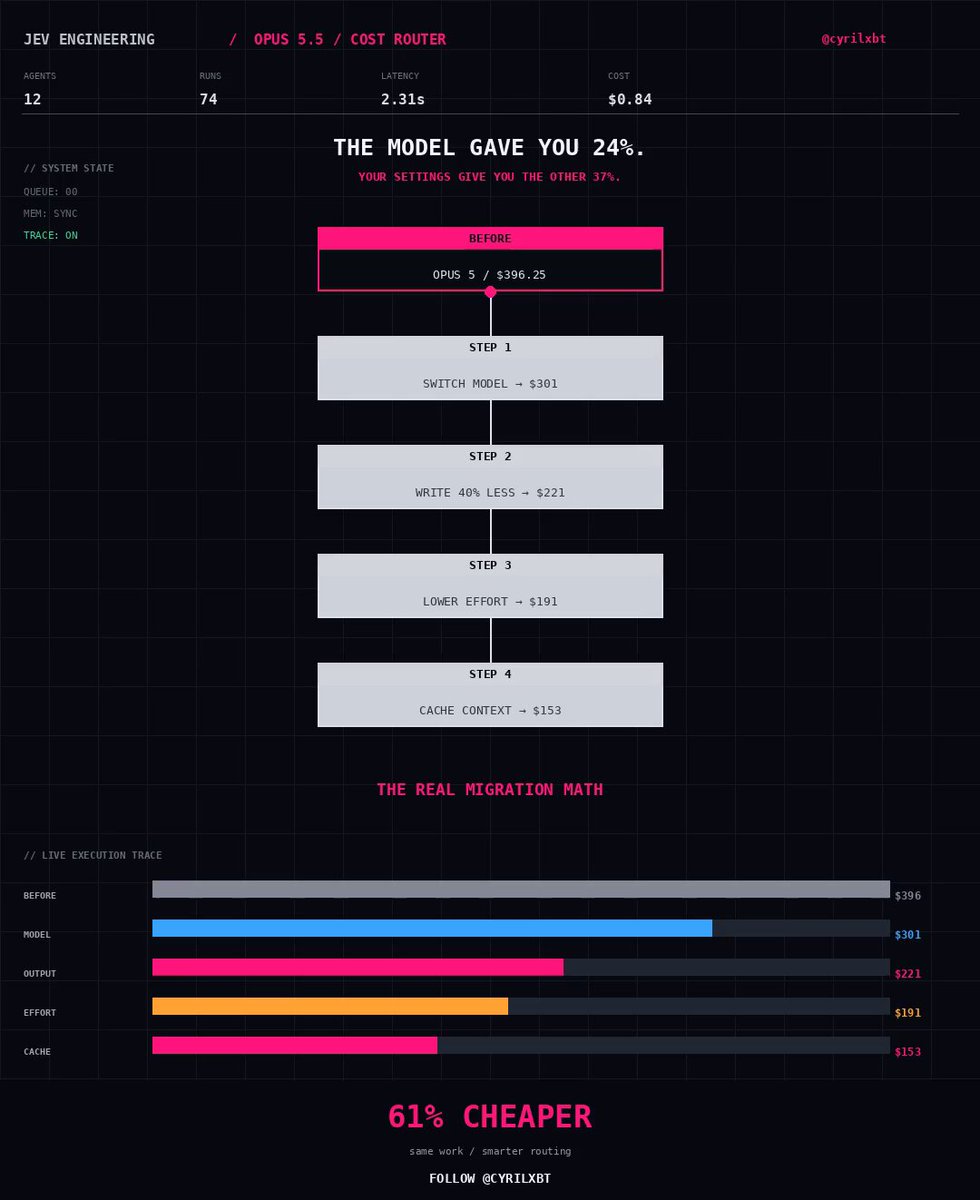
AI engineer and analyst Cyril (@cyrilXBT) has shared a concrete 4-step configuration guide on X detailing how engineering teams can cut their monthly AI API billing by up to 61% when migrating workloads to Anthropic's flagship Claude Opus 5.5 model. Rather than simply swapping out the model identifier to capture a baseline 24% price discount and stopping there, this workflow demonstrates how reconfiguring output generation and caching parameters can unlock an additional 37% in direct cost savings.
Image source: @cyrilXBT on X
When new frontier models launch, many development teams simply update their model strings and accept whatever discount appears on the headline pricing sheet. However, in production environments—particularly autonomous agent systems processing complex loops and heavy context—granular runtime settings govern the true monthly bottom line far more than sticker prices alone.
To illustrate the financial impact, Cyril modeled a representative agent workload processing 100 million (100M) input tokens and 10 million (10M) output tokens over a single month. Under legacy Claude Opus 5 pricing, this baseline configuration generated a monthly bill of $396.25:
- Cache reads: 80M tokens × $0.50 per million = $40.00
- Cache writes: 5M tokens × $6.25 per million = $31.25
- Uncached input: 15M tokens × $5.00 per million = $75.00
- Output tokens: 10M tokens × $25.00 per million = $250.00
- Monthly Baseline (Before): $396.25
1. Baseline Model Migration and Sticker Price Savings (Step 1)
The first step reflects the standard upgrade path: maintaining identical token consumption volumes while pointing requests to the Opus 5.5 model endpoint.
Opus 5.5 introduces reduced baseline token rates across the board: cache reads drop to $0.20/M, cache writes to $5.00/M, uncached inputs to $4.00/M, and output tokens to $20.00/M. Applying these revised rates to the original token distribution yields:
- Cache reads: 80M × $0.20 = $16.00
- Cache writes: 5M × $5.00 = $25.00
- Uncached input: 15M × $4.00 = $60.00
- Output tokens: 10M × $20.00 = $200.00
- Step 1 Subtotal: $16 + $25 + $60 + $200 = $301.00
This direct switch reduces the bill by 24% (from $396.25 to $301.00). While this headline reduction represents the savings most developers capture in initial screenshots, Cyril emphasizes that an additional 37% discount remains locked inside application settings.
2. Reducing Verbosity and Tuning Thinking Effort (Steps 2 and 3)
The second step capitalizes on the intrinsic efficiency of Opus 5.5 to curb unnecessary output generation.
Empirical measurements published by enterprise storage platform Box indicate that Opus 5.5 generates approximately 40% less verbose output than its predecessor without any degradation in reasoning accuracy. By designing prompts that allow the model to communicate concisely rather than generating superfluous prose, the 10 million output token workload contracts down to 6 million (6M) tokens.
- Step 2 Output Cost: 6M × $20.00 = $120.00 (a direct $80 reduction from Step 1)
- Step 2 Cumulative Total: $16 + $25 + $60 + $120 = $221.00 (a 44% discount off baseline)
The third step eliminates the common anti-pattern of running every API request at maximum reasoning effort. Because thinking cannot be turned off entirely in Opus 5.5, the parameter determining reasoning 'effort' serves as the primary operational dial.
Routine system calls such as document classification, prompt routing, JSON formatting, and summarization do not require heavy deliberation. Lowering the effort parameter on these routine calls preserves high reasoning budgets strictly for complex logic. Modeling this operational split yields an additional 25% reduction in total output tokens, dropping the volume from 6M to 4.5M tokens.
- Step 3 Output Cost: 4.5M × $20.00 = $90.00
- Step 3 Cumulative Total: $16 + $25 + $60 + $90 = $191.00 (a 52% discount off baseline)
3. Maximizing Prompt Caching and Cumulative Impact (Step 4)
The fourth step tackles the most frequently neglected optimization lever: caching repetitive context that is continuously retransmitted across API calls.
With Opus 5.5, cache read pricing dropped from $0.50 to $0.20 per million tokens—a 60% price reduction applied to the cheapest tier on the bill. Restructuring API payloads to move static system prompts, dynamic tool definitions, and repository context trees into persistent prompt cache blocks shifts uncached input volume down from 15M to 5M tokens, while elevating cache reads from 80M to 90M tokens.
- Cache reads: 90M × $0.20 = $18.00
- Cache writes: 5M × $5.00 = $25.00
- Uncached input: 5M × $4.00 = $20.00
- Output tokens: 4.5M × $20.00 = $90.00
- Final Monthly Total (After): $18 + $25 + $20 + $90 = $153.00
Completing all four steps brings the monthly workload cost down from $396.25 to $153.00, achieving a cumulative 61% cost reduction for the exact same agent work. The provider's model price cut accounted for 24%, while engineering-driven configuration and architecture yielded the remaining 37%.
Anthropic cites an average cost reduction of approximately 40% across typical production workloads. However, the precise savings realized by any team depend heavily on the proportion of billing attributable to output tokens and the volume of repetitive prompt context resent without caching. Teams preparing for an Opus 5.5 migration should prioritize evaluating these two configuration levers before adjusting anything else.
Original source
- Cyril's official post on X: How to cut your AI bill by 60% switching to Opus 5.5