Claude Code Cuts Latency via Per-Turn Gzip Compression and Cloud Session Pre-Startup
Anthropic announced a Claude Code update, using per-turn conversation gzip compression and typing-triggered cloud session pre-startup to cut response latency.
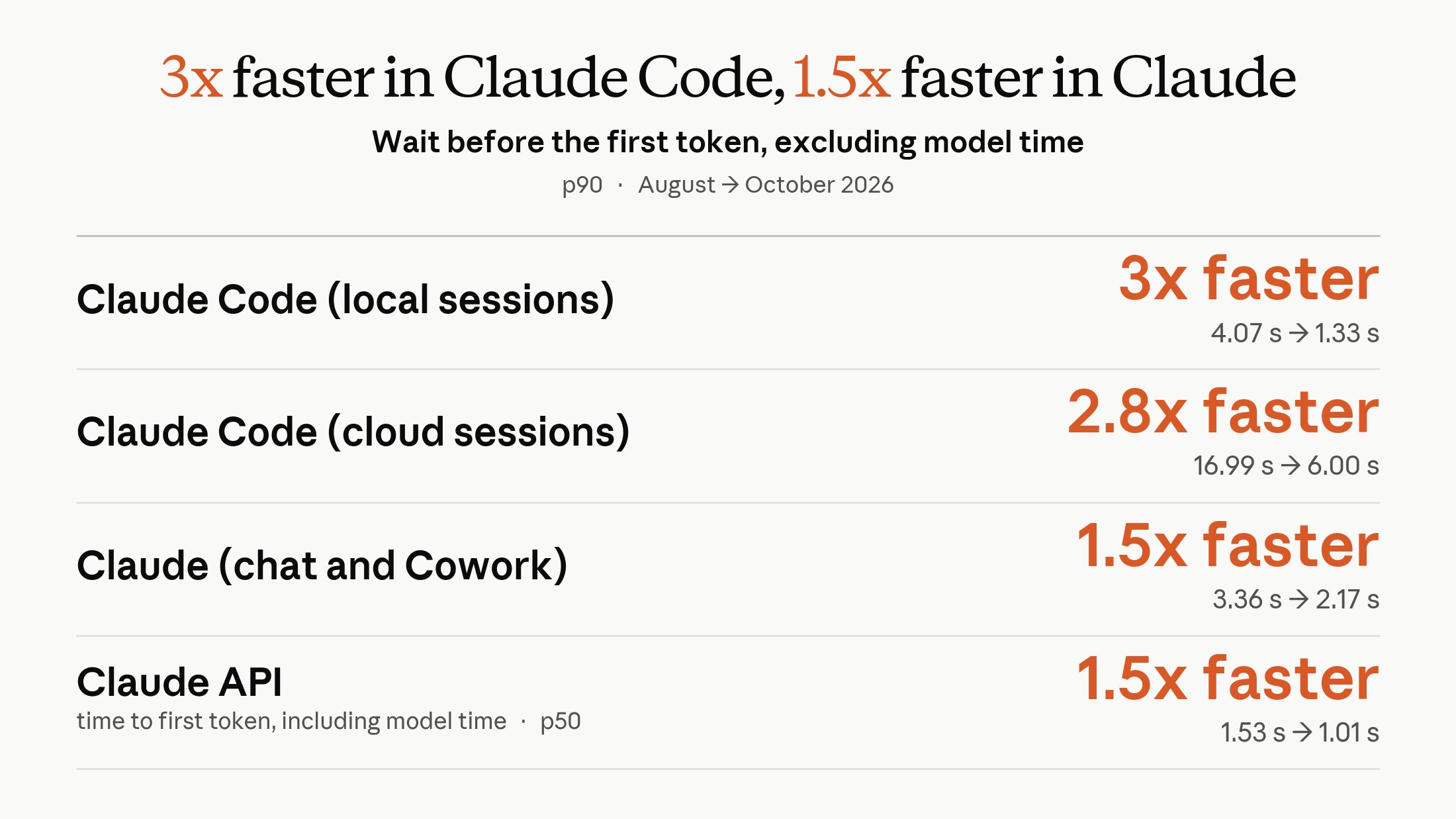
On October 17, 2026, Anthropic's official Claude developer team (@ClaudeDevs) announced a performance optimization update for Claude Code, its terminal-based coding agent harness. The release targets network payload transmission efficiency and initial response latency, rolling out immediately to all users through the latest Claude Code CLI update without requiring additional credits or subscription tiers.
This release focuses on two key pipeline optimizations: per-turn gzip compression of conversation payloads to shorten the time required for data to reach the model, and typing-triggered cloud session pre-startup that primes the backend runtime the moment a developer begins typing. Together, these enhancements systematically shave away waiting periods across iterative agent coding loops.
Per-Turn Conversation Gzip Compression: Reducing Payload and Network Transit Time
Claude Code operates directly within the developer's terminal, autonomously inspecting files, editing code, executing bash shell commands, and managing version control workflows.
Due to the nature of autonomous agent architectures, as an interactive session progresses, the accumulated context window expands rapidly. Each subsequent turn carries forward not only prior user prompts and assistant replies, but also extensive file contents, diff snippets, and tool execution outputs. Previously, Claude Code transmitted these conversational payloads across HTTP requests in uncompressed raw text format. For lengthy sessions spanning multiple complex modules, uploading large conversational and code payloads on every single turn introduced noticeable network transit delays before model inference could even begin.
- Per-Turn Gzip Compression (gzip conversation): Claude Code now compresses conversation payloads using gzip on every single turn before dispatching the request to Anthropic's inference endpoints.
- Bandwidth Efficiency and Payload Reduction: Compressing cumulative conversation histories and code payloads significantly reduces on-wire payload size, improving overall transmission efficiency.
- Faster Model Reach Time: By reducing payload size over the wire, requests reach the model servers faster, smoothing out multi-turn tool interaction cycles and cutting idle upload overhead.
Cloud Session Pre-Startup: Typing-Triggered Pre-Warming to Cut TTFT
The second major optimization addresses runtime readiness and Time to First Token (TTFT) for cloud-hosted environments.
In cloud sessions—such as remote cloud development containers and browser-integrated agent execution runtimes—session containers traditionally remained idle until the user finished typing and pressed Enter to dispatch the command. This request-triggered initialization model meant that container startup, state verification, and connection handshakes were forced into the critical path after submission, causing an annoying lag before the first token streamed back onto the screen.
- Startup as Soon as You Start Typing: The optimized architecture detects user typing activity in the terminal input field and immediately triggers cloud session startup in the background.
- Overlapping Thought and Initialization: While the developer drafts and refines instructions, the backend environment warms up execution contexts concurrently.
- Drastically Reduced First-Token Latency: When the user finally hits Enter, the session is already hot and ready to receive the payload, minimizing the perceived delay between prompt submission and the initial response stream.
Perceived Responsiveness, Community Impressions, and Practical Limits
Following the rollout, developers across the community shared positive reactions regarding the snappier operational feel. Notably, community builder @yulmu_coffee posted that Claude Code felt "3× faster" in interactive sessions, highlighting that the update requires no extra credit consumption across all plans.
However, understanding the technical reality requires separating user impressions from underlying architectural mechanics:
- Perceived Latency versus Raw Generation Speed: Community descriptions of a "3× speedup" reflect subjective user perception of reduced initial response lag (TTFT) and faster upload handshakes, rather than an official benchmark metric from Anthropic. The underlying model's raw generation speed (tokens per second) remains unchanged; the efficiency gains stem entirely from trimming dead transit time and eliminating cold-start container latency.
- Pronounced Benefits in Deep-Context Sessions: Gzip compression yields its greatest advantages in long-running sessions where large context histories, diffs, and tool outputs would otherwise create heavy network payloads. Short, single-turn prompts with minimal history will naturally experience more modest upload savings.
- Zero-Credit Client-Side Upgrade: This update does not burn additional credits or incur extra API costs. It functions as a pure client-side efficiency improvement, accessible simply by updating the Claude Code CLI to its latest release.
- Authentication Prerequisites Intact: Operational requirements remain unchanged; users still require valid Anthropic Console API credentials or authenticated account access to run Claude Code sessions.
Sources
- Claude Developers Official X (@ClaudeDevs): 2026-10-17 Claude Code Performance Optimization Announcement
- YulmuCoffee on X (@yulmu_coffee): Feedback on Claude Code Update Perceived Speed