5 Thinking Shortcut Prompts for Architecture and Plan Reviews in Claude Code
How a big tech software engineer uses 5 concise method prompts and a single consolidated review command in Claude Code to eliminate overengineering before writi
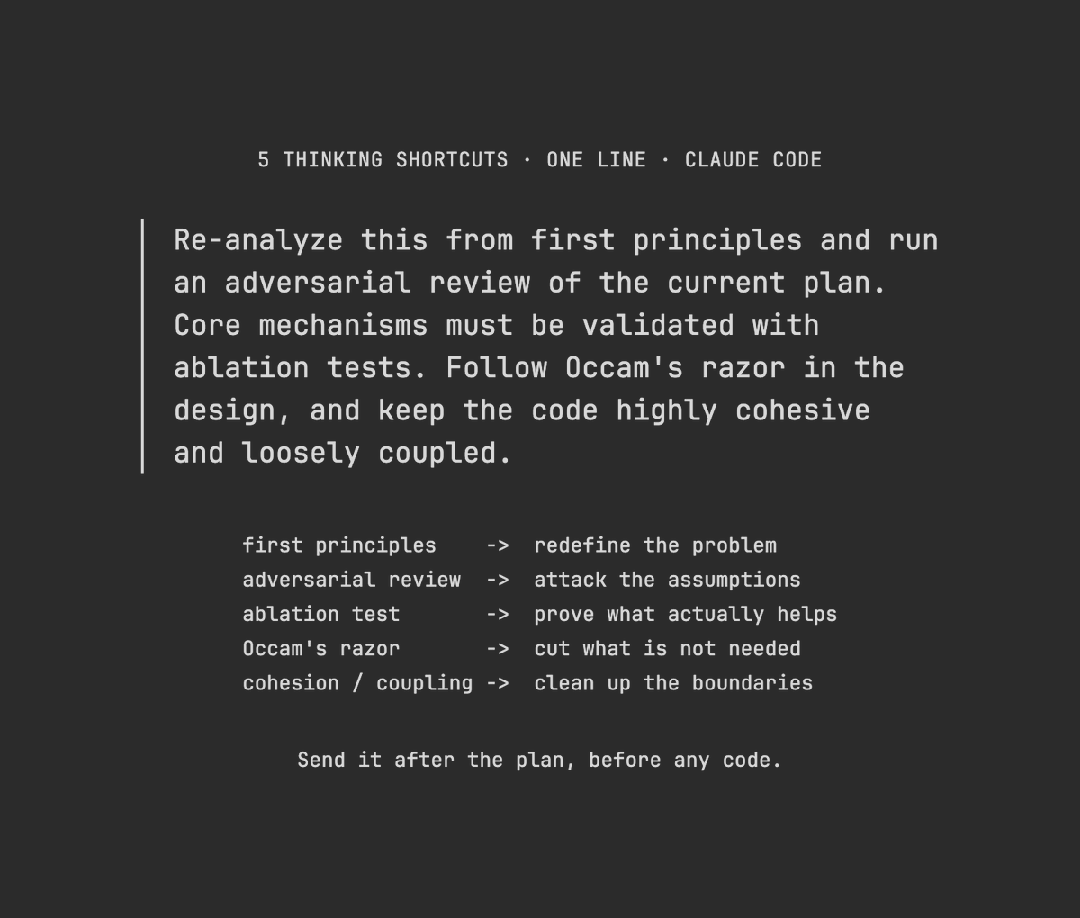
Tech analyst Vox (@Voxyz_ai) on X recently highlighted the AI-driven development workflow of a software engineer who took ownership of several projects just two months into a big tech role. The engineer's manager scheduled a few 1:1 check-ins to find out how the AI dev workflow behind that rapid delivery was built, uncovering a deliberate strategy centered around five ultra-concise prompts described as the model's "thinking shortcuts."
Image source: Vox (@Voxyz_ai) / X
Because frontier large language models absorb vast corpora of computer science papers, distributed systems textbooks, and mature production codebases during pre-training, simply invoking a recognized, rigorous methodology can achieve in a single phrase what thousands of words of conversational guidelines cannot. In Claude Code workflows driven by Opus 5.5, the engineer injects these five foundational principles right after an implementation plan is drafted and before a single line of application code is touched.
First Principles and Adversarial Review: Eliminating Premature Caching and Locks
When software design decisions are delegated to AI coding agents, a frequent failure mode is the reflexive introduction of external infrastructure layers instead of diagnosing root-cause bottlenecks.
- First Principles Analysis for Performance Bottlenecks: When an API endpoint suffers from latency and the agent's immediate plan proposes "adding a Redis cache," the engineer instructs the model to step back and re-evaluate from first principles. By prompting it to systematically trace whether elapsed time is lost to database queries, network roundtrips, or duplicate compute passes, the model frequently recognizes that a targeted database index can resolve the issue entirely, sidestepping cache invalidation overhead and extra cloud infrastructure.
- Adversarial Review Targeting Core Assumptions: When evaluating an architectural plan or refactoring proposal, the prompt requests an adversarial review specifically designed to surface counterexamples to primary design assumptions. For instance, if an agent proposes deploying a distributed locking mechanism to govern concurrency, an adversarial review prompts the model to first evaluate whether re-architecting the endpoint to be idempotent would eliminate the need for coordination locks altogether.
Ablation Testing and Occam's Razor: Isolating Optimizations and Pruning Stack Bloat
To prevent architectural bloat and unverified component stacking, the workflow enforces disciplined empirical validation standards directly through prompts.
- Ablation Testing to Isolate Optimization Gains: When three performance optimizations are shipped simultaneously and endpoint latency drops, the engineer tasks the model with designing an ablation test to isolate the impact of each variable. This empirical separation often exposes that a single index adjustment accounted for the entire improvement—such as reducing response times from 800ms to 120ms—revealing that the other two optimizations contributed negligible benefits while introducing maintenance debt.
- Applying Occam's Razor to Strip Architectural Overkill: When an agent begins stacking Kafka message brokers, Redis instances, and distributed locks for an otherwise straightforward transactional flow, the instruction to "review this design with Occam's razor" cuts through the excess. Grounded in the principle that the simplest sufficient explanation and design should prevail, the model often pivots back to a lean, reliable pattern: a single database transaction paired with a unique index.
High Cohesion and Low Coupling: Taming 2,000-Line Service Classes
As codebase features accumulate, individual classes and modules tend to balloon, violating separation of concerns and degrading maintainability.
- Responsibility Boundary Audits for Oversized Classes: When a core service class expands beyond 2,000 lines, the engineer issues the directive to "review the responsibility boundaries for high cohesion and low coupling, and don't split things just to split them."
- Preventing Mindless Code Fragmentation: The explicit constraint "don't split things just to split them" is crucial in an AI context. Without it, agents frequently overcorrect, splintering coherent logic into dozens of trivial five-line files, arbitrary helper classes, and single-implementation interfaces that obscure domain clarity. The prompt forces the agent to organize code strictly around meaningful, cohesive domain responsibilities.
Practical Claude Code Workflow: The One-Liner Plan Review Prompt Before Implementation
While each of these thinking shortcuts can be deployed individually, their true leverage in Claude Code comes from bundling them into a single consolidated review command injected during the planning phase.
In Claude Code, once Opus 5.5 finishes producing an architectural implementation plan and before it begins modifying files, submit this single prompt as your next message:
"Re-analyze this from first principles and run an adversarial review of the current plan. Core mechanisms must be validated with ablation tests. Follow Occam's razor in the design, and keep the code highly cohesive and loosely coupled."
Injecting this review gate at the transition between planning and coding delivers maximum leverage. Correcting faulty assumptions at the plan stage saves substantial token expenditures, averts costly rollback cycles, and prevents the agent from committing to overengineered abstractions before they infect the repository.
Original source
- Vox (@Voxyz_ai) on X: 5 Very Short Prompts: The Model's Thinking Shortcuts in Claude Code