Building a Bug Bounty Automation Pipeline with Claude and Security Tools
A practical workflow guide for automating repetitive bug bounty tasks and prioritizing attack surfaces using Claude Code alongside Subfinder, httpx, Katana, Nuc
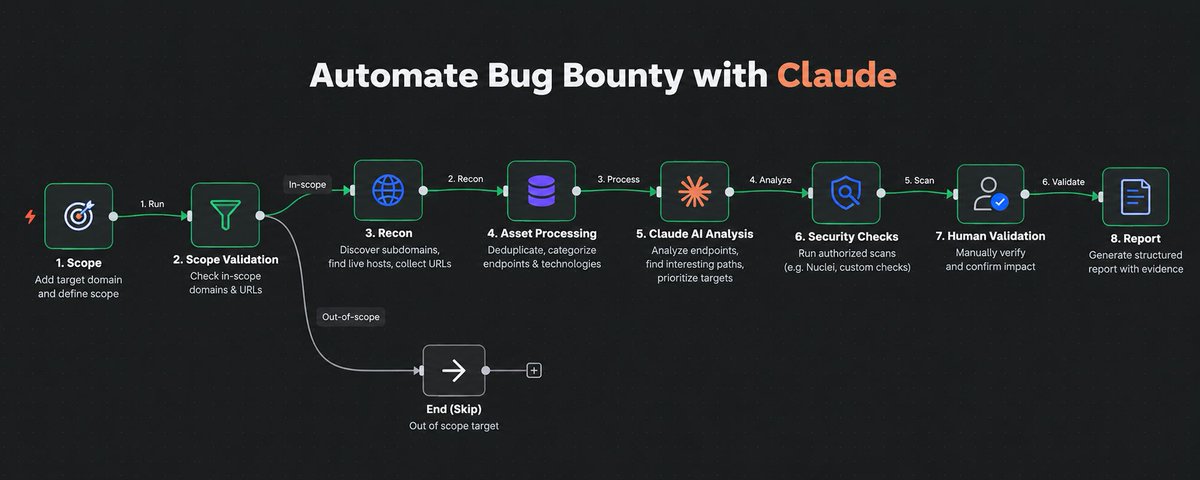
Security researcher Nitin Gavhane (@NitinGavhane_) has shared a practical architecture for automating repetitive bug bounty workflows by integrating Claude with standard open-source reconnaissance and vulnerability assessment tools.
Image source: Nitin Gavhane (@NitinGavhane_)
In modern bug bounty hunting, initial reconnaissance phases—such as subdomain discovery, URL crawling, and asset deduplication—often demand substantial manual effort. Instead of treating large language models as blunt scanners, Nitin Gavhane's approach positions Claude as an intelligent analytical layer that processes structured asset data to prioritize high-risk attack surfaces and correlate security findings.
The 8-Stage Bug Bounty Automation Pipeline
The proposed pipeline divides the entire workflow into eight clear, modular stages from target onboarding to report generation:
- Target → Scope Check: Define the target domain and strictly verify program scope rules and authorized assets before initiating any requests.
- Recon → Subdomains + URLs: Run automated discovery tools to enumerate subdomains and harvest reachable URL paths across the target estate.
- Asset Processing → Deduplicate + Categorize: Clean raw recon output by removing duplicate URLs, stripping irrelevant parameters, and grouping endpoints by technology stack and functional category.
- Claude → Analyze endpoints + prioritize targets: Pass the structured endpoint dataset to Claude to evaluate URL parameters and path structures, identifying anomalous endpoints and prioritizing targets with higher vulnerability potential.
- Security Tools → Run authorized checks: Execute targeted security scanners and automated checks exclusively against prioritized, in-scope assets.
- Claude → Correlate results + explain findings: Supply scanner outputs and response metadata to Claude to filter out false positives, correlate cross-endpoint observations, and contextualize security implications.
- Human → Validate vulnerability: A human security researcher manually verifies the identified issue, validating its real-world exploitability and business impact.
- Claude → Generate report: Once validated, Claude assists in drafting a well-structured, professional submission report tailored for bug bounty platforms such as HackerOne or Bugcrowd.
Recommended Tool Stack and Structured Data Strategy
To build this modular pipeline efficiently, Gavhane outlined a representative technology stack and a key data processing principle.
Example Tool Stack
- Orchestration & LLM Interface: Claude Code, Python
- Subdomain Enumeration & Live Probing: Subfinder, httpx
- Web Crawling & URL Discovery: Katana
- Vulnerability Scanning: Nuclei
- Interception & Manual Web Analysis: Burp Suite
- Data Persistence & State Management: SQLite, PostgreSQL
Core Strategy: Feed Structured Outputs to Claude
The fundamental key to this pipeline is delivering clean, structured data (JSON, CSV, or relational database records) to Claude rather than dumping raw scanner terminal text directly into the prompt.
- Dumping raw terminal scans overwhelms model context windows and significantly increases the likelihood of hallucination and noise.
- Using Python scripts or lightweight databases (SQLite/PostgreSQL) as an intermediate processing layer ensures that only normalized endpoint metadata, parameter lists, and concise scanner findings are presented to Claude for targeted analysis and correlation.
Key Operational Rules and Safety Principles
Gavhane emphasized three foundational operational rules when adopting AI across security research workflows:
- Automate the Repetitive Work: Leverage scripts and specialized CLI utilities for routine subdomain gathering, deduplication, and baseline filtering, freeing up researcher time for in-depth analysis.
- Keep Exploitation and Final Validation Under Human Control: Never delegate actual exploitation or final vulnerability confirmation entirely to autonomous models; critical validation must remain strictly under human supervision.
- Test Only Authorized Scope: Ensure automated scripts strictly respect bug bounty program rules and never bleed outside explicitly authorized targets during enumeration and scanning passes.
Original source
- Nitin Gavhane (@NitinGavhane_) X Post: Automate Bug Bounty Workflow with Claude