China MOFCOM Proposes Export Restrictions on Frontier AI Technologies: Controls on Weights and Source Code
On October 16, 2026, China's Ministry of Commerce unveiled draft amendments restricting exports of core AI technologies exceeding 10²⁶ FLOPs or 2 trillion param
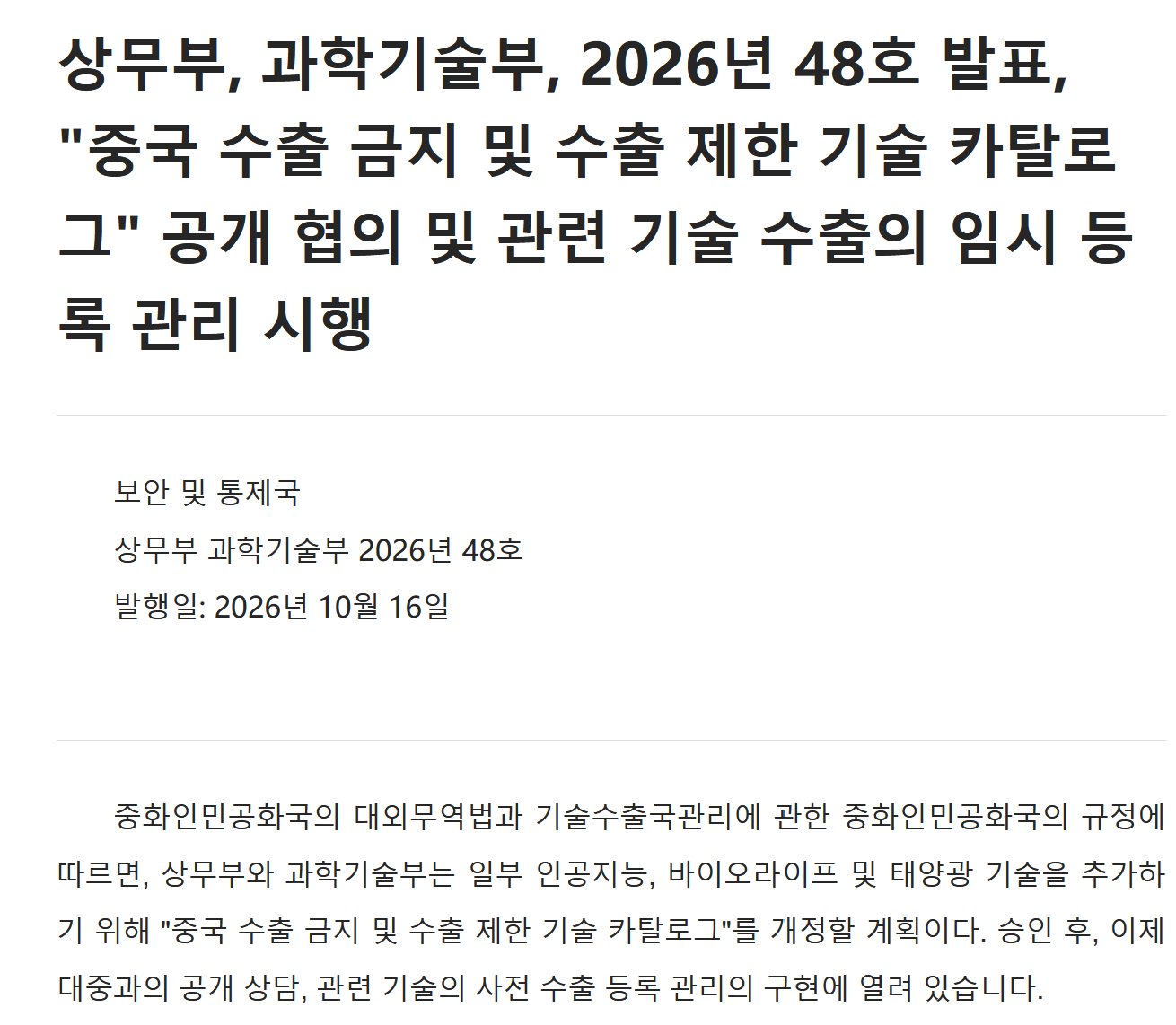
On October 16, 2026, China's Ministry of Commerce (MOFCOM) officially published proposed revisions to its Catalogue of Technologies Subject to Export Restrictions under the Regulations on Technology Import and Export Administration, initiating a 30-day public consultation period through November 15, 2026. The draft introduces targeted export controls over frontier artificial intelligence (AI) core technologies.
Image source: 중국 상무부 (MOFCOM) / X @UniverseB1020
The proposed regulatory update does not represent a blanket ban on international AI engagement, but rather places frontier AI assets into the formal "restricted exports" classification, requiring state review and provisional administrative procedures prior to cross-border transfer. Because the regulation explicitly encompasses model weights, checkpoints, and underlying source code, the initiative carries significant implications for the global open-source AI ecosystem.
Regulatory Thresholds: 10²⁶ FLOPs, 2 Trillion Parameters, and Global Top 10 Benchmarks
MOFCOM's regulatory framework establishes two primary categories of subject technologies.
The first category covers large-scale models trained on China's local "important data" and deployed as public or commercial services. The second category targets core technologies of frontier models that satisfy at least one of three quantitative technical thresholds:
- Cumulative Training Compute: Total training compute equal to or exceeding 10²⁶ FLOPs (floating-point operations)
- Model Architecture Scale: Total parameter volume equal to or exceeding 2 trillion (2T) parameters
- Benchmark Performance: Ranked within the top 10 globally across established public evaluation benchmarks
The scope of regulated "core technologies" is comprehensively detailed in the announcement. It explicitly covers completed model weights and training checkpoints, source code repositories, model architecture designs, training optimization algorithms, and inference acceleration techniques.
Prior Registration for Technology Transfers and Clear Exemptions for APIs and SaaS
From an administrative standpoint, the draft regulation mandates that domestic entities undergo a provisional registration process with relevant authorities prior to executing cross-border technology transfers or granting overseas licenses for covered frontier AI capabilities.
At the same time, the ministry established critical operational carve-outs to preserve routine international connectivity:
- International Cloud API Calls: Routine foreign consumption of domestic Chinese AI models via hosted cloud API endpoints remains exempt from export control oversight.
- Web and App-Based SaaS Utilization: End-user access through standard web portals or mobile application SaaS (Software as a Service) interfaces is explicitly excluded from the regulatory perimeter.
This distinction indicates that while international end users and developers can continue accessing Chinese cloud-hosted intelligence services, regulatory oversight is concentrating heavily on sovereign control over core intellectual property—specifically preventing unvetted physical migration or legal licensing of the raw weights, architectures, and codebase to foreign entities.
Repercussions for Open-Weights Models and Pending Implementation Details
The primary concern across the international AI landscape centers on the future trajectory of China's "open-weights" release model.
In recent years, leading Chinese tech enterprises and AI research institutes have earned widespread global influence by publishing weights and inference code for frontier language and multimodal models across open repositories such as Hugging Face. Classifying weights and source code as restricted export technologies raises questions about whether upcoming 2-trillion-parameter frontier systems will face regulatory clearance hurdles or licensing conditions before being posted publicly.
However, MOFCOM's release remains a legislative draft under active review through November 15, 2026. Specific thresholds, compliance procedures, and legal interpretations may be refined before the final regulatory text takes effect. In particular, how regulatory bodies interpret whether an open-source permissive release constitutes an "overseas licensing" event under the rules will be the central variable shaping the global open-weights landscape.
Sources
- Ministry of Commerce of the People's Republic of China (MOFCOM): Notice Soliciting Public Comments on Revisions to the Catalogue of Technologies Subject to Export Restrictions
- Ministry of Commerce of the People's Republic of China (MOFCOM): Spokesperson Remarks on the Revisions to the Catalogue of Technologies Subject to Export Restrictions
- X (@UniverseB1020): Analysis of MOFCOM Draft Revisions on Frontier AI Export Restrictions