CERN and Mistral AI Partner to Train Foundation Physics Models on Billions of Simulated Proton Collisions
CERN and Mistral AI have announced plans to collaborate on scientific foundation models, training AI on billions of simulated proton collisions rather than stan
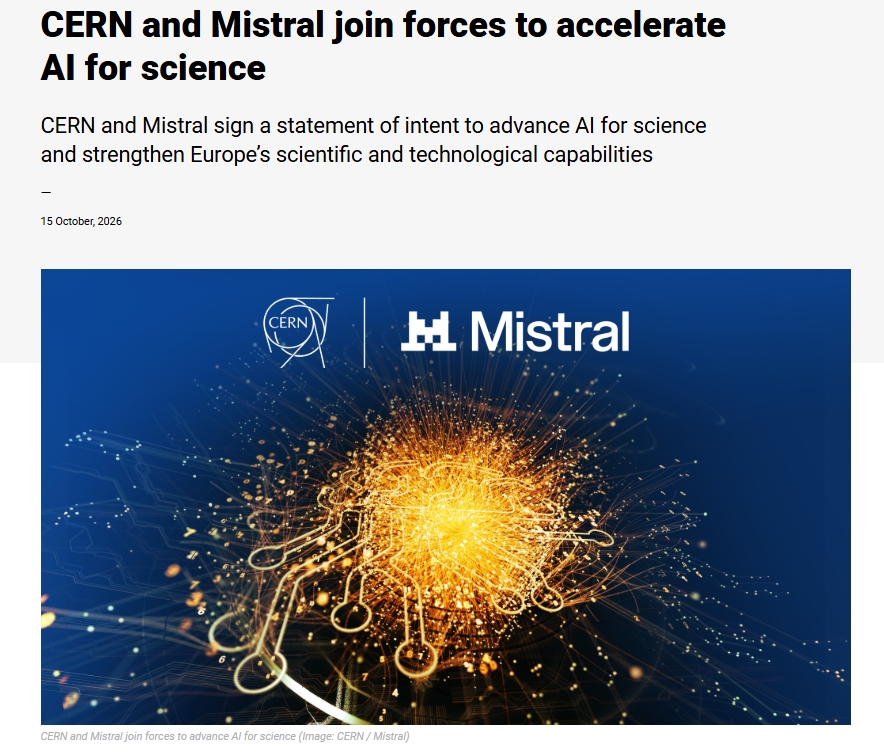
On October 15, 2026, the European Organization for Nuclear Research (CERN) and French AI lab Mistral AI officially announced plans to collaborate on accelerating scientific research under an "AI for Science" initiative. The partnership brings together CERN's high-energy physics expertise from operating the Large Hadron Collider (LHC) and Mistral AI's foundation model engineering to train AI models directly on simulated particle physics datasets.
Image source: @Skoorbkaz / X
Departing from the conventional approach of training large language models on human-authored text, books, and conversational data, the project focuses on feeding billions of simulated proton collisions directly into the model training pipeline to capture fundamental matter interactions.
Training on Billions of Simulated Collisions Instead of Text Corpora
Mainstream generative AI models learn contextual representations by tokenizing natural language, code, or multimodal media. In contrast, the joint initiative between CERN and Mistral AI introduces numerical simulation data from subatomic particle collisions directly into the architecture.
- Physics-Ground Simulation Datasets: The training pipeline uses billions of simulated proton collision events and decay trajectories accurately modeled after LHC experimental environments.
- Modeling Fundamental Matter Interactions: Instead of abstract conceptual relationships in text, the neural network learns high-energy physical states, interaction rules, and particle decay cascades.
By pairing modern foundation model architectures with domain-specific scientific computing, the project aims to build foundation models specialized in interpreting high-dimensional particle trajectory data.
Precision Particle Identification and Anomaly Detection Beyond the Standard Model
CERN aims to leverage this collaboration to enhance experimental data processing and assist in exploring fundamental physics questions.
- High-Precision Particle Identification: Rapidly classifying particle types, flight paths, and decay patterns within dense collision events.
- Accelerating Data Reconstruction Pipelines: Reducing computational bottlenecks in high-energy physics simulation and reconstruction workflows to improve overall throughput.
- Detecting Unexpected Signals: Assisting physicists in surfacing subtle anomalies and irregular patterns that may not be predefined or immediately recognizable under current human analysis frameworks.
Rather than simple workflow automation, the initiative seeks to integrate AI pattern recognition into the ongoing search for physical phenomena beyond the Standard Model of particle physics.
Current Statement of Intent and Boundaries of Theoretical Verification
While the partnership marks a notable milestone for scientific AI, the announcement remains a statement of intent, and several practical boundaries apply.
First, formal budget commitments, allocated compute infrastructure, and concrete release milestones for model weights or deliverables have not yet been finalized. The collaboration is currently at the stage of establishing operational frameworks and methodological baselines.
Second, because the model is trained on collision data simulated from established Standard Model physics, it inherently learns governed physical rules. Any anomalies or unexpected patterns flagged by the model will require rigorous cross-validation against physical detector data, and theoretical interpretation remains the exclusive responsibility of human physicists.
Sources
- CERN: CERN and Mistral join forces to accelerate AI for science
- ʞɔɐ𝘡 (@Skoorbkaz) on X: CERN and Mistral AI Collaboration Announcement Signal