Byeori: Open-Source Cloud-Based Research Paper LLM Wiki System for Academic Labs
Byeori, an open-source AWS-based LLM-Wiki system managing over 13,000 papers in a research lab, has been released. Explore its Fargate, Bedrock Claude, Lambda,
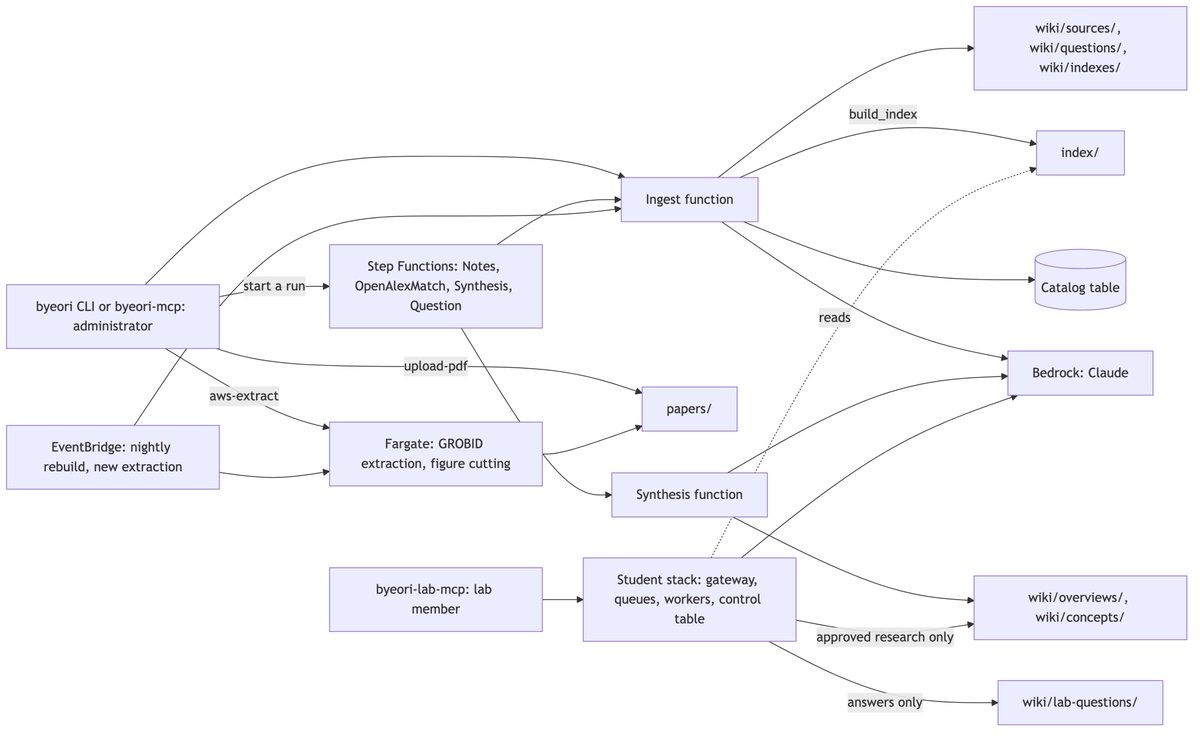
Managing thousands of academic papers and fostering collaborative knowledge sharing has long been a foundational bottleneck for research laboratories. While the LLM-Wiki paradigm proposed by Andrej Karpathy has gained widespread adoption in local environments, scaling it to a multi-user, multi-tenant cloud infrastructure capable of indexing tens of thousands of manuscripts presents non-trivial engineering challenges. Byeori, an open-source AWS-native research paper wiki system battle-tested with over 13,000 papers and 200 GB of data in an active lab, has now been publicly released.
Image Credit: Joon An (@joonomics) on X
Serverless AWS Infrastructure and Service Roles
Rather than maintaining heavy, constantly active server instances, Byeori is engineered around serverless and managed AWS primitives that scale on demand, eliminating idle operational overhead while ensuring reproducible cloud deployments.
-
Storage and Pipeline State Tracking
- Amazon S3: Serves as the central repository storing raw paper PDFs, parsed text bodies, cropped figure and table assets, generated Markdown wiki pages, and full-text search indices.
- Amazon DynamoDB: Acts as a pipeline ledger tracking the progress stage of each manuscript across parsing, evidence note generation, and synthesis.
-
Compute and Foundation Model Execution
- AWS Lambda: Hosts the serverless application runtime that orchestrates note generation, builds synthesis pages, and responds to real-time researcher queries. Lambda instances execute strictly on demand and remain completely idle otherwise, incurring zero baseline costs.
- AWS Fargate: Runs containerized text extraction and asset cropping tasks (isolating figures and tables) on a per-paper basis, terminating immediately upon execution.
- Amazon Bedrock: Hosts the Anthropic Claude models responsible for reading manuscripts, producing evidence notes, generating higher-order syntheses, and answering user prompts, accounting for the primary share of total operating costs.
-
Orchestration, Security, and Governance
- AWS Step Functions: Coordinates sequential execution workflows across batch pipelines processing thousands of papers reliably.
- AWS Systems Manager Parameter Store: Centralizes secure storage and rotation for third-party API tokens and operational parameters.
- Amazon EventBridge: Automates scheduled tasks, such as triggering nightly full-text search index rebuilds during off-peak hours.
- AWS CloudTrail: Maintains transparent audit logs documenting all write and update operations across wiki pages.
- AWS IAM: Enforces role-based permissions, allowing lab directors and administrators to ingest papers and modify the wiki, while granting students and researchers read and query access.
Ingestion, Structured Evidence Notes, and MCP Agent Interaction
Byeori adapts the core mechanics of the local LLM-Wiki framework and reimagines them for distributed, lab-scale collaboration.
When a paper PDF is uploaded into S3, an AWS Fargate container automatically extracts raw text alongside visual assets. Amazon Bedrock's Claude model then reviews the full text to generate a concise, standardized single-page 'Evidence Note' per manuscript. Each note adheres strictly to a predetermined structural hierarchy:
- Standard Evidence Note Layout: Every note methodically records a one-line summary, key contributions, methodology, experimental results, acknowledged limitations, related work, and a terminology glossary in fixed sequence.
- Traceable Version Provenance: Notes permanently record the exact PDF edition, pipeline version, and foundation model identifier utilized, ensuring reproducible attribution for subsequent scientific audits.
As evidence notes accumulate across the repository, Bedrock Claude periodically synthesizes higher-level subtopic overviews and comprehensive domain summaries, constructing a hierarchically organized knowledge base.
Lab members interface with Byeori directly from their daily development environments using Claude Code, Codex, or compatible coding agents via the Model Context Protocol (MCP). Researchers submit natural language inquiries and receive synthesized responses supported by direct source citations. If a complex inquiry calls for synthesizing novel insights beyond existing wiki coverage, Byeori prompts the user for confirmation before generating a new synthesis page, creating the permanent documentation only after explicit member approval.
In this routing workflow, determining whether to attach backlinks to existing documentation or synthesize a fresh page based on query depth is currently handled cheaply via JEV, though the developer noted that this decision classifier requires ongoing refinement and remains under active evaluation as to whether it is the optimal long-term solution.
Operational Scale at 13,000 Papers and Current Beta Considerations
The primary significance of Byeori lies in its empirical validation within an active academic setting.
In the developer's lab, the platform currently manages 13,115 research papers comprising 219 GB of data across original PDFs, extraction artifacts, visual figures, and synthesized Markdown documents. Onboarding lab personnel requires only issuing individual AWS IAM credentials, significantly streamlining access governance across the research cohort.
Nevertheless, as emphasized by its author, Byeori is currently released as a beta project with several practical limitations to consider prior to deployment:
- Unverified Container Build Automation: The worker container image responsible for cropping figures and tables requires local Docker compilation, and standardized multi-environment build paths remain under active testing.
- Metadata Recognition Failures: If the automated parser fails to identify a manuscript's bibliographic metadata from the PDF, ingestion halts without generating an evidence note, and no manual correction interface is currently available.
- Incomplete Localization: Portions of the student-facing prompt templates and system notifications are currently hardcoded in Korean, requiring internationalization for global research teams.
- Synthesis Tuning and Model Guardrails: Determining the optimal balance between synthesis quality, token cost, and note linkage thresholds remains an ongoing research challenge. While Claude Opus 5.5 provides superior reasoning at lower unit costs, it occasionally triggers automated biological research safety filters during academic synthesis.
- Ingestion Token Economics: Ingesting large volumes of literature currently remains more cost-effective via subscription-based plans rather than direct API consumption, prompting ongoing experiments to reduce token weight while preserving extraction fidelity.
Byeori provides an actionable, production-tested blueprint for academic labs, research organizations, and R&D engineering teams seeking to transform sprawling PDF libraries into an interactive, verifiable collective intelligence. The codebase is openly accessible on GitHub, with ongoing development and issues tracked through the official repository tracker.
Sources
- GitHub Repository: joonan-lab/byeori
- Joon An on X (@joonomics): Announcement Post