Master Programming by Recreating Technologies from Scratch: build-your-own-x (550K+ GitHub Stars)
A comprehensive guide to build-your-own-x, the massive open-source curation repository bringing together step-by-step tutorials to build Git, Docker, databases,
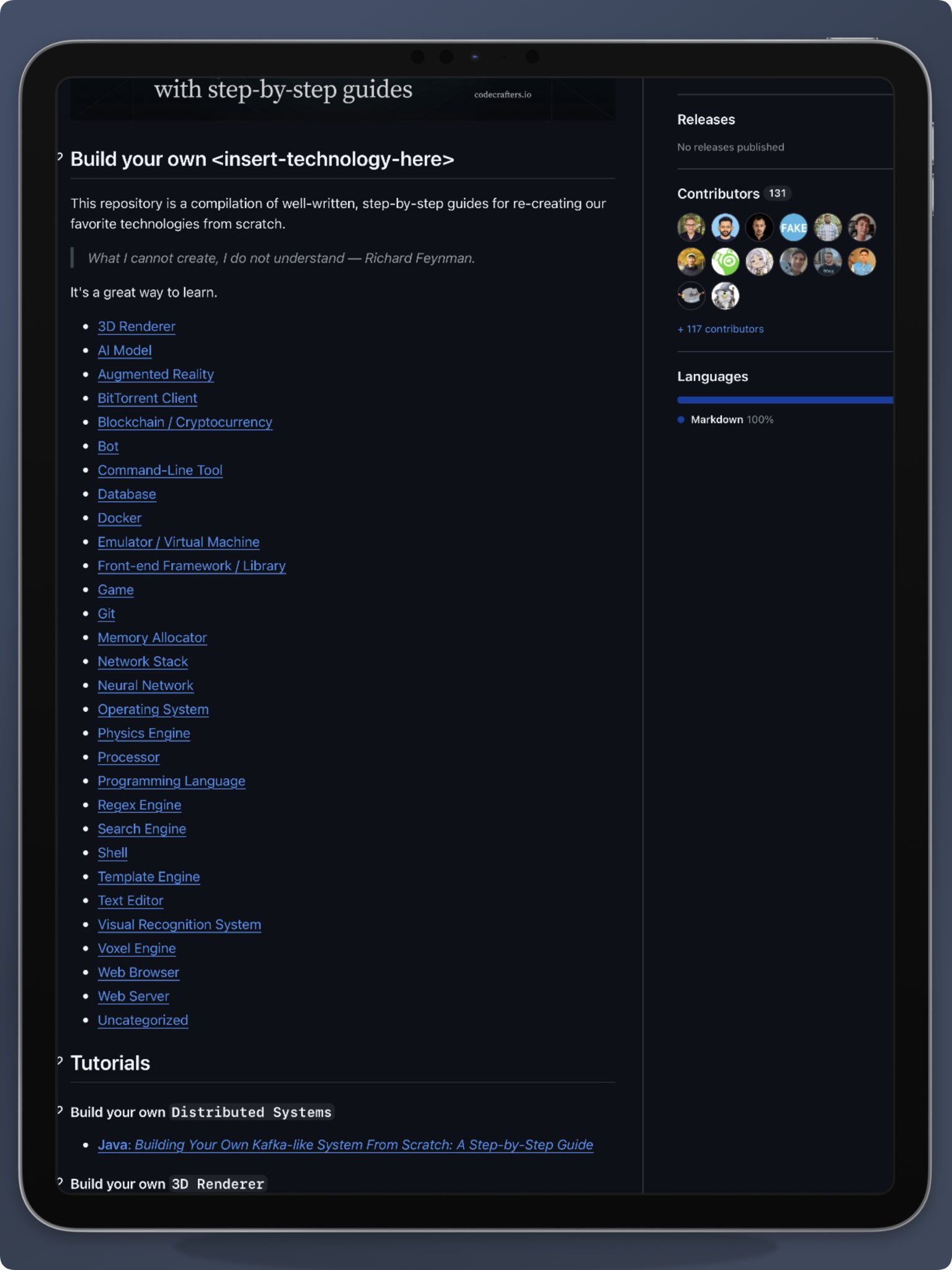
The most effective way to truly master the core infrastructure and tools developers use daily is to build them from the ground up. Maintained by CodeCrafters, the open-source repository build-your-own-x compiles well-crafted, step-by-step tutorials from across the global community to help engineers recreate over 27 fundamental technology domains from scratch.
Image source: @Sn0wbrave / X
Boasting more than 550,000 stars (551.2k+ Stars) and over 50,000 forks on GitHub, this project stands as one of the most prominent educational resources in the open-source ecosystem. It provides an indispensable roadmap for developers seeking to move beyond consuming high-level abstractions and uncover the inner mechanisms of foundational systems.
'What I Cannot Create, I Do Not Understand': The Philosophy Behind build-your-own-x
The central motto of build-your-own-x draws directly from Nobel laureate Richard Feynman's iconic quote: "What I cannot create, I do not understand."
As modern frameworks and cloud platforms grow increasingly sophisticated, the underlying systems often turn into opaque black boxes. By writing the core logic line by line, this repository helps engineers cultivate critical systems-level intuition:
- Demystifying Black Boxes: Gain direct code-level visibility into how essential tools like Git, Redis, and Docker handle persistence, protocol parsing, and concurrency.
- Cross-Language Paradigm Comparison: Compare how identical architectural concepts—such as a Lisp interpreter or an in-memory key-value store—are tackled across different languages like C, Go, Python, Rust, and JavaScript.
- Hands-On Reverse Engineering: Solidify problem-solving skills by creating working, self-contained prototypes rather than merely absorbing abstract theory.
27+ Technology Domains and Multi-Language Micro-Implementations
The repository spans more than 27 major technology categories, each organized by language and implementation scope.
Key covered domains include:
- Systems & Runtimes: Operating Systems, Docker containers, Processors, Memory Allocators, and Emulators/Virtual Machines
- Data & Networking: Databases, Network Stacks, Web Servers, BitTorrent Clients, and Blockchain/Cryptocurrency implementations
- Developer Tooling & Languages: Git version control, Programming Languages (interpreters and compilers), Regex Engines, Shells, Text Editors, and Template Engines
- Frontend & Graphics: Frontend Frameworks (React, Virtual DOM implementations), 3D Renderers, Physics Engines, and Games
- AI & Vision: Neural Networks, AI Models, and Visual Recognition Systems
A distinctive strength of the collection is its breadth of accessible micro-implementations alongside in-depth projects. Beginners can start with concise guides such as a JavaScript regex engine in under 40 lines of code, a lightweight Linux container in roughly 100 lines of Go or Bash, or a template engine in 20 lines, allowing learners to grasp core structural concepts in a single focused session.
Navigation Workflow and Key Considerations
Exploring build-your-own-x requires no complex toolchains or global installations, as all access is structured directly through the repository's README.md.
- Select a Domain: Use the Table of Contents at the top of the repository to jump directly to any of the 27 technology categories.
- Filter by Language: Within each category, locate tutorials tagged with your preferred programming language (
**Go**:,**Python**:,**JavaScript**:,**C**:,**Rust**:, etc.). - Engage with the Material: Follow the links to access external standalone written tutorials, video walkthroughs, or interactive workshops.
Key Considerations:
- Curated Directory Model: The repository operates as a curated directory index pointing to high-quality external guides rather than hosting all tutorial prose in a single monolithic text.
- Version Awareness: Because tutorials originate from various authors and publication timelines, some guides may use earlier versions of languages or libraries. Learners should refer to current official documentation when adapting code to modern toolchains.
Sources
- GitHub Repository: codecrafters-io/build-your-own-x
- Snow Brave (@Sn0wbrave) on X: 2026-10-03 Post on build-your-own-x