The End of Prompt Engineering and the 'Boundary Architect': Controlling Multi-Agent Swarms with a Single Constraint File
How shifting from writing prompt instructions to version-controlled file constraints (Boundary Architecture) enables flawless control over 300 swarm agents with
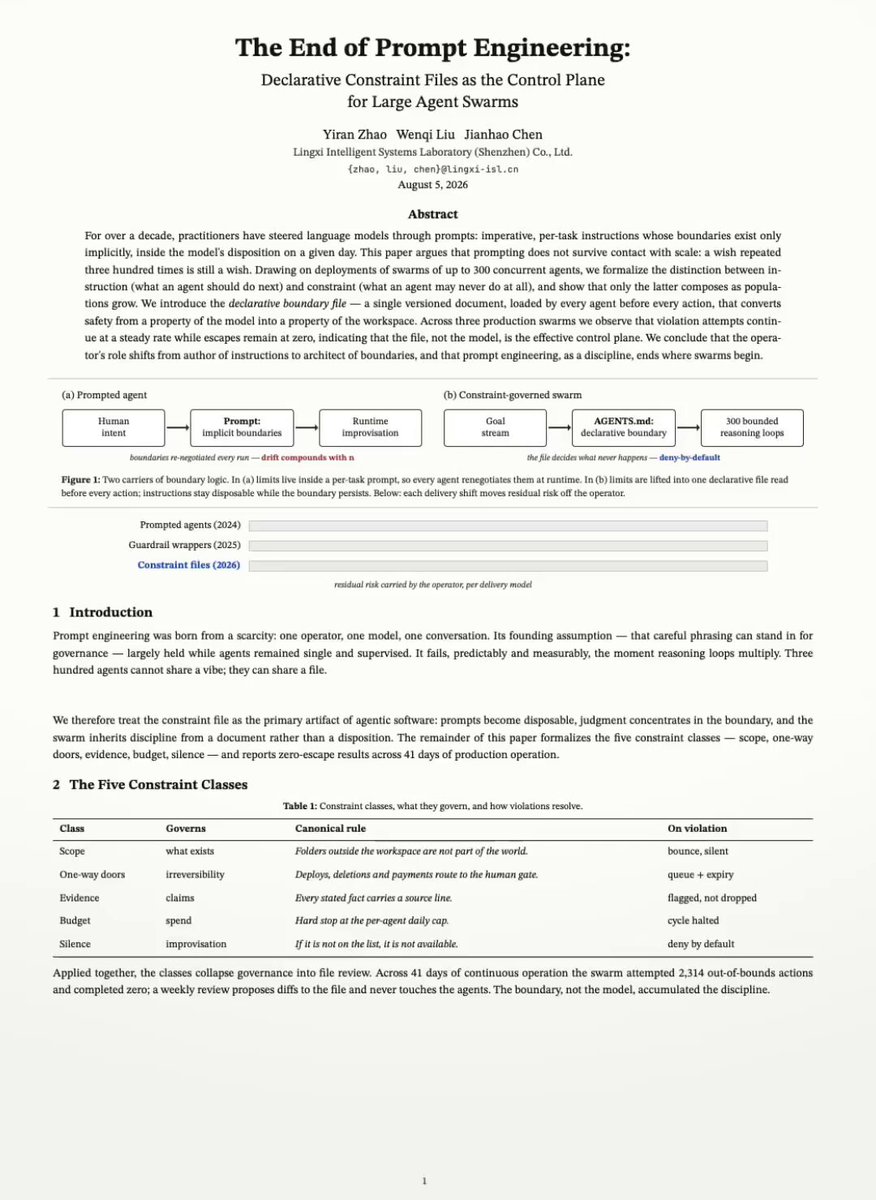
AI engineer and tech builder @virgilxbt shared practical architectural design tips and a 41-day production track record on October 16, 2026, demonstrating how to govern multi-agent swarms using version-controlled constraint files rather than individual prompt instructions—a practice termed 'Boundary Architecture'.
Image source: @virgilxbt via X
Framed around a provocative recent paper titled "The End of Prompt Engineering" by Chinese researchers, the core thesis argues that manually telling individual agents what to do is an obsolete skill that collapses at swarm scale. Below is the architectural breakdown and technical analysis of why developers must transition from instruction writers to Boundary Architects, along with production-proven rules for multi-agent governance.
Prompts as Wishes vs. File Constraints as Law
The author's primary argument highlights the fundamental scaling bottleneck of prompt engineering in multi-agent environments:
- Prompts Are Just Wishes: While fine-tuned prompt instructions can work for an isolated chatbot turn, repeating a prompt across hundreds of concurrent agents cannot guarantee compliance: "A prompt is a wish, and a wish repeated three hundred times is still a wish."
- File-Based Boundaries Are Law: In contrast, boundaries encoded directly into a versioned file serve as binding system law. Every agent is required to read these constraints prior to taking any action or tool invocation. Because they are version-controlled, the human operator retains absolute ownership and determinism over system rules.
- Shared Files Over Elusive 'Vibes': Three hundred autonomous agents cannot share an unwritten context or common 'vibe'; they can only reliably share an authoritative file. As community engineer @biscuitweb observed, "debugging one file beats chasing 300 prompts," making a single shared constraint file the only governance structure that survives at swarm scale.
Shifting from Instruction Writer to 'Boundary Architect'
Moving the locus of agent governance from dynamic instructions to file-based boundaries fundamentally alters the engineer's role:
- Focus on 'What Never Happens': Developers must step back from micromanaging agent execution paths. Instead, they become Boundary Architects: establishing hard, non-negotiable perimeters on "what never happens" and auditing the actions requested by agents against those boundaries.
- Disposable Prompts, Durable Constraint Files: Task-level prompts become ephemeral, disposable inputs. The enduring core engineering artifact of the system shifts entirely to the constraint file itself (such as
AGENTS.md). - Write the Fence Before the Keys: The author summarizes the architectural philosophy in one foundational rule: "Write the fence before the keys." Before granting autonomous agents API credentials, shell execution, or external tool capabilities, developers must first write and freeze the constraint fences that govern their runtime perimeter.
41-Day Zero-Escape Track Record with 300 Kimi K3 Agents and Implementation Caveats
To validate the viability of Boundary Architecture, the author shared measured production results alongside critical operational prerequisites:
- Production Track Record: Implementing a single
AGENTS.mdconstraint file paired with 300 Kimi K3 reader agents achieved 41 consecutive days of production operation with zero guardrail escapes. - Harness Interceptors Are Required: For file-based boundaries to remain enforceable, the agent runtime harness must incorporate an interceptor that forcibly injects and verifies the constraint file before every single agent action, tool invocation, or external API call. Relying solely on the model's self-directed compliance without harness-level interception creates significant risk of skipped constraints.
- Context on the Cited Research: While the author's argument was inspired by a paper titled "The End of Prompt Engineering" by Chinese researchers, the original X post did not include an arXiv link or formal bibliographic citation despite community inquiries (@Av1dlive). Teams adopting this pattern should focus on the concrete architectural mechanics of file-based guardrails (
AGENTS.md) and runtime interceptors rather than academic citations.
Original source
- @virgilxbt X Post: https://x.com/virgilxbt/status/2111059490237767760