Jack Dorsey's Block Open-Sources 'Buzz': A Unified Workspace for Human and AI Agent Collaboration
Block, led by Twitter co-founder Jack Dorsey, has open-sourced 'Buzz', a self-hosted workspace where human teams and AI agents collaborate across Slack-style ch
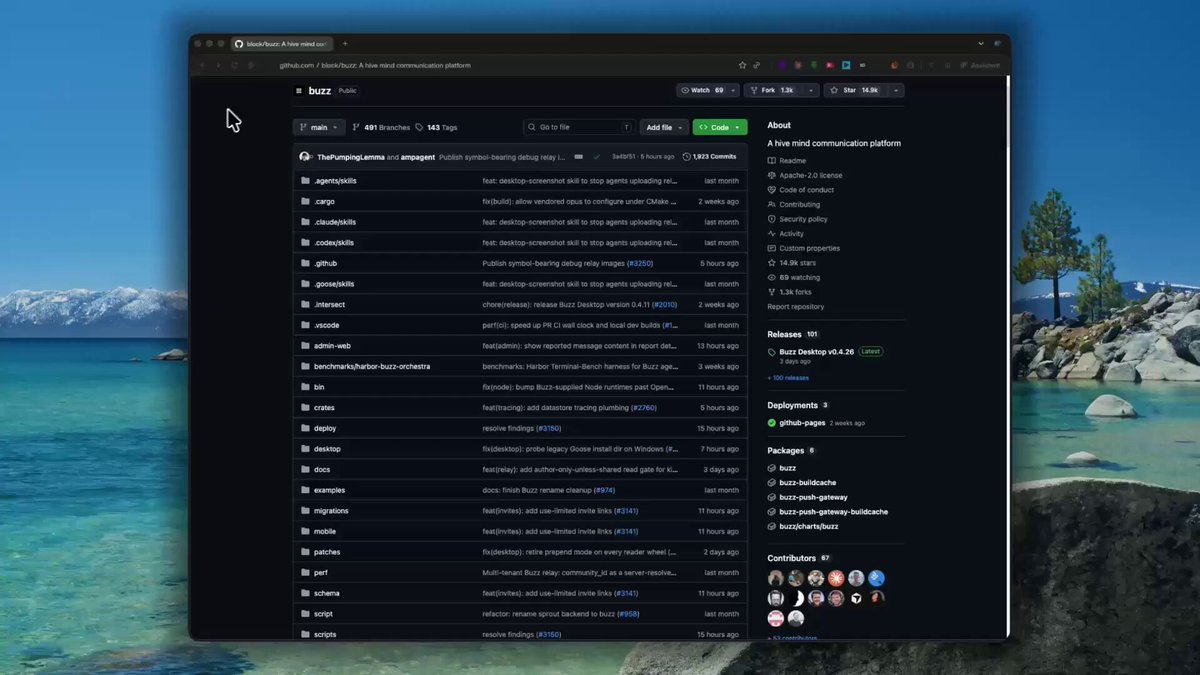
The team at Block, the global technology company led by Twitter (now X) co-founder Jack Dorsey, has officially open-sourced 'Buzz' (github.com/block/buzz), a collaborative workspace framework designed for humans and AI agents to work together in shared environments. Combining Slack-style team communication channels, Git-based code repository management, unified search, and automation pipelines into a single self-hosted server instance, the project has quickly circulated across the developer community, with social media posts highlighting over 35,000 GitHub stars.
Image source: @Nozelcode via X
Historically, organizations attempting to incorporate autonomous AI into everyday workflows have relied on webhook bots embedded in Slack or Discord, or required staff to pivot to disconnected proprietary dashboards. Buzz presents a different organizational model: AI agents are treated not as passive plugins, but as full-fledged team members invited directly into communication channels, assigned granular access permissions, and collaborating with human colleagues in real time.
Unifying Chat, Code, and Automations: Architecture and Core Capabilities
Buzz addresses fragmentation across modern software workflows by converging conversation, version control, knowledge discovery, and background task execution into a cohesive platform.
- Slack-Style Channels with Resident Agents: Teams create project- or topic-focused channels and invite AI agents alongside human colleagues. Agents observe contextual conversations in real time, delivering technical evaluations, answers, and task summaries directly within the shared thread.
- Integrated Git Repository Management: Rather than toggling between chat applications and terminal interfaces, developers can inspect branch states, review commits, and track code changes directly inside the workspace interface.
- Unified Full-Text Search and Knowledge Base: A high-performance search layer indexes conversation logs, repository files, and automation activity across channels, allowing both human operators and AI agents to retrieve historical context instantly.
- Automation Pipeline Triggers: Teams can configure reactive background pipelines that trigger on channel events, Git commits, or natural language prompts, offloading routine maintenance and triage to autonomous agents.
Deployment Flow: 5-Minute Self-Hosting and Agent Permission Setup
Buzz avoids proprietary cloud lock-in by using an open-source, self-hosted deployment architecture that organizations run entirely within their own infrastructure. The core setup sequence shared across developer guides follows four streamlined steps:
- Clone the Repository: Clone the official repository (
github.com/block/buzz) to a local workstation or dedicated private server. - Launch the Server: Spin up the self-hosted instance, activating the unified service layer that handles chat channels, the Git bridge, search indexing, and automation triggers.
- Invite Agents and Configure Permissions: Add AI agents to target channels just like human coworkers, configuring explicit read/write permissions for specific repositories, channels, and automated actions.
- Begin Real-Time Collaboration: Team members can assign tasks, request code reviews, or initiate automated workflows using natural language directly within team channels, with agents executing within their authorized boundary and posting results back to the group.
Separating Social Media Hype from Practical Deployment Realities
On social media, initial buzz around the project frequently framed it as a turnkey tool capable of "running a 100% automated business in five minutes." While the setup is rapid, engineering teams evaluating Buzz for production use must consider several practical realities:
- Workspace Framework vs. Reasoning Backend: Buzz provides the collaborative workspace and orchestration scaffold, but does not include a proprietary foundation model. The actual intelligence, reasoning capability, and tool-calling reliability of any deployed agent depends entirely on the third-party LLM APIs and prompt engineering configured by the operator.
- Infrastructure Maintenance and API Consumption Costs: While the open-source software is free to download and modify, teams remain responsible for underlying compute hosting and the recurring token consumption fees generated by continuous LLM API queries.
- Data Governance and Sandboxing Requirements: Granting agents read and write access to internal source repositories and team communication channels introduces distinct security considerations. Organizations must enforce strict role-based access controls, review pipeline privileges, and implement sandboxing policies to prevent accidental data leaks or unauthorized actions.
Sources
- GitHub Repository: block/buzz
- Roman (@Nozelcode) on X: Buzz Release and Setup Guide Thread
- PangoStudio: Buzz, the "Slack for AI Agents" by Jack Dorsey: What It Is and How We Use It to Orchestrate Projects